

More Than Mathematics: Jiya’s Journey of Confidence and Growth



The Challenge
Geometry asks students to interpret diagrams, recognise relationships, and explain mathematical reasoning rather than simply follow a procedure. Developing confidence in these skills is an important part of becoming an independent problem-solver.
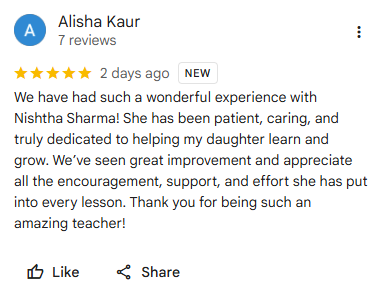
For Jiya, the available feedback highlights something especially meaningful: growth in confidence and learning. Her parent specifically appreciated the patience, encouragement, and support provided by her tutor, Nishtha Sharma.
The Approach
Making geometry easier to visualise. Diagrams and visual explanations can help students recognise shapes, relationships, and important mathematical information.
Working through problems step by step. Guided examples can help students understand how to approach a problem before trying similar questions independently.
Encouraging mathematical reasoning. Asking students to explain their thinking helps them develop a deeper understanding of why a method works.
Building confidence through encouragement. Patience and positive reinforcement can help students feel more comfortable asking questions, exploring ideas, and learning from mistakes.
Gradually developing independence. As confidence grows, students can be encouraged to attempt more challenging questions and trust their own reasoning.
The Result
Jiya’s progress is reflected in the positive feedback shared by her parent, who described growth in both confidence and learning.
While the available evidence does not include a numerical score comparison, the qualitative feedback is meaningful. Confidence is an important part of learning mathematics because it influences how willing students are to attempt unfamiliar questions, explain their thinking, and persevere when a problem becomes challenging.
Her parent’s appreciation of Nishtha’s patience, encouragement, and effort also highlights the value of a supportive learning relationship.
What Made the Difference
- A patient and encouraging tutor.
- Support that helps Jiya feel comfortable with the learning process.
- Opportunities to explore geometry and develop mathematical reasoning.
- Growing confidence in her ability to learn and improve.
Looking Ahead
Jiya’s journey is about more than getting individual questions right. It is about developing the confidence to explore ideas, work through challenges, and become increasingly independent in her mathematical thinking.
The next step is to build on this positive progress by attempting more challenging geometry questions, explaining her reasoning clearly, and trusting the skills she is developing.
Jiya’s story reminds us that some of the most important learning milestones cannot be measured by a score alone. Growing confidence, asking questions, and developing the courage to try are meaningful achievements that can support a student long beyond a single lesson.

Book a Free Trial for your child!


