


77.32% of parents see better grades in 3 months!
Ask a class to expand (a + b)³ and a few students will write a³ + b³. It looks reasonable, but it is wrong, and the missing terms are where the marks are.
The (a + b)³ formula, also called the "a plus b whole cube" formula, gives the full expansion in one step. Its partner, (a − b)³, does the same for a difference. Alongside them sit the sum and difference of cubes, a³ + b³ and a³ − b³, and the three-term (a + b + c)³. Together they save time in algebra, mental arithmetic and later in the binomial theorem.
This guide shows each formula, proves it three different ways, and works through examples at CBSE, IGCSE and IB level.
Quick checklist: cube identities
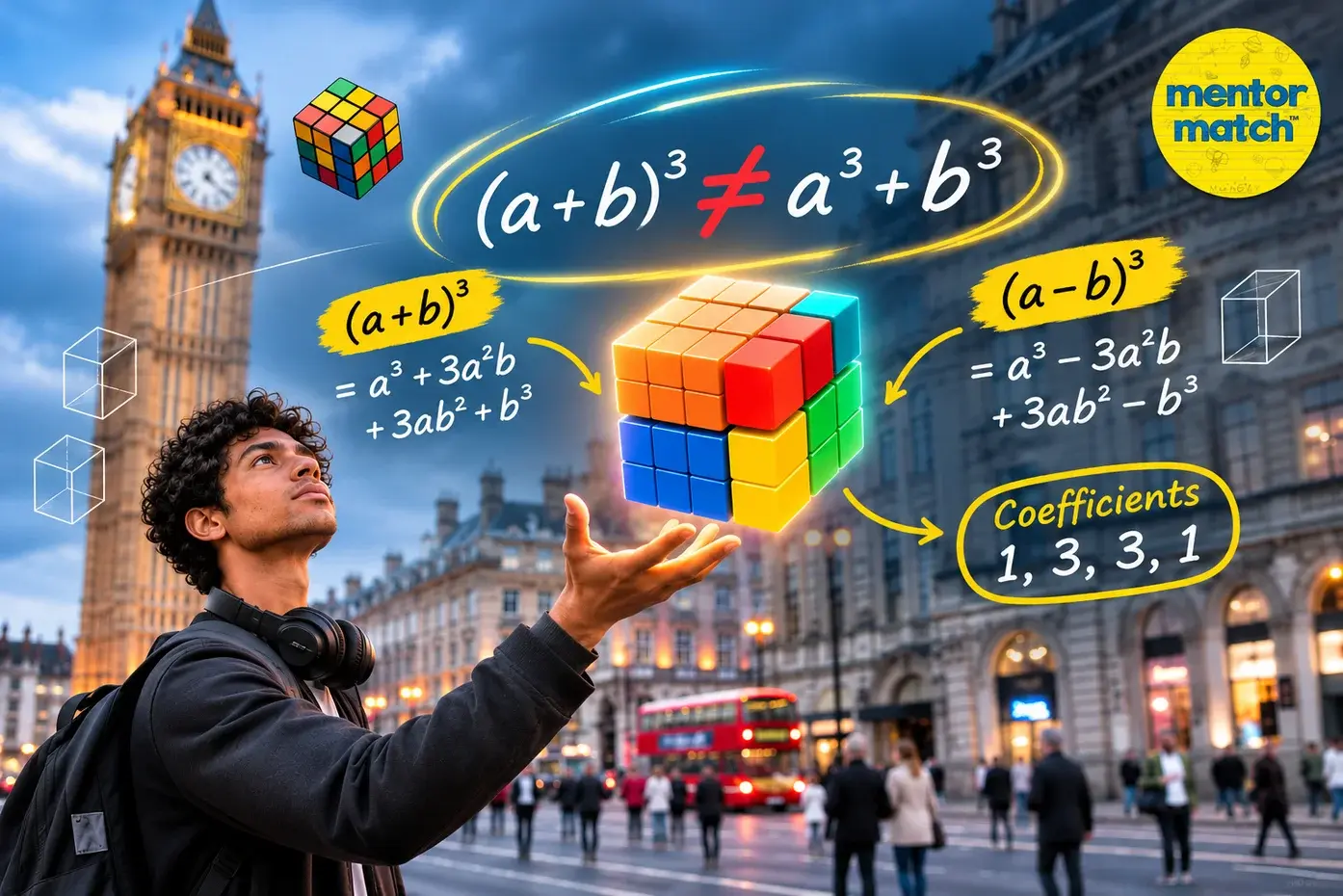
- (a + b)³ = a³ + 3a²b + 3ab² + b³
- Short form: (a + b)³ = a³ + b³ + 3ab(a + b)
- (a − b)³ = a³ − 3a²b + 3ab² − b³
- Short form: (a − b)³ = a³ − b³ − 3ab(a − b)
- a³ + b³ = (a + b)(a² − ab + b²)
- a³ − b³ = (a − b)(a² + ab + b²)
- The coefficients 1, 3, 3, 1 come from row 3 of Pascal's triangle
- (a + b)³ is not equal to a³ + b³
- (a + b + c)³ = a³ + b³ + c³ + 3(a + b)(b + c)(c + a)
- a³ + b³ + c³ − 3abc = (a + b + c)(a² + b² + c² − ab − bc − ca)
- α³ + β³ = (α + β)³ − 3αβ(α + β)
What is the (a + b)³ formula?
The (a + b)³ formula expands the cube of a binomial, which is an expression with two terms added together.
(a + b)^3 = a^3 + 3a^2b + 3ab^2 + b^3
It can also be written in a grouped form, which is useful when you know a + b and ab:
(a + b)^3 = a^3 + b^3 + 3ab(a + b)
Both forms are the same identity. Grouping the middle terms gives 3a²b + 3ab² = 3ab(a + b).
Proof of the (a + b)³ formula
Proof 1: expand the brackets
Write the cube as three brackets and multiply two at a time.
- (a + b)³ = (a + b)(a + b)(a + b)
- First, (a + b)(a + b) = a² + 2ab + b²
- Next, multiply by (a + b): (a² + 2ab + b²)(a + b)
- = a³ + a²b + 2a²b + 2ab² + ab² + b³
- Collect like terms: a³ + 3a²b + 3ab² + b³
This is exactly the "expand three brackets" skill tested in IGCSE Extended Maths.
Proof 2: build the cube
Imagine a cube with side length a + b. Cut each edge into a piece of length a and a piece of length b. The big cube splits into eight blocks:
- 1 cube of volume a³
- 1 cube of volume b³
- 3 flat slabs, each of volume a × a × b = a²b
- 3 thin rods, each of volume a × b × b = ab²
Add the volumes: a³ + 3a²b + 3ab² + b³. The picture shows why a³ + b³ alone is not enough. It leaves out six of the eight blocks.
Image suggestion: an exploded 3D cube showing the eight pieces, colour-coded by volume.
Proof 3: Pascal's triangle and the binomial theorem (IB)
The coefficients 1, 3, 3, 1 are row 3 of Pascal's triangle. The powers of a fall from 3 to 0 while the powers of b rise from 0 to 3.
(a + b)^3 = \binom{3}{0}a^3 + \binom{3}{1}a^2b + \binom{3}{2}ab^2 + \binom{3}{3}b^3
This is the n = 3 case of the binomial theorem, a core topic in IB Maths AA. Learn this pattern and (a + b)⁴, (a + b)⁵ and beyond follow the same rule.
The (a − b)³ formula (a minus b whole cube)
The (a − b)³ formula gives the cube of the difference of two terms. Like (a + b)³, it is one of the standard algebraic identities for the cube of a binomial.
(a - b)^3 = a^3 - 3a^2b + 3ab^2 - b^3
Grouped form:
(a - b)^3 = a^3 - b^3 - 3ab(a - b)
The signs alternate: +, −, +, −. Any term with an odd power of b is negative.
Proof: replace b with −b
There is no need to expand three brackets again. Start from the (a + b)³ formula and put −b in place of b:
- (a + (−b))³ = a³ + 3a²(−b) + 3a(−b)² + (−b)³
- (−b)² = b², and (−b)³ = −b³
- So (a − b)³ = a³ − 3a²b + 3ab² − b³
This substitution trick is worth learning in its own right. It turns up again with the binomial theorem in IB.
a³ + b³ and a³ − b³ formulas (a cube plus b cube, a cube minus b cube)
These are the sum and difference of two cubes. They are different from (a + b)³ and (a − b)³: each one factorises into two brackets instead of expanding into four terms.
a^3 + b^3 = (a + b)(a^2 - ab + b^2)
a^3 - b^3 = (a - b)(a^2 + ab + b^2)
Proof of the a³ + b³ and a³ − b³ identities
Multiply out the right-hand side and the middle terms cancel.
- (a + b)(a² − ab + b²) = a³ − a²b + ab² + a²b − ab² + b³ = a³ + b³
- (a − b)(a² + ab + b²) = a³ + a²b + ab² − a²b − ab² − b³ = a³ − b³
Alternative forms
When a question gives you a + b (or a − b) and ab, use these instead:
- a³ + b³ = (a + b)³ − 3ab(a + b)
- a³ − b³ = (a − b)³ + 3ab(a − b)
Quick examples
- Factorise x³ + 64: x³ + 4³ = (x + 4)(x² − 4x + 16)
- Find 10³ − 7³ using the identity: (10 − 7)(100 + 70 + 49) = 3 × 219 = 657. Check: 1000 − 343 = 657 ✓
Using cube identities with roots of a quadratic (α³ + β³)
If α and β are the roots of ax² + bx + c = 0, then α + β = −b/a and αβ = c/a. The cube identities give α³ + β³ without solving the equation:
\alpha^3 + \beta^3 = (\alpha + \beta)^3 - 3\alpha\beta(\alpha + \beta)
For α³ − β³, use (α − β)³ + 3αβ(α − β), where (α − β)² = (α + β)² − 4αβ.
Example: for x² − 5x + 6 = 0, α + β = 5 and αβ = 6. So α³ + β³ = 125 − 90 = 35. Check: the roots are 2 and 3, and 8 + 27 = 35 ✓
This kind of question appears in CBSE Class 10–11 and in IB Maths AA HL work on the sum and product of roots.
Related cube identities
These come up alongside the cube formulas, especially in factorising questions.
(a + b + c)³ formula (a plus b plus c whole cube)
(a + b + c)^3 = a^3 + b^3 + c^3 + 3(a + b)(b + c)(c + a)
Fully expanded:
(a + b + c)^3 = a^3 + b^3 + c^3 + 3a^2b + 3a^2c + 3ab^2 + 3b^2c + 3ac^2 + 3bc^2 + 6abc
Check with a = b = c = 1: the left side is 3³ = 27. The right side is 3 + 18 + 6 = 27 ✓
a³ + b³ + c³ identity (a cube plus b cube plus c cube)
a^3 + b^3 + c^3 - 3abc = (a + b + c)(a^2 + b^2 + c^2 - ab - bc - ca)
So if a + b + c = 0, then a³ + b³ + c³ = 3abc. This shortcut is a CBSE favourite.
The same formulas with x and y
- (x + y)³ = x³ + 3x²y + 3xy² + y³
- (x − y)³ = x³ − 3x²y + 3xy² − y³
- x³ − y³ = (x − y)(x² + xy + y²)
(a − b − c)³ formula (a minus b minus c whole cube)
Replace b with −b and c with −c in the three-term identity:
(a - b - c)^3 = a^3 - b^3 - c^3 - 3(a - b)(b + c)(a - c)
Check with a = 3, b = 1, c = 1: the left side is 1³ = 1. The right side is 27 − 1 − 1 − 3(2)(2)(2) = 1 ✓
A quick way to remember the sign patterns for the sum and difference of cubes is SOAP: the Same sign as the question, then the Opposite sign, then Always Positive.
Where you will use these formulas
- CBSE (Class 9 Polynomials): algebraic identities are tested directly. Typical questions ask you to expand, evaluate cubes of numbers, or find a³ + b³ from given values. If your child needs help here, see our Class 9 maths tutoring guide.
- IGCSE Extended Maths: you expand products of three brackets and simplify algebraic expressions. Knowing the cube pattern lets you check your expansion quickly.
- IB Maths AA: the binomial theorem builds directly on this pattern. Exam questions ask for a specific coefficient or term in an expansion.
- Mental maths: cubes of numbers near 10, 100 or 1000 become quick calculations.
Solved examples
Example 1: expand a simple cube
Expand (x + 2)³.
- a = x, b = 2
- x³ + 3(x²)(2) + 3(x)(2²) + 2³
- = x³ + 6x² + 12x + 8
Example 2: terms with coefficients
Expand (2x + 3y)³.
- a = 2x, b = 3y
- (2x)³ + 3(2x)²(3y) + 3(2x)(3y)² + (3y)³
- = 8x³ + 36x²y + 54xy² + 27y³
Example 3: a difference
Expand (3x − 1)³.
- a = 3x, b = 1
- (3x)³ − 3(3x)²(1) + 3(3x)(1)² − 1³
- = 27x³ − 27x² + 9x − 1
Example 4: cube a number using (a + b)³
Find 103³ without a calculator.
- 103 = 100 + 3
- 100³ + 3(100²)(3) + 3(100)(3²) + 3³
- = 1,000,000 + 90,000 + 2,700 + 27
- = 1,092,727
Example 5: cube a number using (a − b)³
Find 98³ without a calculator.
- 98 = 100 − 2
- 100³ − 3(100²)(2) + 3(100)(2²) − 2³
- = 1,000,000 − 60,000 + 1,200 − 8
- = 941,192
Example 6: find a³ + b³ from a + b and ab
If a + b = 7 and ab = 10, find a³ + b³.
- a³ + b³ = (a + b)³ − 3ab(a + b)
- = 7³ − 3(10)(7) = 343 − 210
- = 133
- Check: a = 5 and b = 2 fit the conditions, and 125 + 8 = 133 ✓
Example 7: an expression with x and 1/x
If x − 1/x = 3, find x³ − 1/x³.
- Use (a − b)³ = a³ − b³ − 3ab(a − b), with a = x and b = 1/x, so ab = 1
- 3³ = x³ − 1/x³ − 3(1)(3)
- 27 = x³ − 1/x³ − 9
- x³ − 1/x³ = 36
Example 8: a coefficient question (IB style)
Find the coefficient of x in the expansion of (2x − 1)³.
- (2x)³ − 3(2x)²(1) + 3(2x)(1)² − 1
- = 8x³ − 12x² + 6x − 1
- The coefficient of x is 6.
Example 9: factorise a difference of cubes
Factorise 8x³ − 27.
- 8x³ = (2x)³ and 27 = 3³
- a³ − b³ = (a − b)(a² + ab + b²)
- = (2x − 3)(4x² + 6x + 9)
Common mistakes
- Writing (a + b)³ = a³ + b³. This leaves out the two middle terms. Test it with a = b = 1: (1 + 1)³ = 8, but 1³ + 1³ = 2.
- Using 2 instead of 3 for the middle coefficients. That pattern belongs to (a + b)². For cubes, the coefficients are 1, 3, 3, 1.
- Cubing only the variable. (2x)³ = 8x³, not 2x³. Put brackets around every term before you cube it.
- Getting the signs wrong in (a − b)³. The pattern is +, −, +, −. The ab² term is positive because (−b)² is positive.
- Confusing (a − b)³ with a³ − b³. The first is a cube of a difference with four terms. The second is a difference of cubes that factorises into two brackets.
- Dropping the negative sign of b. In (3x − 1)³, take b = 1 and use the (a − b)³ formula, or take b = −1 and use (a + b)³. Never mix the two.
Practice questions
- Expand (x + 4)³.
- Expand (2a − 5)³.
- Find 101³ using an identity.
- Find 99³ using an identity.
- If a − b = 4 and ab = 5, find a³ − b³.
- If x + 1/x = 4, find x³ + 1/x³.
- Expand (3x + 2y)³.
- (IB style) Find the coefficient of x² in the expansion of (1 + 2x)³.
Answers
- x³ + 12x² + 48x + 64
- 8a³ − 60a² + 150a − 125
- (100 + 1)³ = 1,000,000 + 30,000 + 300 + 1 = 1,030,301
- (100 − 1)³ = 1,000,000 − 30,000 + 300 − 1 = 970,299
- a³ − b³ = (a − b)³ + 3ab(a − b) = 64 + 60 = 124
- x³ + 1/x³ = (x + 1/x)³ − 3(x + 1/x) = 64 − 12 = 52
- 27x³ + 54x²y + 36xy² + 8y³
- The x² term is 3(1)(2x)² = 12x², so the coefficient is 12
Frequently asked questions
What is the a plus b whole cube formula?
(a + b)³ = a³ + 3a²b + 3ab² + b³. It can also be written as a³ + b³ + 3ab(a + b).
What is the a minus b whole cube formula?
(a − b)³ = a³ − 3a²b + 3ab² − b³, or a³ − b³ − 3ab(a − b).
Is (a + b)³ the same as a³ + b³?
No. (a + b)³ has two extra terms, 3a²b + 3ab². The two are only equal when a = 0, b = 0 or a = −b.
What is the formula for a³ + b³?
a³ + b³ = (a + b)(a² − ab + b²). If you know a + b and ab, you can also use a³ + b³ = (a + b)³ − 3ab(a + b).
What is the formula for a³ − b³?
a³ − b³ = (a − b)(a² + ab + b²).
How do I remember the (a + b)³ expansion?
Remember three things. The coefficients are 1, 3, 3, 1. The power of a goes down from 3 to 0. The power of b goes up from 0 to 3. For (a − b)³, alternate the signs.
What is the (a + b + c)³ formula?
(a + b + c)³ = a³ + b³ + c³ + 3(a + b)(b + c)(c + a).
What is the (a − b − c)³ formula?
(a − b − c)³ = a³ − b³ − c³ − 3(a − b)(b + c)(a − c).
How do I use the (a − b)³ formula to cube numbers?
Split the number into a round number minus a small one. For example, 98 = 100 − 2, so 98³ = 100³ − 3(100²)(2) + 3(100)(2²) − 2³ = 941,192.
What is the α³ + β³ formula?
α³ + β³ = (α + β)³ − 3αβ(α + β). It lets you find the sum of the cubes of a quadratic's roots from the sum and product of the roots, without solving the equation.
What is the a cube plus b cube plus c cube formula?
a³ + b³ + c³ − 3abc = (a + b + c)(a² + b² + c² − ab − bc − ca). When a + b + c = 0, this gives a³ + b³ + c³ = 3abc.
How is (a + b)³ linked to the binomial theorem?
It is the binomial theorem with n = 3. The coefficients 1, 3, 3, 1 are the binomial coefficients 3C0, 3C1, 3C2 and 3C3, which form row 3 of Pascal's triangle.
Is this formula in IGCSE and IB Maths?
IGCSE Extended expects you to expand three brackets, which produces this result. IB Maths AA covers it as part of the binomial theorem. CBSE tests it directly in Class 9 algebraic identities.
Book your free demo class with MentorMatch
Algebraic identities are a foundation skill. When they are shaky, expanding, factorising and the binomial theorem all feel harder than they need to.
A MentorMatch tutor works one-to-one with your child. They spot exactly where the method breaks down and build fluency with targeted practice, from CBSE identities to IGCSE expansion and IB binomial questions.
- IGCSE Maths tutoring
- IB Maths AA tutoring
- Online algebra tutoring
- Families in the UAE can meet our IGCSE Maths tutors in Dubai and IB Maths tutors in Dubai.
Book Your Free Demo Class with MentorMatch.


