


77.32% of parents see better grades in 3 months!
A strong grade in Biology, Chemistry or Physics is not just about knowing the syllabus. Students also need to understand how their qualification is assessed, what examiners expect and how their preparation connects to their future university plans.
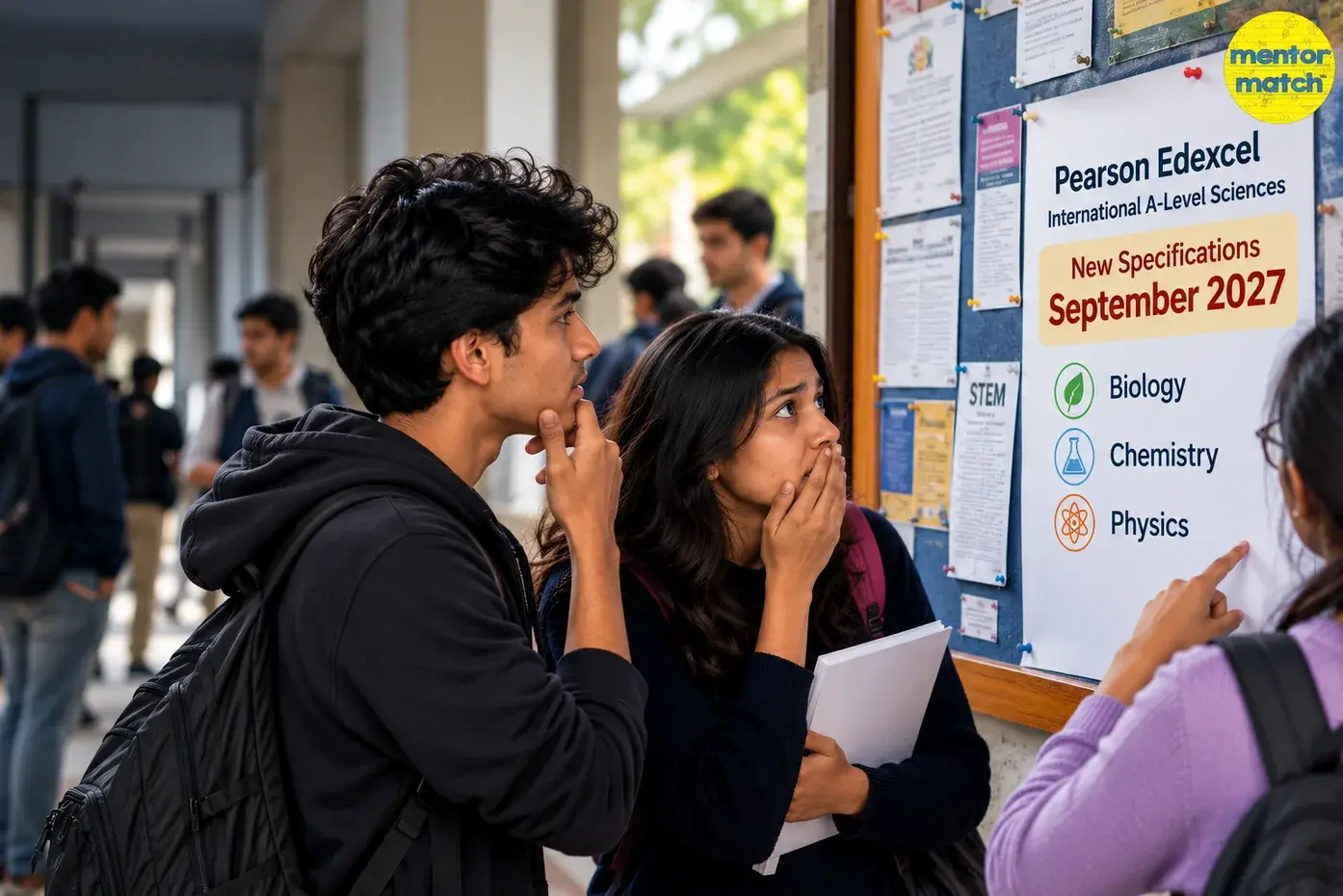
Pearson Edexcel has announced that its International Advanced Level qualifications in Biology, Chemistry and Physics are being redeveloped for first teaching in September 2027. The planned changes focus on improving alignment between the specifications, assessments and learning resources, alongside clearer guidance for students and teachers.
For families whose children are considering International A-Level science subjects, the important question is what this announcement means for their current studies, future subject choices and preparation for university-level STEM courses.
What Has Pearson Edexcel Announced?
In its October 2026 International Science Qualification update, Pearson Edexcel confirmed that its International A-Level Biology, Chemistry and Physics qualifications are being redesigned.
The aim is to create a more coherent teaching, learning and assessment experience. Pearson plans to bring the specifications, assessments and supporting resources—including textbooks—into closer alignment, helping teachers plan courses more confidently and helping students understand what is expected of them.
Official source: Read Pearson Edexcel’s October 2026 International Science Qualification News.
The announcement concerns Pearson Edexcel International A-Level qualifications. It should not be interpreted as a confirmed syllabus change for every A-Level or international curriculum provider.
When Will the New International A-Level Science Specifications Start?
Pearson has outlined the following timeline:
The detailed specifications are expected in the first half of 2027. Until Pearson publishes them, students and parents should avoid assuming that particular topics have been added, removed or moved between examination units.
For students already studying International A-Level Biology, Chemistry or Physics, this announcement does not mean that their current course has automatically changed. The relevant specification and examination arrangements depend on the qualification and the student's course.
Families planning a new course for September 2027 should follow Pearson's official updates and confirm the applicable specification with their school.
What Is Expected to Improve in the New IAL Science Qualifications?
Pearson has highlighted several areas of development. These are the stated aims of the redevelopment; the detailed specification documents are still to come.
1. Better Alignment Between Syllabus, Assessments and Learning Resources
One of the main objectives is to align the qualification specifications, assessments and supporting resources more closely.
For students, clearer alignment could make it easier to understand how the knowledge covered during lessons connects with the skills assessed in examinations. For teachers, it is intended to support more confident course planning.
This does not confirm a new examination format or a specific change to individual topics. Students should wait for the published specifications before changing their study plans.
2. Improved Accessibility for Students Learning in English as an Additional Language
Pearson has also identified improved accessibility for learners who use English as an additional language as a development priority.
This matters because students studying an international science qualification need to understand both the scientific concept and the wording of an examination question. A student may understand a Biology process or a Physics principle but still struggle to communicate the answer precisely in English.
The planned accessibility improvements are intended to support these learners. Pearson has not yet provided the full specifications needed to explain exactly how this will be implemented.
In the meantime, students can work on interpreting command words, explaining scientific processes accurately and structuring answers around the question being asked.
3. Clearer Guidance on Breadth and Depth
Pearson also plans to provide clearer guidance on the breadth and depth of subject knowledge expected.
For International A-Level Biology, Chemistry and Physics students, understanding the required depth is important when deciding how to revise a topic. Memorising definitions alone may not be enough when a question requires application, interpretation or an explanation supported by scientific reasoning.
However, the announcement does not identify individual topics that will become easier or more difficult. Any claims about specific syllabus additions, removals or changes in difficulty should wait until the new specifications are available.
4. Support for Progression to University-Level STEM Courses
Pearson says the redevelopment is intended to support progression to university-level study in science, technology, engineering and mathematics (STEM).
For students considering degrees in medicine-related fields, biological sciences, chemistry, physics, engineering or other STEM disciplines, International A-Level subject choices can form an important part of their academic pathway.
Students should still check the specific entry requirements of their intended universities. The announcement does not guarantee university admission, change university entry requirements or establish that every institution will treat the revised qualifications differently.
What Is Staying the Same?
Pearson has explicitly identified three elements that will remain unchanged under the announced plans.
The Modular Structure
The International A-Level science qualifications will retain their modular structure. This gives students the flexibility to sit units when they are ready across the available examination series.
Students should continue to follow their school's course plan and the applicable examination-entry arrangements. The announcement does not provide a new unit-by-unit timetable.
Three Examination Series
Pearson has stated that the qualifications will continue to offer three examination series. This flexibility is intended to let learners take units when they are ready.
The exact dates, entry deadlines and availability of individual units should be checked through the relevant official examination information and the student's school.
Practical Skills Will Continue to Be Assessed Through Written Papers
Pearson has confirmed that practical skills will continue to be assessed through written examination papers. The announced plan does not add a separate live practical examination burden for schools.
Students should not interpret this as meaning that practical understanding is unimportant. They still need to understand experimental methods, variables, data, observations and the reasoning behind scientific procedures as required by their qualification.
What Does the Announcement Mean for Biology, Chemistry and Physics Students?
Although Pearson is redeveloping all three science qualifications, the practical priorities for students depend on their subject, current course and future plans.
International A-Level Biology
Biology students should continue developing their understanding of biological concepts, scientific terminology, data interpretation and written explanations according to their current specification.
Pearson has not yet published the complete revised International A-Level Biology specification. Students should therefore avoid relying on unofficial lists of predicted additions or removals.
Once the new specification is available, students and teachers will be able to compare the confirmed requirements with the existing course.
International A-Level Chemistry
Chemistry students should maintain a clear understanding of the concepts, calculations, chemical explanations and practical principles required by their current course.
The redevelopment aims to improve the alignment between the specification, assessment and supporting resources. It does not yet confirm specific changes to individual Chemistry topics or examination questions.
Students preparing for university-level Chemistry or related STEM degrees should continue following their school's course requirements while monitoring Pearson's official announcements.
International A-Level Physics
Physics students should continue working on conceptual understanding, calculations, the interpretation of data and the explanation of physical principles under their current specification.
Pearson has confirmed that the modular structure will remain and that practical skills will continue to be assessed through written papers. The detailed revised Physics specification is still needed to establish any topic-level changes.
For students who find it difficult to apply concepts in unfamiliar problems, focused practice with the question types and assessment expectations in their current course remains useful.
Pearson's October 2026 Update: Other Important Information
The October announcement also includes several updates for International Science teachers. Some are directly relevant to students' preparation, while others concern teachers and examination administration.
International A-Level Biology Scientific Articles
Pearson reminded teachers that the scientific articles for the October examination series for International A-Level Biology Unit 5 (WBI15) had been published in the teaching and learning materials section.
The update refers to two versions:
- The standard WBI15_01 scientific article.
- The WBI15_01A article for candidates taking the new regional paper, which is available only in a specific region.
Pearson advises teachers and candidates to check the applicable article with their examinations officer when they are unsure which version applies. Students should not assume that the regional article is available or relevant to every examination centre.
Free International GCSE Science Training Courses
Pearson has introduced free, self-paced online “Mark like an Examiner” courses for International GCSE Biology, Chemistry and Physics teachers.
These are teacher-development resources, rather than a new student examination requirement. Their focus is on helping teachers engage with assessment and marking.
Students should continue using the resources and guidance recommended by their own teachers for their specific qualification.
Upcoming Teacher Training
Pearson's update also lists professional development opportunities, including live online training. The update mentions a “Getting Ready to Teach” session for modular International GCSE Biology on 26 October, with Chemistry and Physics training expected to be listed when available.
These opportunities are aimed at teachers. Students and parents should not confuse teacher-training dates with examination dates or syllabus implementation deadlines.
Teacher Consultation and Feedback
Pearson has invited teachers to express interest in joining its International A-Level science teacher research panel. Participation may include surveys and more detailed focus groups as Pearson develops the new specifications and supporting resources.
This is part of the qualification-development process. It does not mean that the final specifications have already been published.
Examination Dates and Administrative Deadlines
The October update also includes key dates for examination administration:
- 16 October 2026: Pearson listed this as the January International A-Level examination-entry deadline.
- 11 December 2026: Deadline listed for Access to Scripts for the May/June examination series.
- Summer 2027: Final examination timetables were available through Pearson's timetable information.
These dates relate to particular examination-administration processes. Students should confirm their own entry status and deadlines with their school's examinations officer rather than relying on a general news article.
What Should Parents Do Now?
A qualification redevelopment announcement can raise questions for families, particularly when a student is approaching an important examination or planning future subjects.
The most useful next steps are straightforward.
If your child is already studying International A-Level sciences: Continue following the current course and the school's guidance. Do not change revision plans based on unconfirmed predictions about the new specification.
If your child plans to begin in September 2027: Monitor Pearson's official announcements and ask the school which specification will apply to the course.
If your child is preparing for university: Check the subject and grade requirements of the intended universities directly. Pearson's announcement describes the qualification's development aims; it does not change university admissions requirements.
If your child struggles with science examinations: Identify whether the difficulty is in understanding concepts, applying knowledge, interpreting data, solving calculations or structuring written answers. These are different problems and need different preparation strategies.
How Should Students Prepare While Waiting for the New Specifications?
The full revised specifications are expected in the first half of 2027. Until then, students should focus on the requirements of their current course rather than trying to predict changes that Pearson has not confirmed.
A practical preparation plan can include:
- Check the applicable specification. Confirm the qualification, subject and course version your child is studying.
- Identify specific learning gaps. Separate content gaps from problems with exam technique, calculations or written explanations.
- Practise applying knowledge. Work through questions that require students to use scientific ideas rather than simply recall definitions.
- Review answers against the relevant assessment guidance. Understand what the question requires and where marks may be lost.
- Follow official updates. Compare the current course with the revised specification after Pearson publishes the detailed documents.
For students who need additional support, Mentor Match's online tutoring offers personalised 1:1 learning across international curricula. The appropriate subject and course should be confirmed before planning lessons around a specific Pearson qualification.
Personalised Support for Your Child's A-Level Science Goals
A qualification update is useful only when families understand what it means for their child's actual course. For now, the key is to follow the current specification, address subject-specific learning gaps and wait for Pearson's published documents before making decisions based on the revised qualifications.
If your child needs help with Biology, Chemistry or Physics, Mentor Match can help you explore personalised 1:1 tutoring built around their curriculum, current learning needs and academic goals.
Book a free demo class to discuss your child's learning needs and identify the right next step.


