


77.32% of parents see better grades in 3 months!
Short answer: (a + b)ⁿ = ⁿC₀ aⁿ + ⁿC₁ aⁿ⁻¹ b + ⁿC₂ aⁿ⁻² b² + … + ⁿCₙ bⁿ, where ⁿCᵣ = n! ÷ [r!(n − r)!]. Each term picks r of the b's and n − r of the a's, and ⁿCᵣ counts how many ways that can happen.
Multiplying (x + 2) by itself four times by hand is slow and full of chances to slip. The binomial theorem skips all of that: it writes the whole answer down directly, and it can jump straight to any single term you need, like the coefficient of x³ in (1 + 2x)⁷, without expanding the rest.
The binomial theorem is in IB Maths AA (SL and HL), A Level Maths and IGCSE Additional Maths. It's built on factorials and combinations, so if ⁿCᵣ feels shaky, start with our factorial guide. Below you'll find the formula, Pascal's triangle, the general term, eight worked examples, the HL extension to fractional and negative powers, and practice questions with answers.
Binomial Expansion Formula
For any positive whole number n:
(a + b)ⁿ = Σ ⁿCᵣ aⁿ⁻ʳ bʳ, for r = 0 to n
Written out in full:
- (a + b)ⁿ = aⁿ + ⁿC₁ aⁿ⁻¹b + ⁿC₂ aⁿ⁻²b² + … + ⁿCₙ₋₁ abⁿ⁻¹ + bⁿ
The numbers ⁿCᵣ are the binomial coefficients:
ⁿCᵣ = n! ÷ [r!(n − r)!]
You'll also see ⁿCᵣ written as (n r) stacked in brackets, or nCr on a calculator.
Patterns to spot
- There are always n + 1 terms.
- The power of a falls by 1 each term, from n down to 0.
- The power of b rises by 1 each term, from 0 up to n.
- In every term, the two powers add up to n.
- The coefficients are symmetric: ⁿCᵣ = ⁿCₙ₋ᵣ.
- Put a = b = 1 and you see the coefficients always add up to 2ⁿ.
Pascal's Triangle
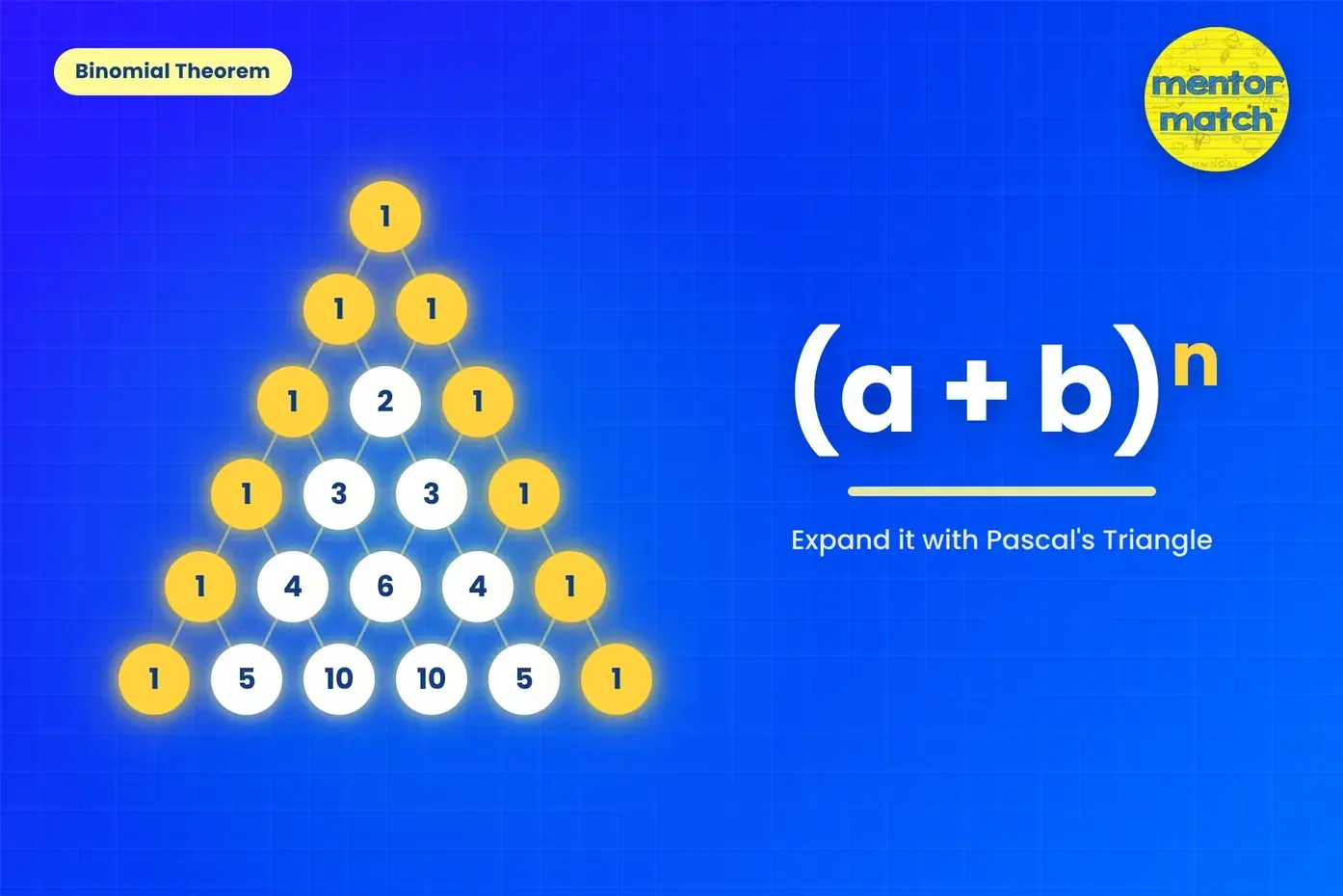
For small powers, Pascal's triangle gives the coefficients without any factorials. Each row starts and ends with 1, and every other number is the sum of the two above it.
- n = 0: 1
- n = 1: 1, 1
- n = 2: 1, 2, 1
- n = 3: 1, 3, 3, 1
- n = 4: 1, 4, 6, 4, 1
- n = 5: 1, 5, 10, 10, 5, 1
- n = 6: 1, 6, 15, 20, 15, 6, 1
So for (a + b)⁴ you read off 1, 4, 6, 4, 1. For bigger powers, nCr on your calculator is faster.
The General Term
The term containing bʳ is the (r + 1)th term:
Tᵣ₊₁ = ⁿCᵣ aⁿ⁻ʳ bʳ
This is the single most useful line for exam questions. It lets you find one specific term, a particular coefficient, or the term independent of x, without writing out the whole expansion.
Watch the "+ 1": the 4th term uses r = 3, not r = 4.
How to Expand a Binomial Step by Step
- Identify a, b and n. Include any sign or coefficient inside a and b. In (2x − 3)³, a = 2x and b = −3.
- Write the coefficients from Pascal's triangle or nCr.
- Write the powers: a's power falls from n, b's rises from 0.
- Multiply out each term, keeping brackets around a and b so the signs and coefficients get raised too.
- Tidy up and check you have n + 1 terms.
Solved Examples on Binomial Expansion
Example 1: A simple expansion
Expand (x + 2)⁴.
- Coefficients (row 4): 1, 4, 6, 4, 1
- Terms: x⁴ + 4x³(2) + 6x²(2²) + 4x(2³) + 2⁴
- Answer: x⁴ + 8x³ + 24x² + 32x + 16
Example 2: With a negative term
Expand (2x − 3)³.
- a = 2x, b = −3, coefficients 1, 3, 3, 1
- Terms: (2x)³ + 3(2x)²(−3) + 3(2x)(−3)² + (−3)³
- = 8x³ + 3(4x²)(−3) + 3(2x)(9) − 27
- Answer: 8x³ − 36x² + 54x − 27
Notice the signs alternate when b is negative.
Example 3: One coefficient only
Find the coefficient of x³ in (1 + 2x)⁷.
- General term: ⁷Cᵣ (1)⁷⁻ʳ (2x)ʳ
- For x³, r = 3: ⁷C₃ × 2³ × x³
- ⁷C₃ = 35, so 35 × 8
- Answer: 280
Example 4: A specific term
Find the 5th term of (a + b)⁹.
- 5th term means r = 4
- T₅ = ⁹C₄ a⁵ b⁴
- Answer: 126a⁵b⁴
Example 5: Term independent of x
Find the term independent of x in (x + 2/x)⁶.
- General term: ⁶Cᵣ x⁶⁻ʳ (2/x)ʳ = ⁶Cᵣ 2ʳ x⁶⁻²ʳ
- Independent of x means the power is 0: 6 − 2r = 0, so r = 3
- Term: ⁶C₃ × 2³ = 20 × 8
- Answer: 160
Example 6: Using Pascal's triangle
Expand (x + 1)⁵.
- Row 5: 1, 5, 10, 10, 5, 1, and every power of 1 is just 1
- Answer: x⁵ + 5x⁴ + 10x³ + 10x² + 5x + 1
Example 7: Estimating a number
Use the first three terms of (1 + x)⁵ to estimate 1.02⁵.
- (1 + x)⁵ ≈ 1 + 5x + 10x²
- Put x = 0.02: 1 + 0.1 + 10(0.0004)
- Answer: 1.104 (the exact value is 1.10408…, so the estimate is very close)
Example 8: Sum of coefficients
What do the coefficients of (1 + x)⁸ add up to?
- Put x = 1: (1 + 1)⁸
- Answer: 2⁸ = 256
For IB HL Students: Fractional and Negative Powers
When n isn't a positive whole number, the expansion never stops. It becomes an infinite series, and it only works for small x.
(1 + x)ⁿ = 1 + nx + [n(n − 1)/2!] x² + [n(n − 1)(n − 2)/3!] x³ + …, valid for |x| < 1
Example: Expand (1 − 2x)^½ up to x³
- n = ½, and the "x" in the formula is −2x
- Term 2: ½(−2x) = −x
- Term 3: [½ × (−½) / 2] (−2x)² = (−⅛)(4x²) = −½x²
- Term 4: [½ × (−½) × (−³⁄₂) / 6] (−2x)³ = (1/16)(−8x³) = −½x³
- Answer: 1 − x − ½x² − ½x³ …, valid for |2x| < 1, so |x| < ½
Use it to estimate √0.98 by putting x = 0.01: 1 − 0.01 − 0.00005 − … ≈ 0.98995. The true value is 0.989949…
If the bracket starts with something other than 1, take it out first. For example, (4 + x)^½ = 2(1 + x/4)^½, valid for |x| < 4.
Common Mistakes to Avoid
- Not bracketing a and b. (2x)³ is 8x³, not 2x³. Raise the whole term, coefficient and all.
- Losing the negative sign. If b = −3, then b² = +9 and b³ = −27.
- Off-by-one on the term number. The (r + 1)th term uses r. The 5th term has r = 4.
- Expanding everything to find one term. Use the general term instead.
- Forgetting the validity range for HL. Fractional and negative powers need |x| < 1 (after factoring the bracket to start with 1).
- Miscounting terms. (a + b)ⁿ always has n + 1 terms, not n.
Practice Questions on Binomial Expansion
Question 1: Expand (x + 3)³ using Pascal's triangle.
Question 2: Expand (x − 2)⁴.
Question 3: Find the coefficient of x² in (3 + x)⁵.
Question 4: Find the 4th term of (2x + 1)⁶.
Question 5: Find the term independent of x in (x² + 1/x)⁶.
Question 6: How many terms are there in the expansion of (a + b)¹⁰?
Question 7: What is the sum of the coefficients in (1 + x)⁸?
Question 8 (HL): Find the first three terms of (1 + x)⁻².
Answers
- x³ + 9x² + 27x + 27
- x⁴ − 8x³ + 24x² − 32x + 16
- ⁵C₂ × 3³ = 10 × 27 = 270
- r = 3: ⁶C₃ (2x)³ = 20 × 8x³ = 160x³
- Power of x is 12 − 3r = 0, so r = 4: ⁶C₄ = 15
- 11
- 2⁸ = 256
- 1 − 2x + 3x²
Frequently Asked Questions
1. What is the binomial expansion formula?
(a + b)ⁿ = Σ ⁿCᵣ aⁿ⁻ʳ bʳ for r = 0 to n. It writes any power of a two-term bracket as a sum of n + 1 terms.
2. What is the binomial theorem?
It's the rule behind the formula: when you expand (a + b)ⁿ, the coefficient of aⁿ⁻ʳbʳ is ⁿCᵣ, the number of ways to choose r items from n.
3. What is the general term of a binomial expansion?
Tᵣ₊₁ = ⁿCᵣ aⁿ⁻ʳ bʳ. It gives the (r + 1)th term directly.
4. How do you find the term independent of x?
Write the general term, collect all the powers of x into one power, set it equal to 0 and solve for r.
5. What is Pascal's triangle used for?
It lists the binomial coefficients row by row. Row n gives the coefficients of (a + b)ⁿ.
6. How many terms are in the expansion of (a + b)ⁿ?
n + 1.
7. What is a binomial coefficient?
ⁿCᵣ = n! ÷ [r!(n − r)!]. It's the number in front of each term, and it equals the number of ways to choose r objects from n.
8. Can you expand a binomial with a negative or fractional power?
Yes, but it becomes an infinite series: (1 + x)ⁿ = 1 + nx + [n(n − 1)/2!]x² + …, valid only for |x| < 1. This is IB HL and A Level content.
9. Where is the binomial theorem used?
In probability (the binomial distribution), approximating numbers like 1.02⁵, counting problems and, at HL, series expansions in calculus.
10. Is the binomial theorem in the IB syllabus?
Yes. Positive whole-number powers are in IB Maths AA SL (topic 1.9). Fractional and negative powers are in AA HL (topic 1.10). It's also in A Level Maths and IGCSE Additional Maths.
Book Your Free Demo Class with MentorMatch
Binomial questions reward method. Bracketing correctly, getting the signs right and using the general term to jump straight to the answer save time and marks in IB Paper 1.
MentorMatch tutors teach 1:1 online, matched to your curriculum, and practise exactly these exam-style questions with you.


