


77.32% of parents see better grades in 3 months!
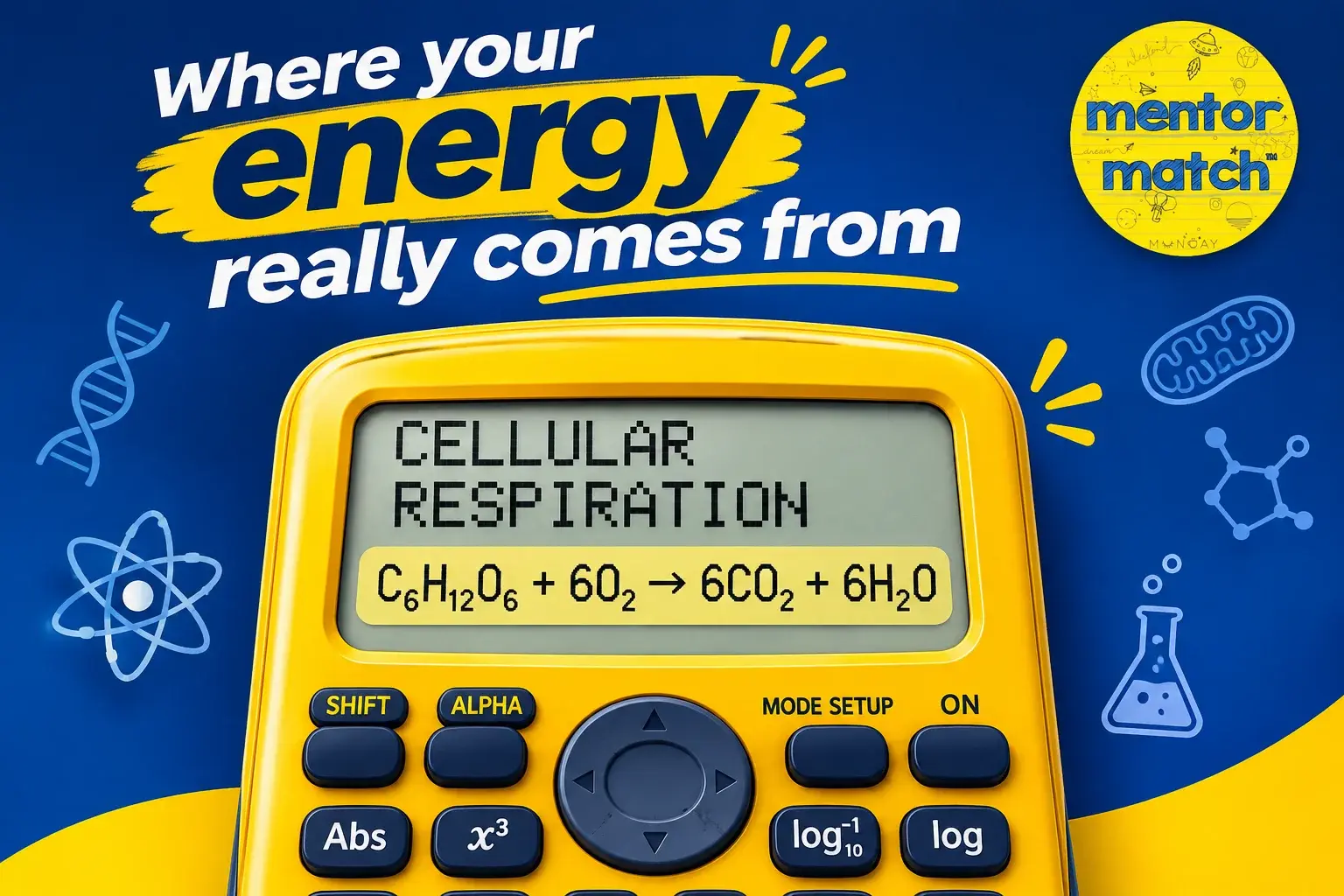
The cellular respiration formula is C₆H₁₂O₆ + 6O₂ → 6CO₂ + 6H₂O + energy. It sums up how a cell uses oxygen to break glucose down into carbon dioxide and water, passing part of the released energy on to ATP.
Cells need a steady energy supply to grow, move, repair themselves and carry substances across membranes. Cellular respiration is the main way they get it in a form they can use.
Put simply, glucose and oxygen go in, and chemical energy comes out. Some of that energy is captured as ATP to run the cell's activities, and the rest is lost as heat.
In IB Biology, writing the equation down is just the first step. You also need to know what each term stands for, which stage happens where, why oxygen matters and how aerobic respiration compares with the anaerobic routes.
Cellular Respiration Formula at a Glance
- Reactants: glucose (C₆H₁₂O₆) and oxygen (O₂)
- Products: carbon dioxide (CO₂) and water (H₂O)
- Energy outcome: part is stored in ATP, part is given off as heat
- Type: aerobic cellular respiration
- First stage: glycolysis, in the cytoplasm
- Later stages (eukaryotic cells): the mitochondrial matrix and the inner mitochondrial membrane
Remember: glucose and oxygen go in, carbon dioxide and water come out, and the energy released along the way is used to make ATP.
What Is the Cellular Respiration Equation?
Written as a balanced chemical equation, aerobic cellular respiration is:
C₆H₁₂O₆ + 6O₂ → 6CO₂ + 6H₂O + energy
It shows glucose being oxidised when oxygen is available.
For every glucose molecule, six oxygen molecules are used up, and six carbon dioxide and six water molecules are made.
Keep in mind that this is a summary. In the cell, the change happens through a chain of enzyme-controlled stages, not in one reaction.
What Does Each Part of the Formula Mean?
- C₆H₁₂O₆: a single glucose molecule, the respiratory substrate being broken down
- 6O₂: six molecules of oxygen used in aerobic respiration
- 6CO₂: six molecules of carbon dioxide given off as waste
- 6H₂O: six molecules of water made overall
- Energy: chemical energy, partly captured in ATP and partly lost as heat
How Is the Cellular Respiration Equation Balanced?
A balanced equation obeys the conservation of mass: each element must have the same number of atoms on the left as on the right.
Here's the atom count.
Left side (reactants):
- Carbon: 6, all from glucose
- Hydrogen: 12, all from glucose
- Oxygen: 6 from glucose plus 12 from the six O₂ molecules
- Total oxygen: 18
Right side (products):
- Carbon: 6, from the six CO₂ molecules
- Hydrogen: 12, from the six H₂O molecules
- Oxygen: 12 from CO₂ plus 6 from H₂O
- Total oxygen: 18
That's 6 carbon, 12 hydrogen and 18 oxygen atoms on each side, so the equation balances.
Why Does Cellular Respiration Produce ATP?
Glucose is packed with stored chemical energy. Respiration releases it gradually through a sequence of controlled reactions.
Part of that energy is used to make adenosine triphosphate (ATP).
ATP is the molecule cells reach for when they need energy right away. It powers jobs such as:
- pumping substances across membranes by active transport
- contracting muscles
- building proteins and other large molecules
- dividing cells
- moving structures around inside the cell
Not all of the released energy ends up in ATP. A share is always lost as heat.
Why Is There No Fixed ATP Number in the Overall Formula?
Textbooks and websites quote different figures for how many ATP molecules one glucose molecule yields.
That's because the real yield shifts with the organism, the type of cell, the energy spent moving molecules across membranes and the conditions inside the cell. So the overall equation leaves the ATP number out.
The safest version to write is:
C₆H₁₂O₆ + 6O₂ → 6CO₂ + 6H₂O + energy
The key idea is the division of roles: glucose stores the energy, and ATP delivers it in usable amounts to cell processes.
What Are the Four Main Stages of Cellular Respiration?
Behind the single overall equation are four linked stages:
- Glycolysis
- Link reaction
- Krebs cycle
- Oxidative phosphorylation
Each one takes the breakdown of glucose a step further and moves energy along the chain.
1. Glycolysis
Glycolysis comes first and happens in the cytoplasm.
Here, one glucose molecule with six carbons is split into two pyruvate molecules with three carbons each.
It produces:
- 2 pyruvate molecules
- a net gain of 2 ATP
- reduced NAD (NADH)
Oxygen isn't directly needed for glycolysis. That's why it can keep running without oxygen, as long as the cell has another way to regenerate NAD.
2. Link Reaction
When oxygen is available, pyruvate moves into the mitochondrion (in eukaryotic cells).
In the link reaction, pyruvate is turned into acetyl coenzyme A (acetyl-CoA).
Along the way it:
- gives off carbon dioxide
- reduces NAD to NADH
- makes acetyl-CoA, ready to feed into the Krebs cycle
As the name suggests, this step links glycolysis to the Krebs cycle.
3. Krebs Cycle
The Krebs cycle, also called the citric acid cycle, runs in the mitochondrial matrix of eukaryotic cells.
Acetyl-CoA joins a loop of enzyme-controlled reactions that oxidise the carbon compounds bit by bit.
Each turn yields:
- carbon dioxide
- reduced NAD (NADH)
- reduced FAD (FADH₂)
- a small amount of ATP (or an equivalent energy carrier)
The reduced carriers then ferry high-energy electrons to the electron transport chain.
4. Oxidative Phosphorylation
The final stage takes place on the inner mitochondrial membrane.
It has two parts that work hand in hand.
Electron transport chain
NADH and FADH₂ hand their electrons to the chain. As the electrons pass along it, the energy they release pumps protons across the inner membrane.
This builds up a proton gradient.
Chemiosmosis
The protons then flow back down their electrochemical gradient through the enzyme ATP synthase.
That flow supplies the energy to join ADP and inorganic phosphate into ATP.
At the end of the chain, oxygen is the final electron acceptor. It picks up the electrons, combines with protons and forms water.
Without oxygen in that last position, this stage can't run, which is why aerobic respiration depends on it.
Aerobic vs Anaerobic Respiration
Which pathway a cell uses depends on whether oxygen is available.
The main cellular respiration equation describes aerobic respiration, the version that uses oxygen.
When oxygen runs short, cells can switch to anaerobic pathways. Their job is to regenerate NAD so that glycolysis can keep going.
Difference Between Aerobic and Anaerobic Pathways
- Oxygen: aerobic respiration needs it as the final electron acceptor in oxidative phosphorylation. Anaerobic pathways don't use oxygen in that role.
- How far glucose is broken down: completely oxidised in aerobic respiration, only partly broken down in anaerobic pathways.
- End products: carbon dioxide and water for aerobic. Lactate in human muscle, or ethanol and carbon dioxide in yeast, for anaerobic.
- ATP yield: far higher for aerobic, much lower for anaerobic.
- Where the ATP comes from: mostly oxidative phosphorylation in aerobic respiration, glycolysis alone in anaerobic pathways.
Anaerobic Pathway in Human Muscle Cells
During hard exercise, the blood may not deliver oxygen fast enough. Muscle cells then turn pyruvate into lactate.
Glucose → lactate + a small amount of ATP
This step regenerates NAD, so glycolysis can carry on making a little ATP.
Anaerobic Pathway in Yeast
Without oxygen, yeast switches to alcoholic fermentation.
It converts glucose into ethanol and carbon dioxide, getting only the small ATP yield of glycolysis.
Glucose → ethanol + carbon dioxide + a small amount of ATP
In neither pathway is glucose fully oxidised. A lot of its chemical energy stays locked in the lactate or ethanol, which is why the ATP return is so much lower than in aerobic respiration.
How Does Oxygen Help in Cellular Respiration?
Oxygen matters because it sits at the very end of the electron transport chain as the final electron acceptor.
The sequence runs like this:
- NADH and FADH₂ pass electrons into the electron transport chain.
- As electrons move along, their energy pumps protons across the inner mitochondrial membrane.
- A proton gradient builds up.
- Protons flow back through ATP synthase.
- ATP synthase uses that flow to make ATP.
- Oxygen takes the electrons at the end and combines with protons to form water.
Take oxygen away and the electrons have nowhere to go. The chain backs up, oxidative phosphorylation stops, and the cell has to fall back on other ways to regenerate NAD.
That's the reason aerobic respiration makes so much more ATP than the anaerobic pathways.
Where Does Cellular Respiration Occur in a Cell?
In eukaryotic cells, each stage has its own location.
- Glycolysis: cytoplasm
- Link reaction: mitochondrial matrix
- Krebs cycle: mitochondrial matrix
- Electron transport chain: inner mitochondrial membrane
- ATP synthesis by ATP synthase: inner mitochondrial membrane
The mitochondrion's structure is suited to making ATP efficiently.
Its inner membrane carries the electron transport chain and ATP synthase. The narrow intermembrane space lets protons build up quickly, creating the gradient that chemiosmosis needs.
Worked Example: Using the Cellular Respiration Formula
Question: Four glucose molecules are completely oxidised by aerobic respiration. How many oxygen molecules are used, and how many carbon dioxide molecules are released?
Step 1: Write the balanced equation.
C₆H₁₂O₆ + 6O₂ → 6CO₂ + 6H₂O + energy
Step 2: Read off the ratio.
1 glucose : 6 oxygen : 6 carbon dioxide
Step 3: Work out the oxygen used.
4 × 6 = 24 oxygen molecules
Step 4: Work out the carbon dioxide released.
4 × 6 = 24 carbon dioxide molecules
Answer:
- Oxygen used = 24 molecules
- Carbon dioxide released = 24 molecules
The coefficients in a balanced equation give the ratio of molecules, and the same ratio works for moles.
Common Mistakes to Avoid in IB Biology
1. Confusing breathing with cellular respiration
Breathing is the physical movement of gases into and out of an organism.
Cellular respiration is the set of chemical reactions inside cells that transfers energy from respiratory substrates to ATP.
2. Saying that respiration creates energy
Energy can't be made or destroyed. Respiration moves the chemical energy in glucose into ATP and heat.
In exam answers, write "energy is transferred" or "energy is released", never "energy is created".
3. Claiming that oxygen is required for glycolysis
Glycolysis runs without oxygen. Oxygen's role comes much later, as the final electron acceptor in oxidative phosphorylation.
4. Treating cellular respiration as one reaction
The overall equation is a summary of several enzyme-controlled stages. It doesn't happen in a single step.
5. Assuming only animals carry out cellular respiration
Plants, animals, fungi, protists and many prokaryotes all respire.
Plants respire all the time to make ATP, including at night when photosynthesis has stopped.
6. Confusing glucose with ATP
Glucose is the energy-rich fuel. ATP is the molecule that hands energy over to the cell's activities as and when it's needed.
The two do different jobs in energy metabolism.
Cellular Respiration: Quick IB Biology Exam Summary
- State the aerobic respiration equation: C₆H₁₂O₆ + 6O₂ → 6CO₂ + 6H₂O + energy
- Identify the reactants: glucose and oxygen
- Identify the products: carbon dioxide and water
- Explain the role of oxygen: final electron acceptor in the electron transport chain
- State where glycolysis occurs: cytoplasm
- State where the Krebs cycle occurs: mitochondrial matrix
- State where the electron transport chain is found: inner mitochondrial membrane
- Compare ATP production: aerobic respiration yields far more ATP than anaerobic pathways
- Explain the role of ATP: it delivers usable energy to cell processes
Practice Questions: Cellular Respiration
Try these before you check the answers.
Question 1: Write the balanced chemical equation for aerobic cellular respiration.
Question 2: What are the two main reactants in aerobic cellular respiration?
Question 3: Where does glycolysis take place in a eukaryotic cell?
Question 4: What is the final electron acceptor in the electron transport chain?
Question 5: What are the two three-carbon molecules formed when one glucose molecule undergoes glycolysis?
Question 6: Where does the Krebs cycle occur in a eukaryotic cell?
Question 7: If five glucose molecules are completely oxidised aerobically, how many oxygen molecules are required?
Question 8: Why does anaerobic fermentation produce much less ATP than aerobic respiration?
Answers
- C₆H₁₂O₆ + 6O₂ → 6CO₂ + 6H₂O + energy.
- Glucose and oxygen.
- In the cytoplasm.
- Oxygen.
- Two pyruvate molecules.
- In the mitochondrial matrix.
- 5 × 6 = 30 oxygen molecules.
- Glucose is only partly broken down, and there is no oxidative phosphorylation, which is the stage that makes most of the ATP in aerobic respiration.
Frequently Asked Questions
1. What is the formula for cellular respiration?
For aerobic respiration it is C₆H₁₂O₆ + 6O₂ → 6CO₂ + 6H₂O + energy. Glucose and oxygen are used up, carbon dioxide and water are made, and part of the energy released is stored in ATP.
2. What are the four stages of cellular respiration?
Glycolysis, the link reaction, the Krebs cycle and oxidative phosphorylation. Between them they take glucose apart and pass its energy on to ATP.
3. Why is oxygen needed for cellular respiration?
Oxygen collects the electrons at the end of the electron transport chain and joins with protons to make water. Without it, electrons can't keep flowing and oxidative phosphorylation comes to a halt.
4. Where does cellular respiration take place?
In eukaryotic cells, glycolysis happens in the cytoplasm. The link reaction and Krebs cycle take place in the mitochondrial matrix, and the electron transport chain and ATP synthase sit in the inner mitochondrial membrane.
5. What is the difference between aerobic and anaerobic respiration?
Aerobic respiration uses oxygen and breaks glucose down fully to carbon dioxide and water. Anaerobic pathways work without oxygen as the final electron acceptor, break glucose down only partly and produce far less ATP.
6. Is cellular respiration the reverse of photosynthesis?
Only on paper. Their overall equations look like mirror images, but the actual pathways are quite different. Photosynthesis uses light energy to build carbohydrates, while respiration breaks carbon compounds down and moves their energy into ATP. Plants do both.
7. Do IB Biology students need to memorise a precise ATP yield?
Go by your current IB Biology guide and your teacher. Published ATP totals vary because conditions in cells and transport costs differ. What you do need to know is that aerobic respiration makes far more ATP than anaerobic pathways, and that glycolysis gives a net 2 ATP per glucose.
8. What is the role of ATP in cellular respiration?
ATP is the cell's immediate energy carrier. Energy released from glucose during respiration is used to make ATP, which then powers jobs such as active transport, muscle contraction and building new molecules.
Build Your IB Biology Understanding with MentorMatch
Cellular respiration takes more than learning one equation. You need to link the stages together, explain what oxygen does, understand where the ATP comes from and use all of it to answer exam-style questions.
With personalised 1:1 online lessons, a tutor can unpack the topics you find hardest, help you practise structured answers and build your confidence with biology concepts.
Book Your Free Demo Class with MentorMatch and turn tricky biology topics into clear, connected understanding with an experienced IB Biology tutor.


