


77.32% of parents see better grades in 3 months!
Every chemical change shifts energy around. In some reactions energy escapes into whatever is nearby, so the beaker warms up. In others the reaction pulls energy in, so things nearby cool down. Chemists call the first kind exothermic and the second endothermic.
Getting this distinction right underpins a big chunk of IB Chemistry and IGCSE Chemistry. It's how you read enthalpy changes, sketch energy-profile diagrams, process calorimetry data, and explain where a reaction's energy actually comes from.
It all comes down to which way the energy flows:
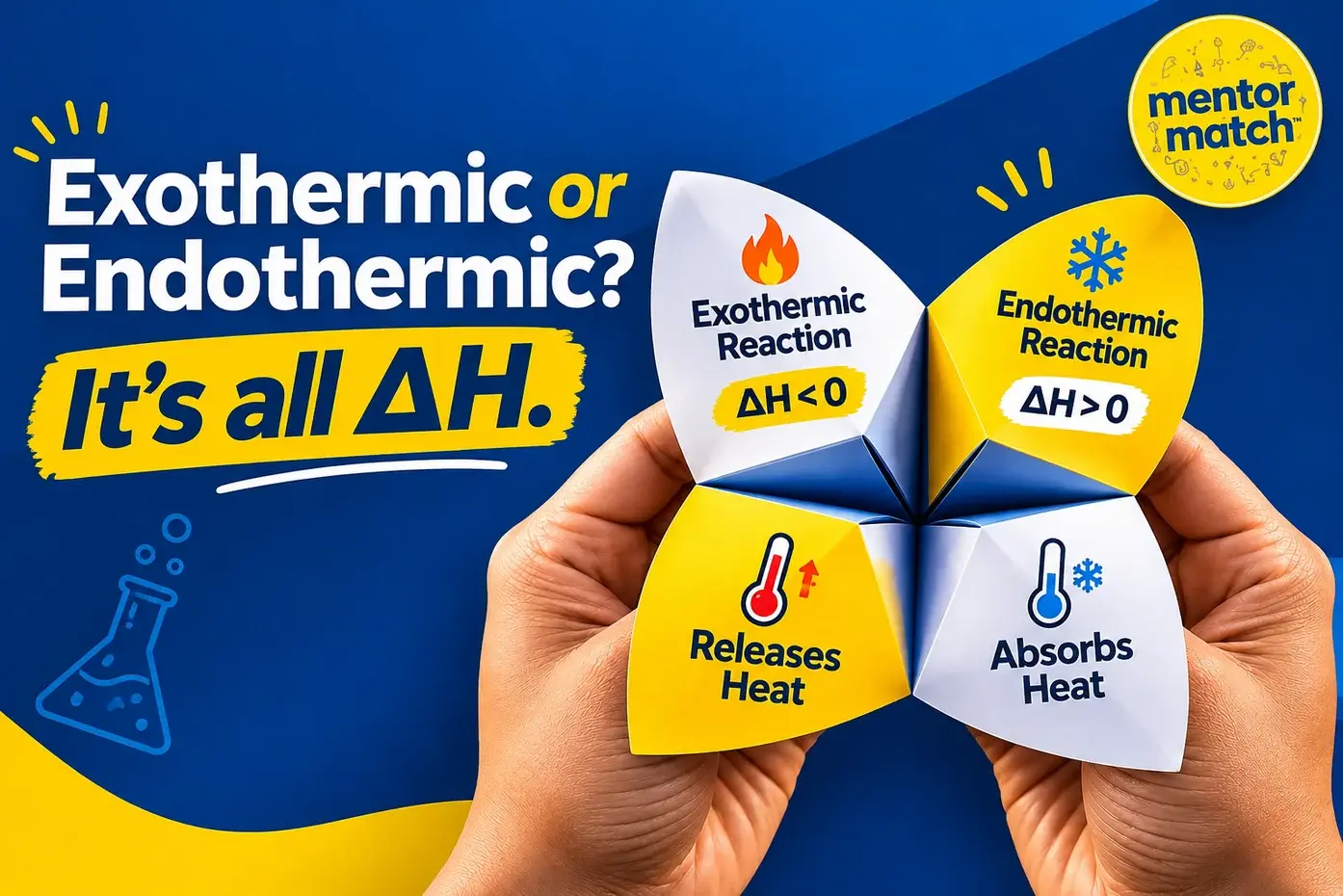
- Exothermic reaction: energy leaves the reacting system and heads into the surroundings. The enthalpy change is negative (ΔH < 0).
- Endothermic reaction: energy is drawn in from the surroundings to the reacting system. The enthalpy change is positive (ΔH > 0).
Below, we compare the two side by side, then work through the formulas, examples and exam technique.
Exothermic vs Endothermic Reactions: Key Differences
- Direction of energy: exothermic sends it out to the surroundings, endothermic takes it in from them.
- Sign of ΔH: negative for exothermic, positive for endothermic.
- What you notice: the surroundings tend to warm up in exothermic reactions and cool down in endothermic ones.
- Enthalpy of products: below the reactants for exothermic, above them for endothermic.
- Energy-profile shape: the line ends lower than it starts for exothermic, and higher for endothermic.
- Bond energy balance: exothermic means making the new bonds gives out more than breaking the old ones took in. Endothermic is the reverse.
- Everyday examples: combustion, neutralisation and respiration are exothermic. Thermal decomposition and photosynthesis are endothermic.
Memory trick:
- Exothermic: energy exits.
- Endothermic: energy enters.
What Are System and Surroundings?
To talk sensibly about energy moving "in" or "out", you need to know where the boundary is.
System: the reaction itself, meaning the particles that are actually changing.
Surroundings: everything else that can swap energy with it. That means the water the reactants are dissolved in, the beaker, the thermometer, even the air in the room.
Take an acid being neutralised by an alkali in a beaker. The reacting ions form the system, and the water, glass and thermometer are the surroundings.
Heat is not a substance hidden inside the chemicals. It is energy on the move, flowing because one place is hotter than another.
We track the energy change with:
ΔH = H(products) − H(reactants)
When the pressure stays constant, as in an open beaker, ΔH equals the heat exchanged with the surroundings.
What Is an Exothermic Reaction?
In an exothermic reaction, the reacting chemicals hand energy over to their surroundings as heat.
The system ends up with less energy than it started with, so the products sit at a lower enthalpy than the reactants.
How to recognise one:
- energy flows outward, from system to surroundings
- the surroundings typically get warmer
- the products hold less enthalpy than the reactants
- ΔH carries a minus sign
Formula: ΔH = H(products) − H(reactants), and for an exothermic reaction ΔH < 0.
Examples of Exothermic Reactions
1. Combustion of methane
When a fuel burns in oxygen, a large amount of energy is given out.
CH₄(g) + 2O₂(g) → CO₂(g) + 2H₂O(l)
Heat and light pour out into the surroundings. Carbon dioxide and water together hold less enthalpy than methane and oxygen did, so ΔH is negative.
2. Acid-base neutralisation
Mix an acid with a base and you get a salt plus water. Stripped down to the particles that actually react:
H⁺(aq) + OH⁻(aq) → H₂O(l)
The mixture usually warms up, which is a sign that energy is passing into the solution around the reaction.
3. Cellular respiration
Inside cells, glucose is broken down step by step. Overall the process gives out energy, part of which the cell captures to power its work, and the rest escapes as heat.
Real-Life Applications of Exothermic Reactions
- Cooking gas: burning LPG supplies the heat under your pan.
- Vehicle engines: burning fuel inside the cylinders drives the car.
- Hand warmers: a chemical change inside the pack gives off warmth for your fingers.
- Respiration: your cells free up energy from food to keep you going.
What Is an Endothermic Reaction?
An endothermic reaction soaks up heat from its surroundings and stores it in the products.
Because the system gains energy, the products finish at a higher enthalpy than the reactants.
How to recognise one:
- energy flows inward, from surroundings to system
- the surroundings typically get colder
- the products hold more enthalpy than the reactants
- ΔH carries a plus sign
Formula: ΔH = H(products) − H(reactants), and for an endothermic reaction ΔH > 0.
Examples of Endothermic Reactions
1. Thermal decomposition of calcium carbonate
Heat limestone strongly and it splits into quicklime and carbon dioxide.
CaCO₃(s) → CaO(s) + CO₂(g)
Take the heat away and the reaction stops, because it keeps needing energy to carry on.
2. Photosynthesis
Green plants trap light to turn carbon dioxide and water into glucose and oxygen.
6CO₂(g) + 6H₂O(l) → C₆H₁₂O₆(s) + 6O₂(g)
Sunlight is the energy source, and that energy ends up stored in the glucose.
3. Dissolving certain salts
Stir ammonium nitrate into water and the solution turns noticeably cold, because the dissolving process draws heat in.
Strictly, dissolving is a physical process rather than a chemical reaction, but it is still described as endothermic because it takes in energy overall.
Real-Life Applications of Endothermic Processes
- Instant cold packs: a salt dissolving in water chills the pack for sports injuries.
- Photosynthesis: plants lock sunlight away as chemical energy.
- Thermal decomposition: industry heats limestone to make lime for cement.
- Evaporation: sweat cools your skin as it evaporates and carries heat away.
Melting and boiling are endothermic too, though they are changes of state rather than chemical reactions.
Why Do Some Reactions Release Energy While Others Absorb It?
Every reaction involves pulling some bonds apart and building new ones, and each step has an energy cost or payoff.
Two rules to hold on to:
- Breaking a bond costs energy. You have to put energy in to separate atoms that are held together.
- Making a bond pays energy out. Energy is given off whenever atoms bond.
Which of these wins decides the result:
- Exothermic: the payoff from new bonds is bigger than the cost of breaking the old ones.
- Endothermic: the cost of breaking bonds is bigger than the payoff from forming new ones.
Bond Enthalpy Formula
For gas-phase reactions between covalent molecules, average bond enthalpies give an estimate of ΔH:
ΔH ≈ Σ(bond enthalpies of bonds broken) − Σ(bond enthalpies of bonds formed)
- Bonds broken: energy taken in
- Bonds formed: energy given out
Example:
Say 600 kJ goes into breaking the old bonds and 850 kJ comes out when the new ones form.
- ΔH = 600 − 850
- ΔH = −250 kJ mol⁻¹
The negative answer tells you the reaction is exothermic.
A common slip is to say "breaking bonds releases energy". It never does. Breaking costs energy, and only bond formation gives energy out.
Energy Profile Diagrams: Exothermic vs Endothermic
An energy-profile diagram tracks the enthalpy of the reacting system from start to finish.
One glance tells you where the reactants and products sit relative to each other, how high the activation-energy hump is, and the size and sign of the overall enthalpy change.
Exothermic Energy Profile
For an exothermic reaction:
- the reactants start higher up
- the products finish lower down
- the line drops overall from left to right
- ΔH is negative
Endothermic Energy Profile
For an endothermic reaction:
- the reactants start lower down
- the products finish higher up
- the line climbs overall from left to right
- ΔH is positive
Comparing the Two Energy Profiles
- Reactant level: higher in exothermic, lower in endothermic.
- Product level: lower in exothermic, higher in endothermic.
- ΔH arrow: points down for exothermic, up for endothermic.
- Sign of ΔH: negative for exothermic, positive for endothermic.
- Activation energy: in both cases, measure it from the reactant level up to the top of the hump.
What Is Activation Energy?
Activation energy (Eₐ) is the smallest amount of energy colliding particles need to get over the barrier and react by a given pathway.
Don't confuse it with the enthalpy change:
- Activation energy: the climb from the reactant level up to the peak of the profile.
- Enthalpy change: the gap between the product level and the reactant level.
Exothermic and endothermic reactions both have an activation-energy barrier.
That's why a fuel can sit in air without burning, even though combustion gives out lots of energy. It needs a spark or flame to get started.
Adding a catalyst opens up a different route with a lower hump. The start and end levels stay exactly where they were, so ΔH doesn't change.
How Is Calorimetry Used to Identify Exothermic and Endothermic Reactions?
Calorimetry is the practical technique for measuring how much heat moves during a reaction or physical change.
In solution calorimetry, you record how much the solution's temperature changes and use that to work out the heat transferred.
The key equation is:
q = mcΔT
Where:
- q = heat energy transferred (J)
- m = mass of the substance being heated or cooled, usually the water or solution (g)
- c = specific heat capacity (J g⁻¹ K⁻¹)
- ΔT = temperature change (K or °C)
Find the temperature change with:
ΔT = T(final) − T(initial)
The heat change of the reaction and of its surroundings are linked by:
q(reaction) = −q(surroundings)
In other words, whatever heat the solution picks up, the reaction must have lost, provided we assume no heat escapes the container.
Worked Example: Calculating Heat Transfer
During a reaction, 100 g of solution warms from 20°C to 25°C. Take the specific heat capacity of the solution as 4.18 J g⁻¹ K⁻¹.
Work out the heat taken in by the solution and decide whether the reaction is exothermic or endothermic.
Step 1: List the given values
- Mass = 100 g
- Initial temperature = 20°C
- Final temperature = 25°C
- Specific heat capacity = 4.18 J g⁻¹ K⁻¹
Step 2: Find the temperature change
- ΔT = 25 − 20
- ΔT = +5 K
Step 3: Substitute into q = mcΔT
- q = 100 × 4.18 × 5
- q = +2090 J
Step 4: Decide the reaction type
The solution picked up 2090 J of energy, so:
- q(reaction) = −2090 J
Energy left the reaction and went into the surroundings, so the reaction is exothermic.
Common Misconceptions in Exothermic and Endothermic Reactions
1. Exothermic reactions are not always fast
A negative ΔH says nothing about speed. How fast a reaction goes depends on activation energy, temperature, concentration, pressure, surface area and whether a catalyst is present.
2. Endothermic reactions can still be spontaneous
Taking in energy doesn't stop a process from happening by itself. Ice melting on a warm day and ammonium nitrate dissolving are both endothermic, yet both happen without any push. At IB Chemistry Higher Level, spontaneity is judged with Gibbs free energy:
ΔG = ΔH − TΔS
A positive ΔH can be outweighed when the entropy change is large and positive and the temperature is high enough, which makes ΔG negative.
3. Temperature change is evidence, not the definition
A warmer surroundings usually points to an exothermic reaction, and a cooler one usually points to endothermic.
But in a real experiment, heat leaking out of the cup, poor insulation and other errors can distort the reading.
What actually defines the two types is the direction energy moves.
4. Breaking bonds does not release energy
Bond breaking always takes energy in, and bond making always gives energy out. Whichever is larger decides whether the reaction as a whole is exothermic or endothermic.
5. Reversing a reaction changes the sign of ΔH
If a forward reaction has ΔH = −50 kJ mol⁻¹, then running it backwards under the same conditions gives ΔH = +50 kJ mol⁻¹.
6. Physical states affect enthalpy change
The value of ΔH depends on the states of the reactants and products.
Making liquid water releases a different amount of energy from making steam, for instance. That's why thermochemical equations always need state symbols.
How to Answer Exothermic and Endothermic Questions in IB Chemistry
In "explain" questions, a one-word answer of "exothermic" or "endothermic" won't earn full marks. Link three things: what happened to the temperature, which way energy moved, and the sign of the enthalpy change.
Model answer: exothermic reaction
The solution gets warmer because it takes in thermal energy. That energy has come from the reacting system and passed into the surroundings. The products therefore have less enthalpy than the reactants, giving a negative enthalpy change (ΔH < 0). The reaction is exothermic.
Model answer: endothermic reaction
The surroundings get cooler because thermal energy is moving out of them and into the reacting system. The products therefore have more enthalpy than the reactants, giving a positive enthalpy change (ΔH > 0). The reaction is endothermic.
On energy-profile questions, make sure you label the reactants, the products, the activation energy and ΔH, with the ΔH arrow pointing the right way.
Practice Questions: Exothermic vs Endothermic Reactions
Try these before checking the answers.
Question 1: What is the sign of ΔH for an exothermic reaction?
Question 2: Which type of reaction absorbs thermal energy from the surroundings?
Question 3: In an exothermic reaction, do the products have higher or lower enthalpy than the reactants?
Question 4: What happens to the temperature of the surroundings during a typical endothermic process?
Question 5: Does breaking chemical bonds release or absorb energy?
Question 6: A reaction has an enthalpy change of +75 kJ mol⁻¹. Is it exothermic or endothermic?
Question 7: A solution's temperature increases by 4°C during a reaction. Assuming the temperature rise is due to the reaction, what type of reaction has occurred?
Question 8: What does a catalyst change on an energy-profile diagram?
Answers
- Negative (ΔH < 0).
- An endothermic reaction.
- Lower enthalpy.
- The surroundings usually get cooler.
- Breaking bonds absorbs energy.
- Endothermic, because ΔH is positive.
- Exothermic, because the solution gained energy from the reaction.
- It lowers the activation-energy hump by offering a different pathway. The reactant and product levels, and so ΔH, stay the same.
Frequently Asked Questions
1. What is the main difference between exothermic and endothermic reactions?
An exothermic reaction gives thermal energy out to its surroundings and has a negative ΔH. An endothermic reaction takes thermal energy in from its surroundings and has a positive ΔH.
2. Why is ΔH negative in an exothermic reaction?
The system loses energy to the surroundings, so the products end up with less enthalpy than the reactants. Because ΔH = H(products) − H(reactants), subtracting a bigger number from a smaller one gives a negative answer.
3. Does an endothermic reaction always feel cold?
Not always. Drawing energy from nearby usually cools things down, but if you're heating the reaction from outside, as in thermal decomposition, or other energy changes are happening at the same time, you may not notice any cooling.
4. Is combustion exothermic or endothermic?
Complete combustion is exothermic. A fuel reacting with oxygen to make products such as carbon dioxide and water gives out a large amount of energy.
5. What is the difference between activation energy and enthalpy change?
Activation energy is the barrier particles must get over for the reaction to go by a particular route. Enthalpy change is the gap between the products' enthalpy and the reactants' enthalpy. The first is about how fast a reaction goes (kinetics), and the second is about the overall energy change (energetics).
6. Can an endothermic reaction be spontaneous?
Yes. If the entropy increase is big enough and the temperature high enough, an endothermic process can happen on its own. You check this with Gibbs free energy, ΔG = ΔH − TΔS: a negative ΔG means the process is spontaneous.
7. What happens to ΔH when a reaction is reversed?
Its sign flips while the size stays the same. A forward reaction with ΔH = −80 kJ mol⁻¹ has a reverse reaction with ΔH = +80 kJ mol⁻¹ under the same conditions.
8. Why do exothermic reactions release energy?
Because forming the new bonds gives out more energy than was needed to break the old ones. The surplus is passed to the surroundings.
9. Can a catalyst change whether a reaction is exothermic or endothermic?
No. A catalyst only lowers the activation-energy barrier. The enthalpy levels of the reactants and products are unchanged, so ΔH and its sign stay the same.
10. Are melting and boiling endothermic processes?
Yes. Both take energy in from the surroundings to separate particles. They are endothermic physical changes rather than chemical reactions.
Strengthen Your IB Chemistry Understanding with MentorMatch
Energetics is about more than remembering which sign goes with which reaction. You need to read and draw energy-profile diagrams, run calorimetry calculations, explain bond-energy changes and turn all of it into answers that score marks.
With personalised 1:1 online lessons, a tutor can work through the topics you find hardest, set you structured exam-style questions and help you apply the ideas with confidence.
Book Your Free Demo Class with MentorMatch and build a stronger foundation in energetics with an experienced IB Chemistry tutor.


