
77.32% of parents see better grades in 3 months!
No texts, no notes, four questions, and 1 hour 45 minutes.
The students who do well aren't the ones who remember the most plot. They're the ones who walked in with a structure.
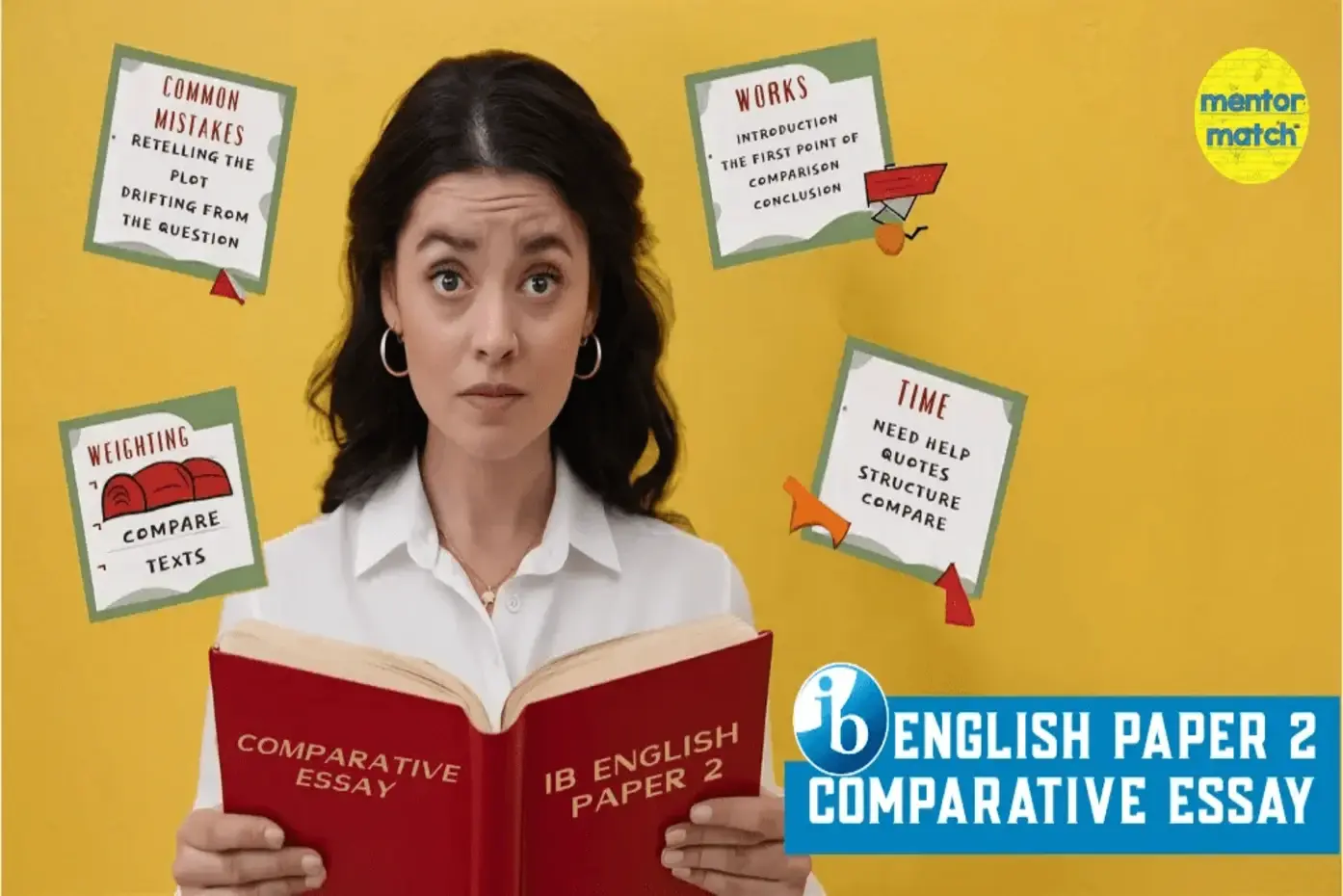
The IB English Paper 2 comparative essay asks you to answer one of four general questions by comparing two literary works you've studied.
You write it from memory, and you're marked on how well you analyse and compare, not on how much you can retell.
This guide shows you how to structure the essay and how to compare texts properly.
But first, what exactly are you walking into?
What Is the IB English Paper 2 Comparative Essay?
Paper 2 is a comparative literary essay on two works you've studied, written in response to one of four general questions. It's the same paper for SL and HL, and for both IB English Lang & Lit and Literature.
Here are the basics:
- Time: 1 hour 45 minutes
- Questions: four general questions, you answer one
- Works: two literary works by two different authors
- Weighting: 35% of your grade at SL, 25% at HL
- Texts in the exam: none, so you write from memory
Good news on that last point: you're expected to refer to the works in detail, but the IB doesn't expect quotations.
The essay is marked out of 25:
- Criterion A: Knowledge, understanding and interpretation (5)
- Criterion B: Analysis and evaluation (10), split into analysing authorial choices (5) and comparative analysis (5)
- Criterion C: Focus and organization (5)
- Criterion D: Language (5)
See that 5 marks for comparison? That's why structure matters so much, so let's build one.
How to Structure an IB English Paper 2 Essay
The strongest structure is the integrated one: each body paragraph discusses both works side by side around a single idea. It keeps the comparison running through the whole essay instead of saving it for the end.
Introduction
Answer the question in one clear thesis that names both works and the key difference or similarity between them.
Body paragraph 1: The first point of comparison
Pick one idea from the question. Show how Work A treats it, then how Work B does, and say what the difference reveals.
Body paragraph 2: The second point
Move to a new idea, ideally one that builds on the first, and compare the authorial choices each writer makes.
Body paragraph 3: The third point
Use your most interesting contrast here, so the argument gets stronger as it goes.
Conclusion
Come back to your thesis and say what the comparison shows that neither work shows alone.
You could write one work's section first, then the other's.
The risk is two mini-essays with a comparison bolted on at the end. Which raises the bigger question, what does a real comparison look like?
How to Compare Texts in IB English Paper 2
Comparing texts means explaining how two writers handle the same idea differently, or similarly, and why their choices matter.
You don't need both.
The IB says you can score highly by focusing on either similarities or differences.
Use this four-step method in every body paragraph:
- Name the shared idea from the question.
- Show Work A's choice: a specific authorial choice, such as narrative perspective, structure or setting.
- Show Work B's contrasting or matching choice.
- Explain what the comparison reveals about the idea.
A Simple Example
Imagine the question asks how writers present the cost of ambition. You've studied a novel told in first person and a play.
A basic comparison would be, “Both works show that ambition has a cost.”
That's true, but it's a similarity anyone could spot.
A stronger comparison would say that the novel's first-person narrator justifies every sacrifice as it happens, so the reader only sees the cost once he's too late to undo it.
The play has no narrator to explain things away, so the audience watches the cost pile up in front of them while the character refuses to see it. Both present ambition as self-blinding, but one traps us inside the excuse while the other makes us witnesses to it.
That last sentence is the comparison earning its marks. Getting there consistently, though, means dodging a few common traps.
Common Mistakes in the IB English Paper 2 Essay
Most lost marks in Paper 2 come from one of these four mistakes.
1. Retelling the plot
The examiner knows what happens. They want to know how the writer presents it and why.
2. Writing two separate essays
If the works only meet in the conclusion, you're leaving comparison marks on the table. Compare in every paragraph.
3. Drifting from the question
The questions are general, so it's tempting to write a prepared essay. Use the question's own words in your thesis and topic sentences.
4. Choosing works that don't fit
Some pairs suit some questions better than others. Prepare more than two works so you have options on the day.
Fix these, and you're on the way to a strong Paper 2. But what if you know all this and your essays still don't come together under time pressure?
Need Help With IB English Paper 2?
Most students don’t lose Paper 2 marks because they haven’t read enough.
They lose them in the first ten minutes, when they have to pick a question, pair two works and plan a comparison with no texts to hand.
That speed only comes from practice with someone who can see where your essays slip.
At Mentor Match, 1:1 IB English tutoring starts with a diagnostic that pinpoints where your Paper 2 essays lose marks. From there, your tutor builds timed practice around the work you’re actually taking into the exam, so the structure becomes second nature before exam day. And if Paper 1 is on your list too, our guide to IB English authorial choices covers the analysis skills both papers share.
Book a free session and find out where your marks are going.
FAQs
What is IB English Paper 2?
Paper 2 is a comparative essay in which you answer one of four general questions using two literary works you've studied. It lasts 1 hour 45 minutes and is marked out of 25.
How do you structure an IB English Paper 2 essay?
Write a thesis that answers the question and names both works, then three body paragraphs that each compare the works around one idea, and a conclusion that returns to your thesis.
Do you need quotes in IB English Paper 2?
No. You're expected to refer to the works in detail, but the IB doesn't expect quotations, since the exam is written without the texts.
Do you have to compare similarities and differences in Paper 2?
No. The IB says you can score highly by focusing on either similarities or differences.
Can I use non-literary texts in IB English Language and Literature Paper 2?
No. Paper 2 is a literary component, so both works must be literary works, written by two different authors. You also can't use a work you've already used for your oral or HL essay.