

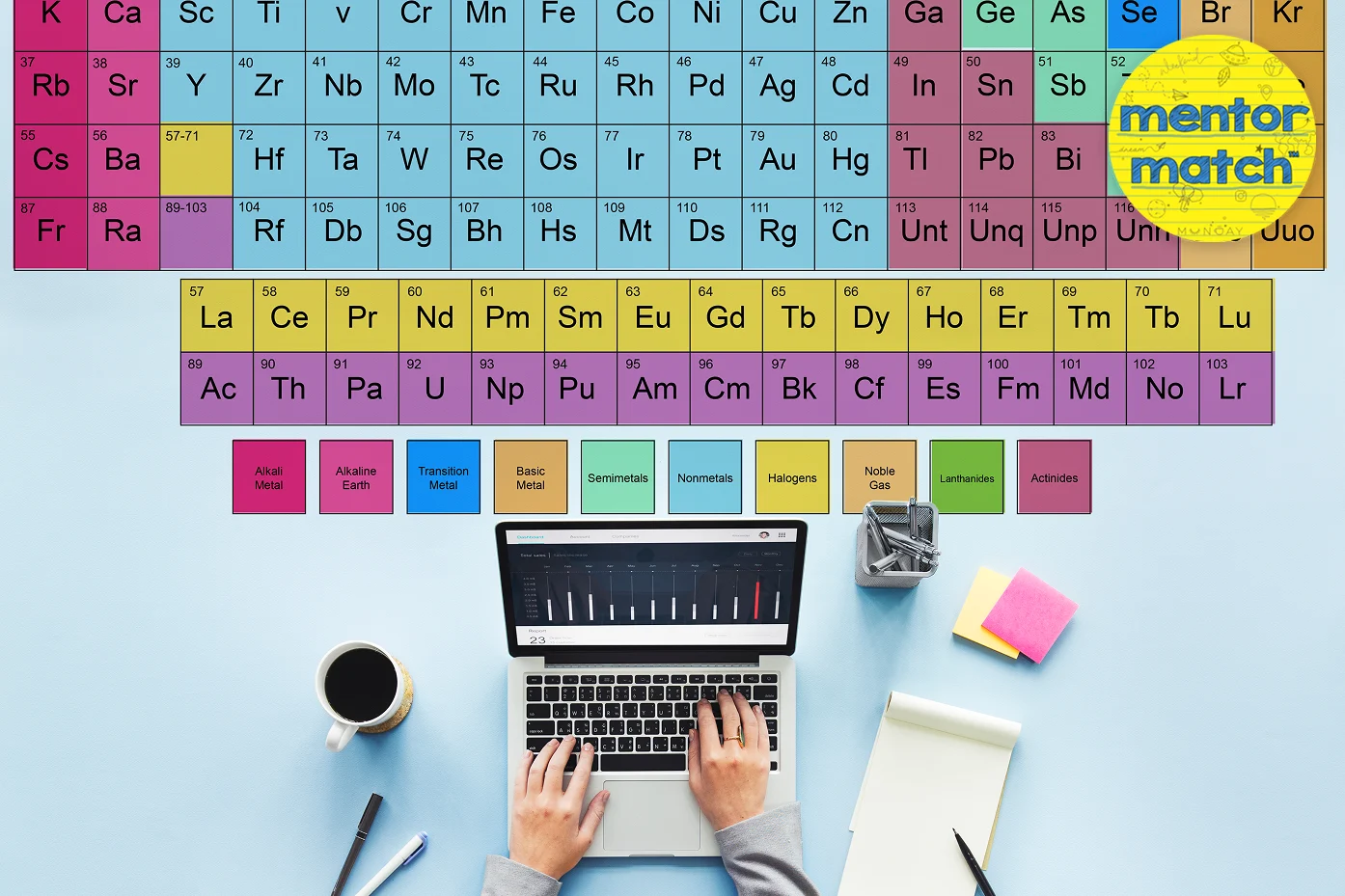

77.32% of parents see better grades in 3 months!
IGCSE Chemistry Periodic Table: A Smarter Way to Revise
The Periodic Table isn't something you need to memorise box by box.
It becomes much easier when you learn how an element's position connects to its electron arrangement and chemical behaviour.
For IGCSE Chemistry, focus on three questions:
Where is the element? → What does its electron arrangement look like? → How will it behave?
1. Start With the Element's Position
Two pieces of information can tell you a lot.
Group: gives you information about the outer electrons.
Period: tells you how many occupied electron shells the atom has.
For example, an electron arrangement of 2,8,7 points towards Group 7 and Period 3.
That immediately gives you a clue about the element's likely chemical behaviour.
The Periodic Table is therefore more than a list of elements — it is a way of predicting properties.
2. Think in Patterns, Not Individual Facts
One of the easiest ways to revise chemistry is to ask: What changes as I move through the group or period?
Elements in Group 1 share a similar outer-electron arrangement, while elements in Group 7 have a different one.
That difference affects what happens when they react.
Instead of memorising ten separate facts, learn the relationship between:
Electron arrangement → tendency to gain or lose electrons → chemical behaviour
This makes unfamiliar questions easier to approach.
3. Group 1: The Further Down, the More Reactive
Group 1 metals have one electron in their outer shell.
Moving down the group adds more electron shells around the nucleus.
The outer electron becomes increasingly removed from the nucleus and is affected by the inner electrons around it.
As a result, it becomes easier for the atom to lose that electron.
So Group 1 metals become more reactive down the group.
Exam thinking: If you're asked to compare sodium and potassium, don't just write: Potassium is more reactive. Show the reasoning behind the difference.
4. Group 7: The Trend Goes the Other Way
Group 7 elements need one more electron to complete their outer shell.
Further down the group, the incoming electron is attracted less strongly because the atom has additional shells between the nucleus and that electron.
Therefore, the ability to gain an electron decreases.
Group 7 reactivity decreases down the group.
Easy memory check:
Group 1: losing an electron becomes easier.
Group 7: gaining an electron becomes harder.
That's why their reactivity trends move in opposite directions.
5. Group 0: Look for the Full Shell
Noble gases have complete outer electron shells.
This gives them a particularly stable arrangement, so they generally have little reason to gain, lose or share electrons.
When an exam asks why a noble gas is unreactive, connect the answer to its electron arrangement, rather than simply writing “because it is stable.”
6. Use the Periodic Table to Predict Reactions
Periodic trends aren't only useful for theory questions.
They can help you predict what happens in reactions.
For example, in a halogen displacement reaction, a more reactive halogen can replace a less reactive halogen from its compound.
So before answering, ask: Which halogen is more reactive?
Then use the group trend to make your prediction.
This turns a memorisation question into a reasoning question.
7. Watch the Command Word
The same chemistry can appear in different question styles.
State — Give the required fact.
Describe — Identify what happens or what pattern you observe.
Explain — Give the scientific reason behind it.
Predict — Use a known pattern to decide what is likely to happen.
Compare — Make the relationship between two things clear.
The biggest mistake is giving a one-line fact when the question asks why.
If the command word is explain, build a logical chain instead of stopping at the result.
8. Common Periodic Table Mistakes
Mixing up groups and periods — Remember: groups run vertically; periods run horizontally.
Reversing Group 7's trend — Its reactivity decreases as you move down.
Giving the trend without the reason — An explanation needs more than “it becomes more reactive.”
Ignoring electron arrangement — Electron structure is often the key to explaining behaviour.
Making unsupported predictions — Use the pattern you already know instead of guessing.
9. A 5-Minute Revision Test
Close your notes and see if you can answer these:
1. What does the group tell you about an element?
2. What does the period tell you?
3. Why does Group 1 become more reactive down the group?
4. Why does Group 7 become less reactive?
5. Why are Group 0 elements generally unreactive?
6. How can reactivity help you predict a displacement reaction?
If you can explain each answer rather than simply recall a phrase, your understanding is much stronger.
How Mentor Match Makes Chemistry Revision More Personal
Not every student struggles with the Periodic Table in the same way.
One student may need help understanding electron arrangement.
Another may know the trends but lose marks when answering explain questions.
Someone else may understand the topic but struggle to apply it under exam conditions.
Mentor Match focuses on identifying that difference and building learning around the student's actual needs.
Through personalized learning and one-to-one tutoring, students can work on the specific concepts, question types and exam skills that need attention.
Find the gap → Personalise the plan → Prove the progress.
Final Takeaway
Don't try to memorise the Periodic Table as a collection of disconnected facts.
Learn the relationships.
Position → electron arrangement → behaviour → prediction
Once you understand that chain, Periodic Table questions become much more about reasoning and much less about remembering.
FAQs
How do I revise the Periodic Table for IGCSE Chemistry?
Focus on relationships rather than memorising isolated facts. Learn how an element's position and electron arrangement influence its properties and reactivity.
What is the difference between a group and a period?
A group is a vertical column in the Periodic Table, while a period is a horizontal row. Their positions provide information about electron arrangement.
Why does Group 1 reactivity increase down the group?
The outer electron becomes easier to remove as additional electron shells increase its distance from the nucleus and reduce the effective attraction.
Why does Group 7 reactivity decrease down the group?
As the atoms get larger, the attraction for an incoming electron becomes weaker, making electron gain less favourable.
How can the Periodic Table help with exam questions?
Its patterns allow you to predict properties, compare elements and reason through reactions instead of relying entirely on memorised answers.

.webp)
.png)
.webp)