


77.32% of parents see better grades in 3 months!
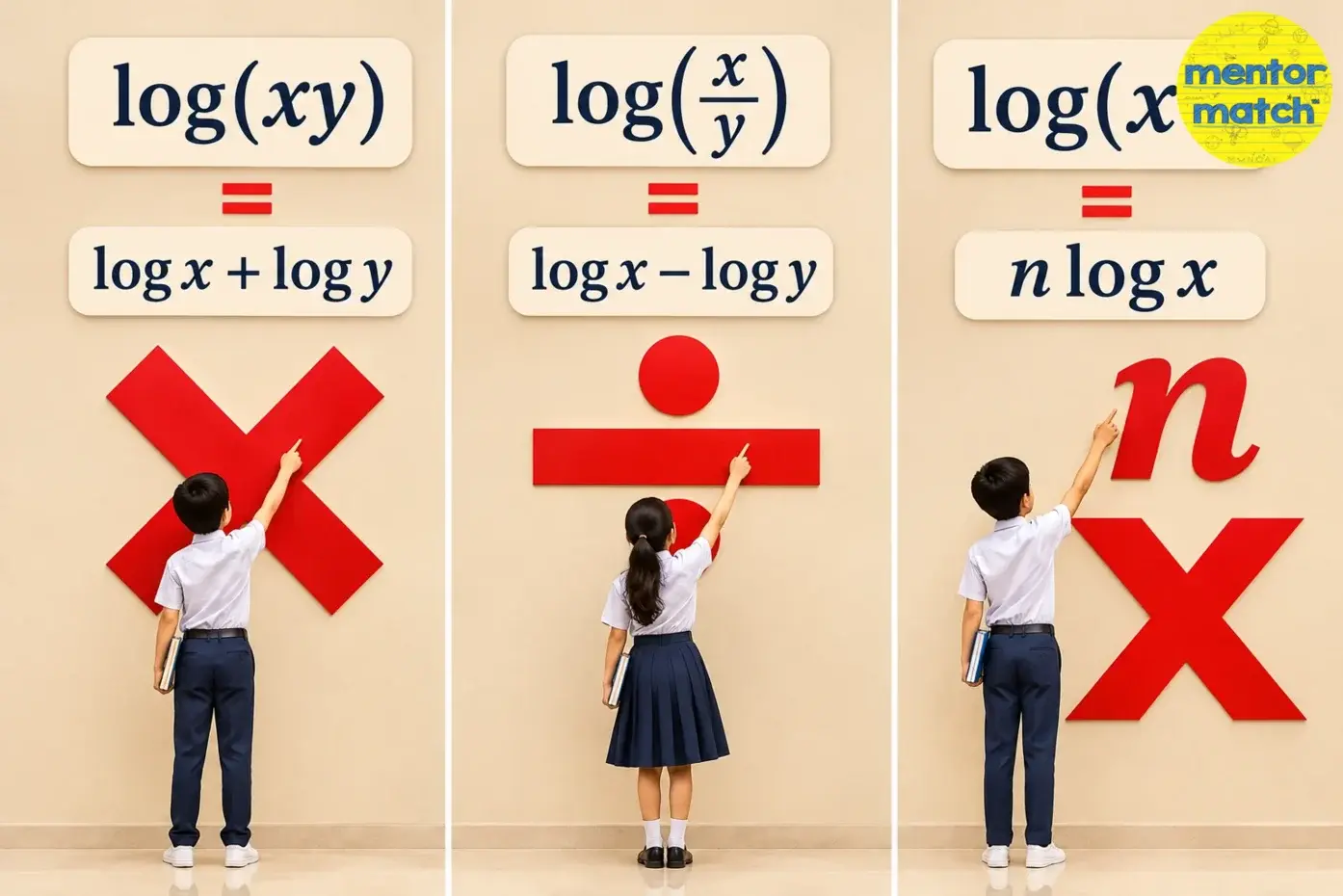
Short version: log(xy) = log x + log y, log(x/y) = log x − log y, log(xⁿ) = n log x, and to switch bases, log_b a = log a ÷ log b. Those four lines carry you through nearly every log question you'll meet.
Think of logs as a detective question. You know the starting number and where it ended up; the log tells you how many times it was multiplied by itself on the way. Ask "2 got turned into 8, so what was the power?" and the log says 3. Seen like that, the log formulas aren't new rules at all. They're the index laws you already know, read backwards.
Below you'll find each of the logarithm formulas, how to prove them from the laws of indices, worked examples, five quick practice questions and where logs show up outside the classroom.
What Are Log Formulas?
Start with what a log actually does.
A logarithm runs a power calculation in reverse: you hand it the base and the answer, and it hands you back the missing index.
Take 2³ = 8. Flip it into log language and you get log₂ 8 = 3. In words: "to get 8 from 2, use the power 3."
The two forms always swap like this:
bˣ = a ⇔ log_b a = x
- b is the base, the number being powered up
- a is the argument, the result you're aiming for
- x is the logarithm, the power that gets you there
Types of Logarithms
Two bases turn up so often that they get their own shorthand.
1. Common Logarithm
This is the base-10 log. If nobody writes a small base number, assume 10. Your calculator's LOG button does this one.
- Example: log 100 = 2, because 10² = 100
2. Natural Logarithm
This one uses e (roughly 2.71828), the number that pops up in continuous growth. You'll see it written ln and find it on the LN button.
- Example: ln e = 1, because e¹ = e
Good news: nothing changes between the two. Every law in the next section behaves identically for log and ln, provided what's inside stays above zero.
Important Logarithm Formulas
The laws of logarithms let you break apart, merge and simplify log expressions, which is exactly what equation-solving needs.
1. Logarithm of One
log_b 1 = 0
Ask "what power turns the base into 1?" The only answer is zero, whatever the base.
2. Logarithm of Its Own Base
log_b b = 1
To get from 7 to 7 you don't need to multiply by anything extra, so the index is just one. log₇ 7, log₁₀ 10 and ln e are all 1.
3. Product Formula of Logarithms
log_b (xy) = log_b x + log_b y
A × trapped inside the brackets turns into a + once you split the log open.
4. Quotient Formula of Logarithms
log_b (x/y) = log_b x − log_b y
A fraction line inside becomes a minus sign outside, always numerator first.
5. Power Formula of Logarithms
log_b (xⁿ) = n log_b x
This is the equation-solver's favourite. Any index sitting on the argument can be pulled out and parked in front.
6. Change of Base Formula
log_b a = log_c a ÷ log_c b
Handy when a question uses a base your calculator doesn't have a button for, such as base 7. Turn it into a fraction of two LOGs or two LNs and type that in.
7. Reciprocal Formula
log_b a = 1 ÷ log_a b
Flip the base and the argument and the answer flips into its reciprocal. For instance, log₃ 9 = 2 while log₉ 3 = ½.
8. Natural Logarithm Formulas
The same three laws, written with ln:
- ln(xy) = ln x + ln y
- ln(x/y) = ln x − ln y
- ln(xⁿ) = n ln x
Ground rules: keep the base above zero and never equal to 1, and keep whatever sits inside the log strictly positive.
Logarithm Formulas Derivation
Every log law is borrowed from an index law. If you can do the swap between log form and power form, you can rebuild any of these in the exam instead of relying on memory.
1. Product Formula of Logarithms
Goal: log_b (xy) = log_b x + log_b y
- Call the two logs p and q, so that bᵖ = x and bᵠ = y
- Their product is bᵖ × bᵠ, and multiplying matching bases means adding indices, giving bᵖ⁺ᵠ
- Ask the log question of xy: the power that produces it is p + q
- Swap p and q back for the original logs, and the rule drops out
2. Quotient Formula of Logarithms
Goal: log_b (x/y) = log_b x − log_b y
- Keep the same p and q, with bᵖ = x and bᵠ = y
- Dividing matching bases means taking the indices apart, so x ÷ y = bᵖ⁻ᵠ
- The log of x/y is therefore p − q, which is the first log minus the second
3. Power Formula of Logarithms
Goal: log_b (xⁿ) = n log_b x
- Write x as bᵖ
- Raise it to the power n: a power of a power multiplies the indices, so xⁿ = bⁿᵖ
- The log of xⁿ is then n × p, which is n lots of the original log
4. Change of Base Formula of Logarithms
Goal: log_b a = log_c a ÷ log_c b
- Suppose log_b a = k, which means bᵏ = a
- Now take a log in some other base c of both sides: log_c (bᵏ) = log_c a
- Use the power rule you just proved on the left: k × log_c b = log_c a
- Divide through by log_c b to isolate k
- Since k was log_b a, you have the change of base rule
Examples Using Logarithm Formulas
Here's each rule in action, step by step.
Example 1: Convert Exponential Form into Logarithmic Form
Rewrite as logarithms: (a) 2⁶ = 64 and (b) 4⁻² = 1/16.
Use the swap bˣ = a ⇔ log_b a = x.
(a) 2⁶ = 64
Base 2, power 6, result 64, so log₂ 64 = 6.
(b) 4⁻² = 1/16
Base 4, power −2, result 1/16, so log₄ (1/16) = −2.
A negative log simply means the result is a fraction smaller than 1.
Example 2: Express the Following as a Single Logarithm
Combine 3 log x + 2 log y − 4 log z into one log.
- Step 1, power rule: log x³ + log y² − log z⁴
- Step 2, product rule on the first two: log (x³y²) − log z⁴
- Step 3, quotient rule: log (x³y² / z⁴)
Tip: always do the power rule first, so every coefficient becomes a power before you merge.
Example 3: Find the Value of log₂ (1/32)
- Quotient rule: log₂ (1/32) = log₂ 1 − log₂ 32
- Log of one: = 0 − log₂ 32
- Since 32 = 2⁵, power rule: = −5 log₂ 2
- Log of its own base: = −5 × 1
- Answer: −5
Check: 2⁻⁵ = 1/32 ✓
Example 4: Simplify a Logarithmic Expression
Evaluate log₂ 8 + log₂ 4.
- Product rule: log₂ (8 × 4) = log₂ 32
- 2⁵ = 32
- Answer: 5
You can confirm it the long way too: log₂ 8 = 3 and log₂ 4 = 2, and 3 + 2 = 5.
Practice Questions on Log Formulas
Five quick ones. Cover the answer and have a go first.
Question 1: Basic Logarithm
What is log₂ 16?
- A) 2
- B) 3
- C) 4
- D) 8
Hint: How many 2s multiply together to make 16?
Answer: C) 4
Question 2: Product Formula
Simplify log₃ 9 + log₃ 27.
- A) 3
- B) 4
- C) 5
- D) 6
Hint: Merge into one log, then ask what power of 3 gives the result.
Answer: C) 5, because log₃ (9 × 27) = log₃ 243 and 3⁵ = 243. (Or: 2 + 3 = 5.)
Question 3: Quotient Formula
Evaluate log₅ 125 − log₅ 5.
- A) 1
- B) 2
- C) 3
- D) 4
Hint: Merge into log₅ 25, or work out each log separately.
Answer: B) 2
Question 4: Power Formula
Simplify 3 log₂ 4.
- A) 3
- B) 6
- C) 8
- D) 12
Hint: log₂ 4 is 2. Multiply by 3.
Answer: B) 6
Question 5: Change of Base Formula
Which of these equals log₂ 8 written with common logs?
- A) log 2 ÷ log 8
- B) log 8 ÷ log 2
- C) log 8 + log 2
- D) log 8 − log 2
Hint: The argument goes on top, the base goes underneath.
Answer: B) log 8 ÷ log 2
Real-World Applications of Logarithms
Logs earn their keep anywhere numbers range from tiny to enormous. They squash that range into something readable.
1. Measuring Earthquake Magnitude
Earthquake scales are logarithmic, so each step up means a much bigger quake. That lets seismologists describe tremors and disasters on the same short scale.
2. Measuring Sound Intensity
Decibels are logs. A small rise on the dB scale stands for a big jump in sound energy, which makes very quiet and very loud sounds comparable.
3. Calculating Population Growth
When a population grows exponentially, logs answer "how long until it reaches this size?" because they bring the unknown time down out of the power.
4. Computer Science and Algorithms
Binary search halves the list each time, so finding one item among a million takes only about 20 checks. That count is a logarithm, and it's why programmers care about log time.
5. Measuring Acidity and pH
pH is a negative log of hydrogen-ion concentration. That's why each whole step on the pH scale means ten times more, or less, acidic.
Key Takeaways: Logarithm Formulas
- A log reverses a power: it finds the missing index.
- "log" on its own is base 10; "ln" is base e.
- Times inside → plus outside. Divide inside → minus outside.
- A power inside slides out to the front as a multiplier.
- Stuck with an awkward base? Rewrite it over log or ln and let the calculator finish.
- Two values to know by heart: any log of 1 is 0, and any log of its own base is 1.
- The number inside a log must always be positive.
FAQs on Log Formulas
1. What are logarithm formulas?
They're the handful of shortcuts that let you take logs apart and stick them back together: the product, quotient and power rules, plus change of base. Every one of them is listed with its formula in the "Important Logarithm Formulas" section above.
2. How are log formulas derived?
Rewrite the log as a power, use the index law that fits (adding for products, subtracting for quotients, multiplying for powers of powers), then turn the answer back into a log. The full steps are in the derivation section above.
3. What are the applications of log formulas?
Anywhere the unknown is stuck in an exponent: compound interest, half-life, bacteria growth. Science leans on them too, for the Richter scale, decibels and pH, and computer scientists use them to describe how quickly an algorithm runs.
4. Which logarithm formula is used to change the base of a logarithm?
Change of base. Put the log of the argument over the log of the old base, both in any base you like. For example, log₂ 8 becomes log 8 ÷ log 2, which is 3.
5. What is the use of the change of base formula?
Calculators usually stop at two log buttons: LOG and LN. Need log₇ 50? Key in log 50 ÷ log 7 and you'll get roughly 2.01.
6. What are natural logarithm formulas?
Exactly the same three laws, just with ln in place of log and e as the base. So ln of a product splits into a sum, ln of a fraction splits into a difference, and a power inside an ln moves to the front. IB calculus leans on these heavily, especially when differentiating.
7. What is the difference between log and ln?
Only the base. Plain log is base 10, so log 1,000 = 3. ln is base e, so ln e² = 2. The rules for handling them are identical.
8. What is the value of log 1?
It's 0. Whatever the base, you need a power of zero to end up at 1.
9. Can the logarithm of a negative number be calculated?
No, not in school maths. Raise a positive base to any power you like and the result stays positive, so there's no index that could ever produce −5. Your calculator will show an error.
10. What is the relationship between logarithms and exponents?
They're two views of the same fact. "10² = 100" and "log 100 = 2" carry identical information; one names the result, the other names the power.
Build Stronger Mathematical Skills with MentorMatch
Knowing the log laws is one thing. Choosing the right one under exam pressure, merging logs cleanly and spotting an answer that can't be allowed is what earns the marks in IB and A Level papers.
At MentorMatch, a 1:1 online tutor works through exactly those steps with you, matched to your curriculum and your pace.
Whether you're meeting logs for the first time or solving IB Paper 1 log equations, the right guidance makes the topic click.


