
77.32% of parents see better grades in 3 months!
Prime factorization means writing a number as a product of prime numbers only. Think of it as taking a number apart to see its prime building blocks.
Take 42. You might first spot 42 = 6 × 7. The 7 is prime, but 6 is not, because 6 = 2 × 3. Break it down and you get:
42 = 2 × 3 × 7
Every factor is now prime, so that is the prime factorization of 42.
Master this and a whole chain of IGCSE topics gets easier: HCF, LCM, divisibility, square roots and simplifying fractions. (British textbooks, including Cambridge IGCSE, spell it "factorisation"; both spellings mean the same thing.)
Below we cover what prime factors are, the factor tree and division methods, worked examples and practice questions.
What Is Prime Factorization?
In short, you keep breaking a number into smaller pieces until each piece is prime.
A prime number has only two divisors, 1 and the number itself, and it must be bigger than 1. Starting from 2, the first ten are 2, 3, 5, 7, 11, 13, 17, 19, 23 and 29.
For example, look at 56:
- 56 = 7 × 8
- 8 is not prime, so split it: 8 = 2 × 2 × 2
- 56 = 2 × 2 × 2 × 7
So 56 = 2³ × 7, and every number in that product is prime.
Prime Factorization Meaning
Put simply, you crack a composite number open, keep cracking any piece that is not prime, and stop once only primes remain. Multiply those primes and you are back where you started.
Try 28:
- 28 = 4 × 7
- 4 is not prime, so 4 = 2 × 2
- 28 = 2 × 2 × 7
So the prime factorization of 28 is 2² × 7.
What Are Prime Factors?
The prime factors of a number are the distinct primes hiding inside it. Since 28 = 2 × 2 × 7, the prime factors of 28 are 2 and 7.
Don't confuse factors with prime factors:
- Factors: anything that goes into the number with no remainder.
- Prime factors: the subset of those divisors that happen to be prime.
The factors of 28 are 1, 2, 4, 7, 14 and 28, but only 2 and 7 are prime factors. Every prime factor counts as a factor, but the reverse is not true.
Prime Factorization of a Number: Quick Chart
These come up often in IGCSE questions:
- 28 = 2² × 7
- 54 = 2 × 3³
- 64 = 2⁶
- 75 = 3 × 5²
- 90 = 2 × 3² × 5
- 96 = 2⁵ × 3
- 98 = 2 × 7²
- 100 = 2² × 5²
- 126 = 2 × 3² × 7
- 144 = 2⁴ × 3²
- 210 = 2 × 3 × 5 × 7
There are two standard ways to find these: the factor tree and repeated division.
Methods of Prime Factorization
The two methods you will use most:
- The factor tree method
- The division (ladder) method
Both always give the same result, so you can use one to check the other.
1. Prime Factorization by Factor Tree Method
Picture an upside-down tree. The number sits at the top, each branch splits into two factors, and a branch stops growing the moment it reaches a prime. The primes at the tips are your answer.
Example: Prime Factorization of 924 Using a Factor Tree
Solution:
Step 1: Write 924 at the top of the tree.
Step 2: Split it into a factor pair: 924 = 4 × 231
Step 3: Keep splitting the composite branches:
- 4 = 2 × 2
- 231 = 3 × 77
- 77 = 7 × 11
Step 4: Every branch now ends in a prime (2, 2, 3, 7, 11).
So 924 = 2 × 2 × 3 × 7 × 11, and in index form:
924 = 2² × 3 × 7 × 11
If you had started with 924 = 12 × 77 instead, the tree would look different, but the primes at the ends would be identical.
2. Prime Factorization by Division Method
Here you work down a ladder: divide by the smallest prime that fits, write the result underneath, and repeat until you hit 1. The primes down the side of the ladder give the answer.
Example: Prime Factorization of 1260 Using the Division Method
Solution:
Step 1: 1260 is even, so divide by 2: 1260 ÷ 2 = 630
Step 2: Still even: 630 ÷ 2 = 315
Step 3: 315 is odd, so try 3 (its digits add to 9): 315 ÷ 3 = 105
Step 4: 105 ÷ 3 = 35
Step 5: 35 is not divisible by 3, so try 5: 35 ÷ 5 = 7
Step 6: 7 ÷ 7 = 1, so stop.
Multiply the divisors: 1260 = 2 × 2 × 3 × 3 × 5 × 7
1260 = 2² × 3² × 5 × 7
The prime factors of 1260 are 2, 3, 5 and 7.
Applications of Prime Factorization
Prime factors are behind HCF and LCM questions, divisibility checks, square and cube roots, and even online security.
1. Cryptography and Prime Factorization
Every time you pay online or send an encrypted message, maths is guarding the data.
Systems such as RSA encryption rely on a simple imbalance: multiplying two very large primes is quick, but working backwards to find those two primes from their product is extraordinarily slow, even for powerful computers. That difficulty is what keeps the data safe.
2. Finding HCF Using Prime Factorization
The HCF (Highest Common Factor, called the GCF in American books) is the biggest number that fits exactly into all the numbers you are given.
- Write each number as a product of primes.
- Pick out the primes that appear in every number.
- For each one, take the lowest power that appears.
- Multiply them.
HCF = product of the shared primes, each at its lowest power.
3. Finding LCM Using Prime Factorization
The LCM (Lowest Common Multiple) is the first number that shows up in the times tables of every number you are given.
- Write each number as a product of primes.
- List every prime that appears in any of the numbers.
- For each one, take the highest power that appears.
- Multiply them.
LCM = product of every prime involved, each at its highest power.
Example: HCF and LCM of 360 and 756
Solution:
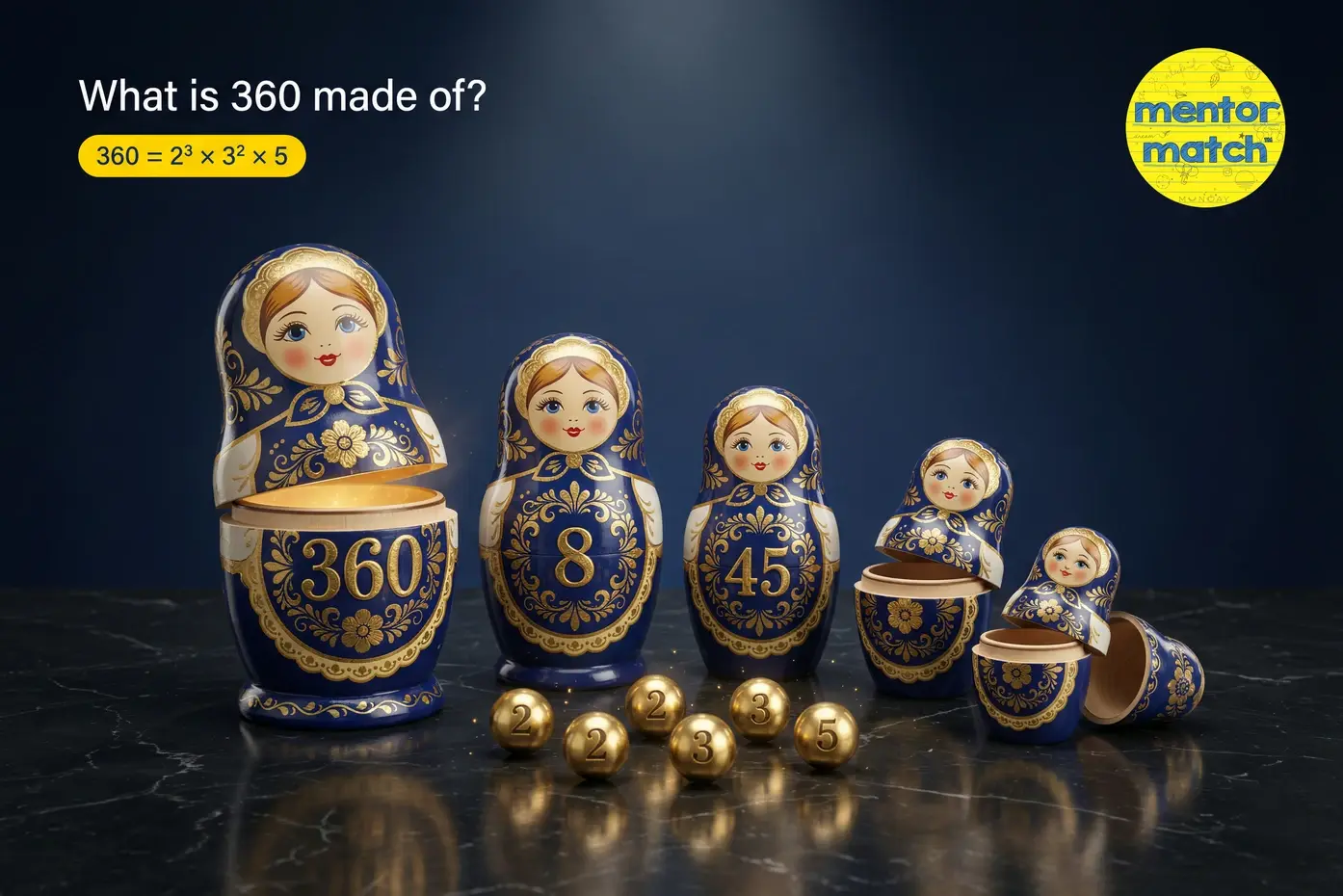
- 360 = 2³ × 3² × 5
- 756 = 2² × 3³ × 7
Step 1: HCF
The primes in both numbers are 2 and 3. Lowest powers: 2² and 3².
HCF = 2² × 3² = 4 × 9 = 36
Step 2: LCM
All primes involved: 2, 3, 5 and 7. Highest powers: 2³, 3³, 5 and 7.
LCM = 2³ × 3³ × 5 × 7 = 8 × 27 × 35 = 7560
Answer: HCF = 36, LCM = 7560.
Check: HCF × LCM = 36 × 7560 = 272 160, and 360 × 756 = 272 160. They match, as they always should for two numbers.
Solved Examples Using Prime Factorization
Example 1: Write 4620 as a Product of Prime Factors
Solution:
Divide by primes, smallest first:
- 4620 ÷ 2 = 2310
- 2310 ÷ 2 = 1155
- 1155 ÷ 3 = 385
- 385 ÷ 5 = 77
- 77 ÷ 7 = 11
- 11 ÷ 11 = 1
So 4620 = 2 × 2 × 3 × 5 × 7 × 11, which in index form is:
4620 = 2² × 3 × 5 × 7 × 11
Example 2: LCM of 54 and 90 Using Prime Factorization
Solution:
- 54 = 2 × 3³
- 90 = 2 × 3² × 5
Take every prime that appears, at its highest power: 2, 3³ and 5.
LCM = 2 × 3³ × 5 = 2 × 27 × 5 = 270
Answer: The LCM of 54 and 90 is 270. (For comparison, their HCF is 2 × 3² = 18.)
Example 3: Prime Factorization of 132 Using Both Methods
Method 1: Division
- 132 ÷ 2 = 66
- 66 ÷ 2 = 33
- 33 ÷ 3 = 11
- 11 ÷ 11 = 1
So 132 = 2 × 2 × 3 × 11 = 2² × 3 × 11
Method 2: Factor tree
- 132 = 12 × 11 (11 is prime)
- 12 = 3 × 4
- 4 = 2 × 2
So 132 = 2 × 2 × 3 × 11 = 2² × 3 × 11
Answer: Both methods give 132 = 2² × 3 × 11. However you break a number down, its prime factorization is always the same. This is known as the Fundamental Theorem of Arithmetic.
Practice Questions on Prime Factorization
Try these on your own before checking the answers.
Question 1: Use the division method to find the prime factorization of 84.
Question 2: Write 120 as a product of prime factors in index form.
Question 3: Use prime factorization to find the HCF of 36 and 60.
Question 4: Use prime factorization to find the LCM of 24 and 40.
Question 5: Draw a factor tree to find the prime factors of 150.
Question 6: Write 360 as a product of its prime factors.
Answers
- 84 = 2² × 3 × 7
- 120 = 2³ × 3 × 5
- 36 = 2² × 3² and 60 = 2² × 3 × 5, so HCF = 2² × 3 = 12
- 24 = 2³ × 3 and 40 = 2³ × 5, so LCM = 2³ × 3 × 5 = 120
- 150 = 2 × 3 × 5²
- 360 = 2³ × 3² × 5
Frequently Asked Questions on Prime Factorization
1. What is prime factorization in maths?
It means rewriting a number using only primes multiplied together. For example, 50 = 2 × 5 × 5 = 2 × 5², so the prime factors of 50 are 2 and 5.
2. How do you do prime factorization?
Use either method:
- Division: work down a ladder of prime divisions until you land on 1.
- Factor tree: branch the number into pairs and keep branching until only primes are left at the tips.
3. What are the prime factors of a number?
They are the distinct primes that appear when you break the number down. For 18 = 2 × 3 × 3, the prime factors are 2 and 3. 6 and 9 also divide 18, but they are not prime.
4. What is the prime factorization of 96, 100 and 126?
- 96 = 2⁵ × 3
- 100 = 2² × 5²
- 126 = 2 × 3² × 7
5. How do you find the LCM using prime factorization?
Put both numbers into prime form and multiply each prime at its biggest power. For 20 = 2² × 5 and 30 = 2 × 3 × 5, the LCM is 2² × 3 × 5 = 60.
6. How do you find the HCF using prime factorization?
Keep only the primes they have in common, each at its smallest power, and multiply. For 20 and 30, the shared primes are 2 and 5, so the HCF is 2 × 5 = 10.
7. Why is prime factorization important?
Once a number is in prime form, HCF, LCM, roots and simplifying fractions become almost mechanical, even with big numbers. Outside school, it sits at the heart of modern encryption.
8. What is the prime factorization of 88?
88 = 8 × 11, and 8 = 2 × 2 × 2. So 88 = 2 × 2 × 2 × 11 = 2³ × 11.
9. How is prime factorization used in real life?
It helps whenever things must be split into equal groups. For example, to arrange 36 chairs in equal rows, 36 = 2² × 3² tells you every possible row size: 1, 2, 3, 4, 6, 9, 12, 18 or 36 chairs. On a bigger scale, it is part of how online payments and messages are kept secure.
10. When should you use prime factorization?
Reach for it whenever writing out lists of factors or multiples would be slow: large HCF or LCM questions, simplifying a big fraction, or testing for a perfect square.
11. How do you find the prime factors of a number?
Repeated division is the most reliable way. For 66: 66 ÷ 2 = 33, 33 ÷ 3 = 11, 11 ÷ 11 = 1. So 66 = 2 × 3 × 11, and its prime factors are 2, 3 and 11.
12. What is the definition of prime factorization?
Formally, it is the one and only way to express a composite number as a product of primes. For example, 44 = 4 × 11 = 2 × 2 × 11, so the prime factorization of 44 is 2² × 11.
Book Your Free Demo Class with MentorMatch
Prime factors are the first step in many IGCSE questions on HCF, LCM, roots and indices. A MentorMatch tutor works through exam-style number questions with you, one-on-one, so you pick up the easy marks and build the confidence to tackle the harder parts.
- Explore IGCSE Maths tutoring
- Find IGCSE Maths tutors in Dubai