


77.32% of parents see better grades in 3 months!
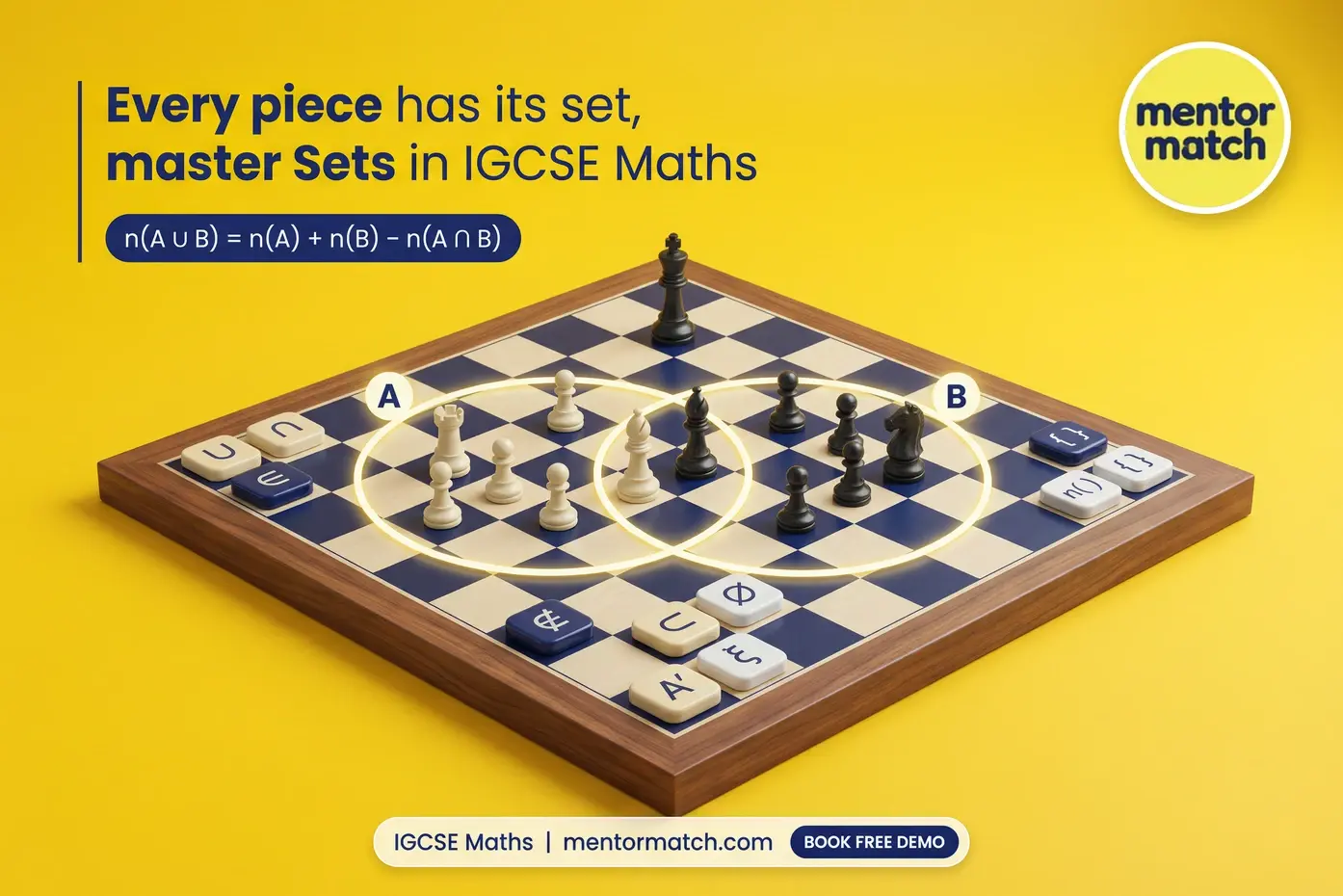
Short answer: the sets formula you'll use most is n(A ∪ B) = n(A) + n(B) − n(A ∩ B). Add the two groups, then take away the overlap once, because those people were counted twice.
A set is just a clearly defined collection of different things, its elements: the even numbers under 10, the students in your class who play football, the vowels in "Dubai". Set theory gives you a tidy way to sort those collections, see where they overlap and count them without double-counting.
The sets formulas below handle union, intersection, complement and difference. They sit underneath probability, statistics and logic, and Venn diagrams make every one of them easy to picture. This guide walks through the notation, each formula and law, six solved examples, practice questions and where sets show up in real life.
What Are the Sets Formulas?
They're rules for counting elements and describing how groups relate to each other. Before the formulas, here's the shorthand you'll see throughout.
Important Set Notations and Symbols
- A, B, C: names for individual sets
- U: the universal set, everything under discussion
- ∅: the empty set, with nothing in it
- n(A): how many elements A contains
- A ∪ B: union, everything in A, in B, or in both
- A ∩ B: intersection, only what A and B share
- A′ or Aᶜ: complement, everything in U that isn't in A
- A − B: difference, what's in A but not in B
- A × B: Cartesian product, every pairing of one element from A with one from B
- A Δ B: symmetric difference, what's in exactly one of the two sets
Important Formulas for Two Sets
For two finite sets A and B, these three handle almost every counting question.
1. Union of two overlapping sets
n(A ∪ B) = n(A) + n(B) − n(A ∩ B)
Anyone in both groups gets counted once in n(A) and again in n(B). Taking away n(A ∩ B) fixes that double count.
2. Union of two disjoint sets
When A and B share nothing at all:
n(A ∪ B) = n(A) + n(B)
3. Intersection of two sets
Rearrange the first formula to find the overlap:
n(A ∩ B) = n(A) + n(B) − n(A ∪ B)
Important Formula for Three Sets
For three finite sets A, B and C:
n(A ∪ B ∪ C) = n(A) + n(B) + n(C) − n(A ∩ B) − n(A ∩ C) − n(B ∩ C) + n(A ∩ B ∩ C)
This is the inclusion–exclusion principle. Think of it as three steps: add every set, remove each pairwise overlap, then put the centre back, because the elements in all three got removed one time too many.
Sets Formulas Based on Properties of Sets
These laws let you rearrange and simplify set expressions, much like algebra rules let you rearrange equations.
1. Commutative Property
Order doesn't matter.
- A ∪ B = B ∪ A
- A ∩ B = B ∩ A
2. Associative Property
Grouping doesn't matter when you're using the same operation throughout.
- A ∪ (B ∪ C) = (A ∪ B) ∪ C
- A ∩ (B ∩ C) = (A ∩ B) ∩ C
3. Distributive Property
This is how union and intersection interact, a bit like expanding brackets.
- Intersection over union: A ∩ (B ∪ C) = (A ∩ B) ∪ (A ∩ C)
- Union over intersection: A ∪ (B ∩ C) = (A ∪ B) ∩ (A ∪ C)
4. Idempotent Law
Combining a set with itself changes nothing.
- A ∪ A = A
- A ∩ A = A
5. Identity and Domination Laws
How a set behaves next to the empty set or the universal set.
Identity laws:
- A ∪ ∅ = A
- A ∩ U = A
Domination laws:
- A ∪ U = U
- A ∩ ∅ = ∅
Sets Formulas of Complement Sets
The complement of A, written A′ or Aᶜ, is everything in the universal set that's left over once you remove A.
For instance, with U = {1, 2, 3, 4, 5, 6} and A = {1, 2, 3}, the leftovers are A′ = {4, 5, 6}.
1. Complement Law
- A ∪ A′ = U (a set and its complement together fill everything)
- A ∩ A′ = ∅ (they never overlap)
- A′ = U − A
2. De Morgan's Laws
These two flip a complement across a bracket, swapping ∪ and ∩ as they go.
- First law: (A ∪ B)′ = A′ ∩ B′. "Not in either" means "outside A and outside B".
- Second law: (A ∩ B)′ = A′ ∪ B′. "Not in both" means "outside A or outside B".
3. Double Complement Law
Take the complement twice and you're back where you started: (A′)′ = A.
4. Complement of Empty and Universal Sets
- ∅′ = U
- U′ = ∅
These turn up often in probability, where "not A" is the complement of event A.
Sets Formulas of Difference of Sets
A − B keeps the elements of A after you've removed anything that's also in B.
Take A = {1, 2, 3, 4} and B = {3, 4, 5, 6}:
- A − B = {1, 2}
- B − A = {5, 6}
Notice the order matters here: A − B and B − A are usually different.
Important Difference of Sets Formulas
- A set minus itself: A − A = ∅
- Using complements: A − B = A ∩ B′, and likewise B − A = B ∩ A′
- Disjoint sets: if A ∩ B = ∅, then A − B = A
- With a third set: (A − B) ∩ C = (A ∩ C) − (B ∩ C)
- Symmetric difference: A Δ B = (A − B) ∪ (B − A), the elements in one set or the other but not both
Important Formulas for the Number of Elements
- n(A − B) = n(A) − n(A ∩ B)
- n(B − A) = n(B) − n(A ∩ B)
- n(A − B) = n(A ∪ B) − n(B)
- n(A′) = n(U) − n(A)
The union splits neatly into three non-overlapping pieces, which is exactly what the three regions of a two-set Venn diagram show:
n(A ∪ B) = n(A − B) + n(B − A) + n(A ∩ B)
Other Important Sets Formulas
1. Formula for the Universal Set
Everything in U is either inside A ∪ B or outside it:
- n(U) = n(A ∪ B) + n((A ∪ B)′)
- Expanding the union: n(U) = n(A) + n(B) − n(A ∩ B) + n((A ∪ B)′)
2. Formula for the Complement of a Union
The "neither" region of a Venn diagram:
n((A ∪ B)′) = n(U) − n(A) − n(B) + n(A ∩ B)
3. Cartesian Product Formula on Sets
A × B lists every ordered pair you can make by taking one element from A and one from B:
- A × B = {(a, b) | a ∈ A and b ∈ B}
With A = {1, 2} and B = {x, y}: A × B = {(1, x), (1, y), (2, x), (2, y)}.
For finite sets, the count is simply n(A × B) = n(A) × n(B). Here that's 2 × 2 = 4.
Solved Examples Using Sets Formulas
Here's how the formulas work on real questions.
Example 1: Finding the Union of Two Sets
In a sports club, 14 members play chess, 9 play badminton and 5 play both. How many play at least one of the two?
- Let C = chess players and B = badminton players
- Given: n(C) = 14, n(B) = 9, n(C ∩ B) = 5
- Formula: n(C ∪ B) = n(C) + n(B) − n(C ∩ B)
- Working: 14 + 9 − 5 = 18
- Answer: 18 members play chess, badminton or both.
Example 2: Finding Students Who Like Only One Activity
A class has 64 students. 40 play football and 37 play basketball, and every student plays at least one. Find (a) how many play both and (b) how many play only football.
- Let F = football and K = basketball
- Every student plays something, so n(F ∪ K) = 64
- (a) 64 = 40 + 37 − n(F ∩ K), so n(F ∩ K) = 77 − 64 = 13
- (b) Only football = n(F) − n(F ∩ K) = 40 − 13 = 27
- Answer: 13 play both; 27 play only football.
Example 3: Finding Students Who Like Neither Activity
A year group has 120 students. 48 take art, 55 take music and 17 take both. How many take at least one, and how many take neither?
- Art or music: n(A ∪ M) = 48 + 55 − 17 = 86
- Neither: 120 − 86 = 34
- Answer: 86 take art, music or both; 34 take neither.
Example 4: Finding the Complement of a Set
The universal set has 64 elements and set A has 23. How many elements are in A′?
- Formula: n(A′) = n(U) − n(A)
- Working: 64 − 23
- Answer: 41 elements.
Example 5: Finding the Difference Between Two Sets
A = {2, 4, 6, 8, 10} and B = {4, 8, 12}. Find A − B and B − A.
- A − B keeps what's in A but not B: {2, 6, 10}
- B − A keeps what's in B but not A: {12}
Example 6: Three Sets (IGCSE Extended)
In a group of 50 students, 28 study French, 22 study Spanish and 18 study Arabic. 8 study French and Spanish, 7 study French and Arabic, 6 study Spanish and Arabic, and 3 study all three. How many study none of these languages?
- Inclusion–exclusion: 28 + 22 + 18 − 8 − 7 − 6 + 3 = 50
- So 50 students study at least one language
- Answer: 50 − 50 = 0. Every student studies at least one of them.
Tip: in a three-set Venn diagram, fill in the centre (all three) first, then the pairwise regions, then each "only" region. Working from the inside out stops you double-counting.
Practice Questions on Sets Formulas
Try these before checking the answers.
Question 1: In a class of 60 students, 35 like maths, 30 like science and 15 like both. How many like at least one subject?
Question 2: If n(U) = 80 and n(A) = 35, find n(A′).
Question 3: If A = {1, 2, 3, 4, 5} and B = {3, 4, 5, 6}, find A − B.
Question 4: If n(A) = 25, n(B) = 30 and n(A ∪ B) = 45, find n(A ∩ B).
Question 5: If A = {a, b} and B = {1, 2, 3}, write out A × B.
Practice Questions: Answers
- 35 + 30 − 15 = 50 students
- 80 − 35 = 45 elements
- {1, 2}
- 25 + 30 − 45 = 10 elements
- {(a, 1), (a, 2), (a, 3), (b, 1), (b, 2), (b, 3)}
Applications of Sets Formulas
Sets aren't only a chapter in a maths book. They're how people sort and count overlapping groups everywhere.
1. Statistics
Survey results are full of overlapping groups: people who own a car, people who cycle, people who do both. Sets keep the counts honest.
2. Probability
The probability version of the union formula is the same idea with chances instead of counts:
- P(A ∪ B) = P(A) + P(B) − P(A ∩ B)
3. Geometry
Shapes and regions can be described as sets of points, and their overlaps as intersections.
4. Mathematical Logic
Union, intersection and complement match the logical words "or", "and" and "not". That's the basis of Boolean algebra and every computer circuit.
5. Data Classification
Spreadsheet filters and database searches are set operations in disguise. A school could, for example, list students in both the swimming team and the debate club with one intersection.
Frequently Asked Questions on Sets Formulas
1. What Is the Formula of Sets?
The one you'll use most is n(A ∪ B) = n(A) + n(B) − n(A ∩ B). It counts everything in two overlapping groups without counting the shared part twice.
2. What Is the Formula for the Intersection of Sets?
n(A ∩ B) = n(A) + n(B) − n(A ∪ B). It gives the size of the overlap, the part both sets have in common.
3. What Are the Applications of Sets Formulas?
They're used in probability, statistics, logic, computer science and anywhere data needs sorting into overlapping groups.
4. What Is the Cartesian Product Formula on Sets?
A × B is every ordered pair (a, b) with a from A and b from B. Its size is n(A) × n(B).
5. What Are the Set Formulas for the Complement of a Set?
A set and its complement fill the universal set and never overlap: A ∪ A′ = U and A ∩ A′ = ∅. De Morgan's laws, (A ∪ B)′ = A′ ∩ B′ and (A ∩ B)′ = A′ ∪ B′, and the double complement (A′)′ = A complete the set.
6. What Are the Set Formulas for the Difference of Sets?
A − B = A ∩ B′, with n(A − B) = n(A) − n(A ∩ B). The symmetric difference A Δ B joins the two one-sided differences.
7. What Is the Inclusion-Exclusion Formula for Three Sets?
Add all three sets, subtract the three pairwise overlaps, then add back the part in all three: n(A ∪ B ∪ C) = n(A) + n(B) + n(C) − n(A ∩ B) − n(A ∩ C) − n(B ∩ C) + n(A ∩ B ∩ C).
8. What Is the Difference Between Union and Intersection of Sets?
Union (∪) gathers everything from either set. Intersection (∩) keeps only what the sets share. In everyday words, union is "or" and intersection is "and".
9. What Are De Morgan's Laws in Set Theory?
They show how a complement passes through a bracket: (A ∪ B)′ = A′ ∩ B′ and (A ∩ B)′ = A′ ∪ B′. The union and intersection swap places.
10. What Is a Venn Diagram in Set Theory?
A picture of sets as overlapping circles inside a rectangle (the universal set). Each region shows one part, such as "A only", "both" or "neither", which makes union, intersection, complement and difference easy to see.
Strengthen Your Mathematical Understanding with MentorMatch
Sets formulas click once you see why each one works, not just what it says. That's what turns a tricky three-set Venn question into a calm, step-by-step one.
At MentorMatch, students get personalised 1:1 online maths tutoring with tutors who explain each idea step by step, work through exam-style problems and build the confidence to solve them independently.
Whether it's set theory, probability, algebra or anything else in maths, focused guidance builds a stronger foundation.


