


77.32% of parents see better grades in 3 months!
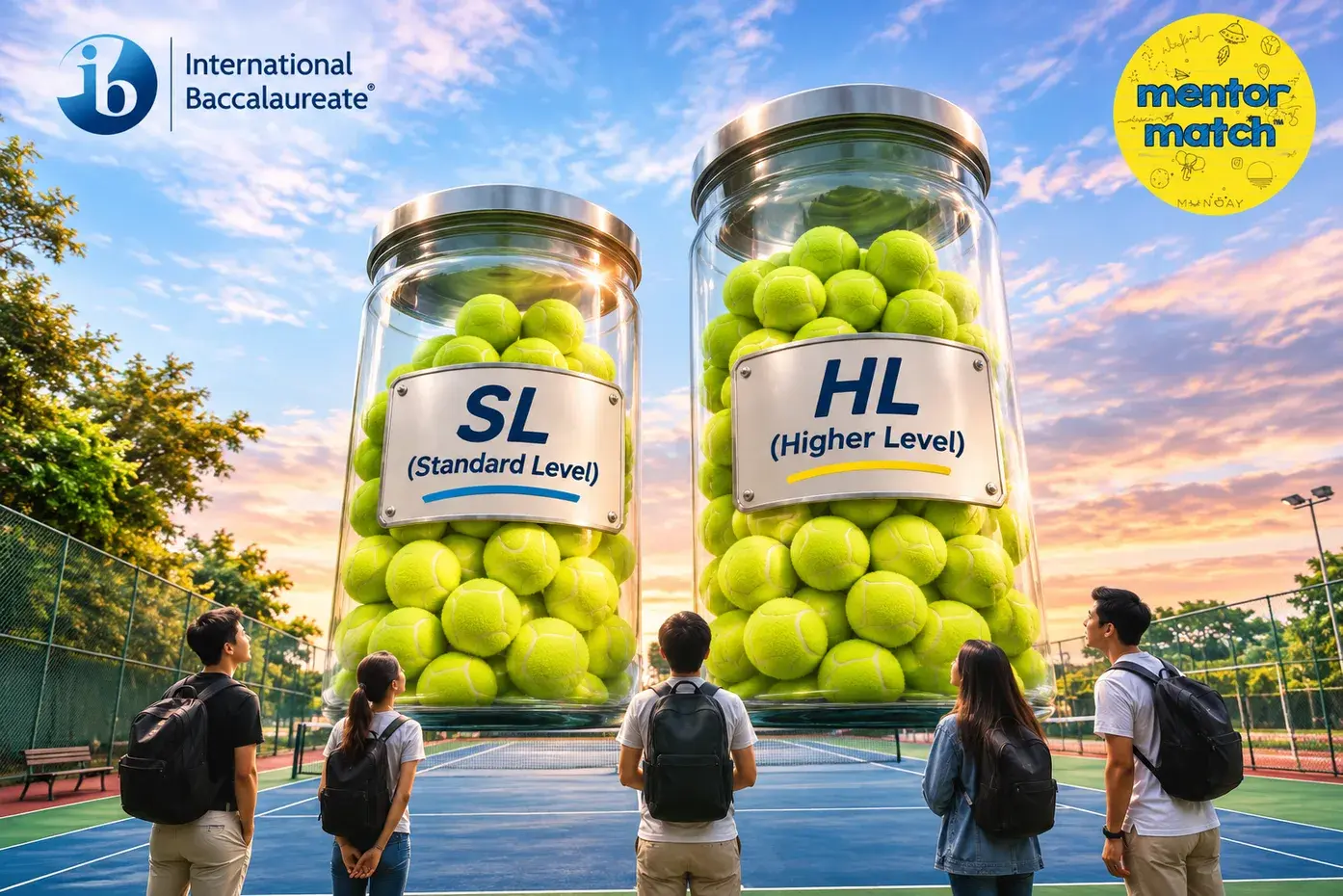
SL stands for Standard Level. That part takes five seconds to learn.
The part that takes longer is understanding what SL actually does to your IB Diploma. Many students treat their SL subjects as the lighter half of their timetable, put most of their effort into HL subjects, and then watch a 6 drop to a 4 in an SL paper they assumed would be fine. Those are some of the most avoidable points in the Diploma.
This guide explains what SL means in IB, how it differs from HL, how many SL subjects you take, and how to choose and revise them so they strengthen your final score instead of quietly dragging it down.
SL in 30 Seconds
Before you pick subjects or plan your revision, keep these five points in mind:
- SL = Standard Level: One of the two subject levels in the IB Diploma Programme. The other is Higher Level (HL).
- About 150 teaching hours: Recommended for each SL subject, compared with about 240 hours for HL.
- The same 1–7 grade scale: A 7 in SL is worth exactly as much as a 7 in HL.
- Less content, not less seriousness: SL covers fewer topics, but its assessments still test real understanding.
- Most students take 3 SL + 3 HL: Some take 2 SL + 4 HL.
SL vs HL: What Actually Changes?
The official difference is 150 recommended teaching hours versus 240. The difference students feel is how far each topic goes.
In SL, you learn the core ideas of a subject and practise applying them accurately. In HL, you study the core content in greater depth and cover additional material, more demanding applications and, depending on the subject, more complex questions.
A few examples:
- Mathematics (AA or AI): HL includes additional content and more demanding problem-solving beyond the SL course.
- Physics: HL explores a broader and deeper range of concepts.
- Economics: HL expects a deeper understanding of economic theory and its application to real-world situations.
The exact difference varies by subject, so always check the relevant IB subject guide before making your choices.
Read next: [IB Maths AA Important Questions and Answers – insert the published article URL]
Exams Feel Different Too
Both SL and HL students complete formal assessments. These can include written examinations and internal assessments, depending on the subject.
The assessment structure is subject-specific. HL may include additional content, different assessment requirements or longer examination components. SL assessments are generally designed around the narrower course content.
That changes how you should revise:
- SL rewards consistency: Strong fundamentals, accurate methods and regular practice.
- HL rewards fundamentals plus depth: The same strong foundation, combined with more extensive content and more demanding applications.
Do not assume that every SL paper follows the same format or duration. Check the assessment details for your chosen subject.
"Less Work" Is the Trap
Fewer recommended teaching hours do not guarantee an easy grade.
You still need to understand concepts, complete assignments and practise exam questions. A student who finds Mathematics challenging will still need regular practice to perform well in Mathematics SL.
The difference between a strong SL grade and a disappointing one often comes down to small, repeated mistakes:
- Misunderstanding a key definition.
- Skipping steps in a calculation.
- Misreading the command term in a question.
- Giving an incomplete explanation.
- Losing marks because of poor time management.
These are fixable problems, but only when you identify them early.
Infographic brief: Two side-by-side columns using Mentor Match brand colours.
SL: Approximately 150 recommended hours, core course content, subject-specific assessments.
HL: Approximately 240 recommended hours, core content plus additional depth and extensions, subject-specific assessments.
Across the bottom: Both graded from 1–7.
Alt text: IB SL vs HL comparison showing recommended teaching hours, content depth and grading.
How Many SL Subjects Do You Take?
The full IB Diploma Programme includes six subjects. The standard subject-level structure is:
- At least 3 subjects at HL.
- No more than 4 subjects at HL.
- The remaining subjects at SL.
This means students normally take either three or two SL subjects.
Taking all six subjects at HL is not part of the standard IB Diploma subject-level structure.
The Two Common Setups
1. 3 HL + 3 SL – The Balanced Default
- English A: Language and Literature – HL
- Economics – HL
- Mathematics: Analysis and Approaches – HL
- Biology – SL
- Spanish B – SL
- Visual Arts – SL
2. 4 HL + 2 SL – A Heavier Combination
- English A: Language and Literature – HL
- Mathematics: Analysis and Approaches – HL
- Physics – HL
- Chemistry – HL
- Economics – SL
- French B – SL
These are illustrative combinations only. Your available options depend on what your school offers and the IB Diploma requirements.
For many students, a 3 HL + 3 SL combination leaves more room to manage Theory of Knowledge (TOK), the Extended Essay (EE) and Creativity, Activity, Service (CAS).
Choose four HL subjects only when they are appropriate for your academic plans and you can realistically manage the additional workload.
Why SL Matters More Than You Think
Here is a situation many IB students recognise.
HL revision is intense throughout the year. SL gets whatever time is left over. Then mock examinations arrive, and two SL grades drop by a point each.
Nothing dramatic appears to have happened, but the final total is suddenly two points short of the university offer.
The scoring system explains why this matters.
Every IB Diploma subject is graded from 1 to 7, whether it is SL or HL:
- Six subjects × 7 points = up to 42 points.
- TOK and the Extended Essay can contribute up to 3 additional core points.
- Maximum IB Diploma score = 45 points.
HL subjects do not automatically earn extra points. A 5 in SL Chemistry contributes the same subject points as a 5 in HL Mathematics.
A Worked Example
Imagine a student receives these grades:
- English A HL: 6
- Economics HL: 6
- Mathematics HL: 5
- Biology SL: 6
- Chemistry SL: 5
- French B SL: 6
Subject total: 34 points
Add 2 core points from TOK and the Extended Essay:
<text>Final Diploma score: 36/45</text>
Now imagine the student improves just two SL grades by one point each:
- Chemistry: 5 → 6
- Biology: 6 → 7
The subject total increases from 34 to 36.
With the same 2 core points, the final Diploma score becomes:
<text>New Diploma score: 38/45</text>
That is a two-point improvement without changing a single HL grade.
For parents, this is an important point. If your child is a few points short of a target, such as moving from the low 30s towards 36+, reviewing their SL performance may reveal opportunities to improve.
The solution may not be another round of last-minute studying. It may be consistent practice and correcting the small mistakes that repeatedly cost marks.
Short of your target score? Book a free IB trial class with Mentor Match and identify the topics that need attention.
Graphic brief: Six vertical subject bars representing three HL and three SL subjects, plus a smaller core-points bar, adding up to 36/45. Highlight two SL bars in yellow as they rise by one point each, with the total updating to 38/45.
Alt text: How improving two IB SL grades raises the Diploma score from 36 to 38.
How to Choose Your SL Subjects
The best SL choices are not about avoiding effort. They are about building a weekly study routine you can realistically sustain for two years.
1. Start With Your University Plans
Universities may have specific HL subject and grade requirements for particular degrees. Check these before finalising your subject combination.
For example:
- Engineering: Often requires Mathematics and Physics at HL, depending on the university.
- Medicine: May require specific science subjects at HL, depending on the country and university.
- Economics: May require Mathematics at a particular level, alongside relevant subject preparation.
- Humanities: May value subjects involving writing, research and analytical skills.
Whatever remains can help shape your SL combination. Always check the exact entry requirements of the courses you are considering.
2. Pick SL Subjects You Can Score in Reliably
Variety is good. Neglecting a subject is expensive.
Ask yourself:
- Which subjects do I enjoy enough to revise every week?
- Where do I already perform well?
- Which subjects take the most time to understand?
- Which topics do I repeatedly struggle with?
An SL subject you enjoy and prepare for consistently can be more valuable than a subject you choose because it appears easy but then neglect.
3. Balance Your Hardest HL Subjects
If your HL combination is demanding, use your SL choices to keep your overall workload realistic.
For example, a student taking several demanding STEM subjects at HL may need to think carefully about the workload of their remaining subjects.
Remember that TOK, the Extended Essay and CAS also require time and attention. Your timetable should account for all of them.
Quick Map: The Six IB Subject Groups
Students normally choose one subject from each of the six groups. Group 6 may be replaced by an additional subject from another eligible group, subject to IB requirements and school availability.
1. Studies in Language and Literature
- Language A: Literature
- Language A: Language and Literature
2. Language Acquisition
- Language B
- Language ab initio
- Classical languages
3. Individuals and Societies
- Economics
- Business Management
- Psychology
- History
- Geography
- Global Politics
- Digital Society
4. Sciences
- Biology
- Chemistry
- Physics
- Computer Science
- Design Technology
- Environmental Systems and Societies (ESS)
5. Mathematics
- Mathematics: Analysis and Approaches (AA)
- Mathematics: Applications and Interpretation (AI)
Both Mathematics courses are available at SL and HL, subject to school offerings.
6. The Arts
- Visual Arts
- Music
- Theatre
- Film
- Dance
For more guidance, see the IB Diploma Programme curriculum and explore 1:1 IB tutoring at Mentor Match.
A Simple SL Revision Rhythm You Can Keep
Forget the 12-hour cram days.
Strong SL grades come from a short loop repeated every week: learn it, test it, fix it, repeat.
Get Clear – 2 Sessions a Week
- Pick one small topic from class and review your notes.
- Write down the one thing you still do not understand.
- Ask your teacher or tutor to explain it until it makes sense.
- Turn important definitions and command terms into a few flashcards.
Get Exam-Accurate – 3 Sessions a Week
- Complete a short set of past-paper-style questions on that topic.
- Mark your answers against the relevant mark scheme.
- For every mistake, write one rule: "Next time, I will…"
- Revisit questions where you lost marks because of incomplete explanations or incorrect methods.
Get Exam-Ready – 1 Session a Week
- Complete one timed section of a paper.
- Look for patterns in the marks you lose: definitions, units, calculations or misread questions.
- Review your Internal Assessment progress so that work does not pile up.
Each session can last around 30–45 minutes, depending on your workload.
Short and steady beats long and rare. If you study for hours but forget everything by the test, this approach helps because it makes you practise, check and correct rather than simply reread.
Image brief: A realistic photograph of an IB student working through a past paper with a tutor on a laptop video call. Notebook open, highlighted mistakes visible, natural lighting and a premium online-learning environment.
Alt text: IB student revising SL past-paper questions with an online tutor.
The Bottom Line: Treat SL as Your Score's Safety Net
SL means Standard Level. Strategically, it can mean something bigger: a stable foundation beneath your HL ambitions.
When HL papers become challenging, strong SL grades help keep your overall Diploma score on track.
Treat your SL subjects seriously, revise them in small and regular sessions, and identify the mistakes that are costing you marks.
The aim is not simply to pass your SL subjects. It is to make every subject contribute to the score you are working towards.
Need Help With IB SL or HL Subjects?
At Mentor Match, IB students receive personalised 1:1 online tutoring with curriculum-trained tutors, matched to their subjects, level and learning needs.
Here's how Mentor Match supports IB students:
- Same tutor from the beginning: Your child continues with the same tutor from the free trial onwards.
- Aligned with the IB syllabus: Sessions follow your school's requirements, whether the student is taking SL or HL, Mathematics AA or AI.
- A diagnostic-first approach: Identify the concepts and question types where your child is losing marks.
- Personalised learning: Sessions focus on the student's subject, current level and academic goals.
- Progress updates for parents: Understand what is improving and where additional support is needed.
Whether your child wants to improve an SL grade from 5 to 6 or build confidence in a challenging HL subject, personalised academic support can help make preparation more focused.
Start With a Free IB Trial Class
Meet an IB tutor, discuss your child's subjects and identify the areas that need attention.
Explore more:
Frequently Asked Questions About SL in IB
1. What does SL stand for in IB?
SL stands for Standard Level. It is one of the two subject levels in the IB Diploma Programme, alongside Higher Level (HL).
2. Is SL easier than HL in IB?
SL has fewer recommended teaching hours, approximately 150 compared with 240 for HL, and generally covers less content. However, it is not automatically easy. Difficulty depends on the subject, your strengths and how consistently you revise.
3. How many SL subjects do you take in IB?
Students take six subjects, with three or four at HL and the remaining subjects at SL. This means students normally take either two or three SL subjects. The most common combination is three SL and three HL subjects.
4. How many teaching hours does an IB SL subject have?
The IB recommends approximately 150 teaching hours per SL subject, compared with approximately 240 hours for an HL subject.
5. Do SL subjects count towards the final IB score?
Yes. Every subject is graded from 1 to 7, whether it is SL or HL. Both levels contribute equally to the six-subject total, which can reach 42 points.
6. Can I get a 7 in an IB SL subject?
Yes. SL uses the same 1–7 grading scale as HL. A grade of 7 is the highest grade at both levels.
7. Can I take all six subjects at HL?
No. The standard IB Diploma Programme subject structure allows a maximum of four HL subjects, with the remaining subjects taken at SL.
8. Can I switch a subject from SL to HL?
It depends on your school's policy, timing, course availability and the relevant IB requirements. Speak to your IB Diploma Programme coordinator before making a change.
9. Do universities accept IB SL subjects?
Yes. Universities recognise SL subjects, but some degree programmes require specific subjects at HL or set minimum grades. Always check the entry requirements of your chosen university and course.
10. Is Maths SL enough for university?
For many university courses, Mathematics SL may be sufficient. However, courses such as engineering, physics and some economics programmes may require Mathematics HL or a particular course, such as AA. Check the exact requirements before choosing.


