


77.32% of parents see better grades in 3 months!
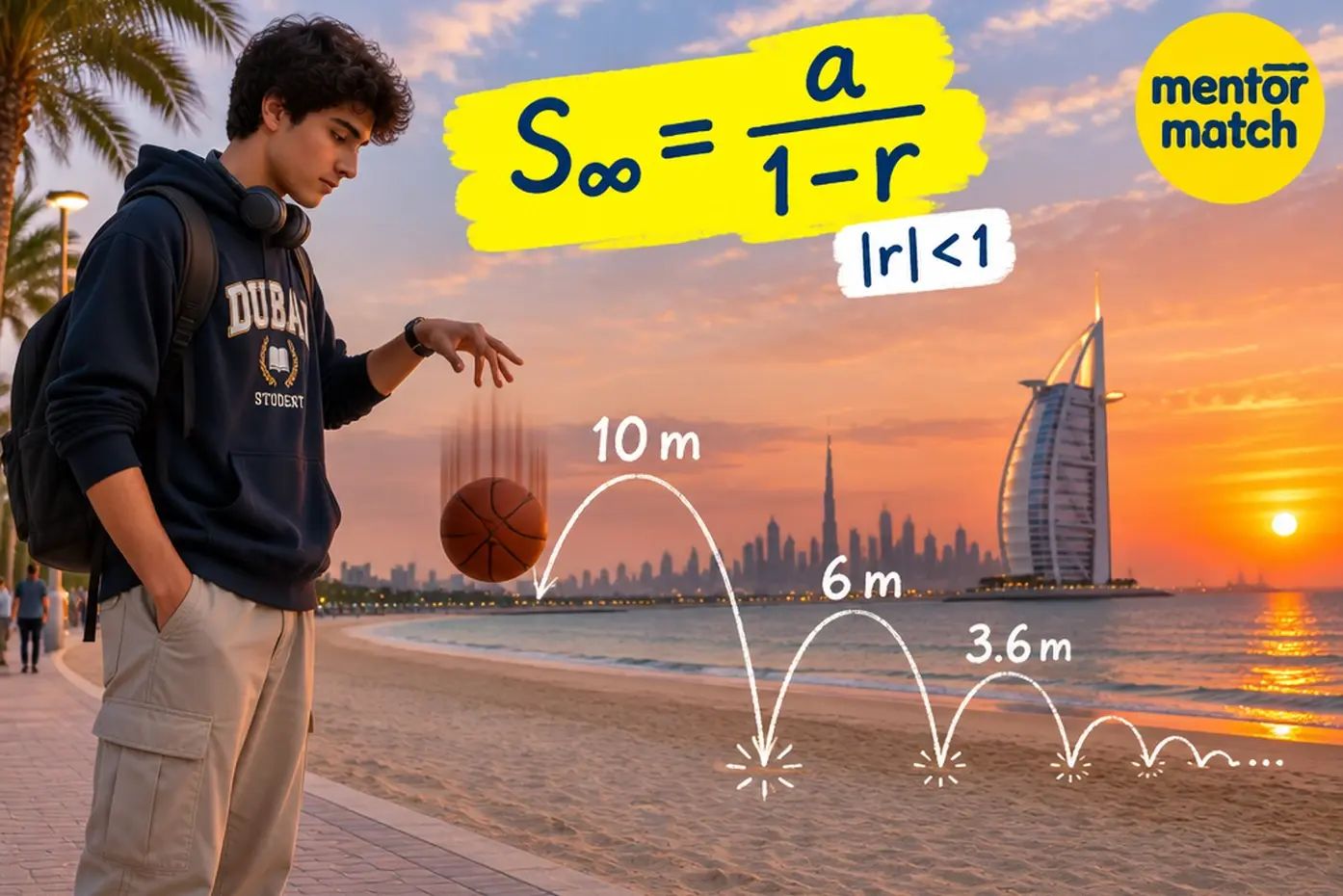
The sum of an infinite geometric progression is S∞ = a / (1 − r), where a is the first term and r is the common ratio. It only works when |r| < 1, meaning the terms keep shrinking towards zero.
Adding infinitely many numbers and getting a finite answer sounds impossible. But try it: walk half the way to a wall, then half of what's left, then half again. You take infinitely many steps, yet you never go further than the wall. The distances 1/2 + 1/4 + 1/8 + … add up to exactly 1.
That idea, called convergence, is a core topic in IB Maths AA (topic 1.8) and A Level Maths, and it's how you turn recurring decimals into fractions. This guide explains the formula, why it works, when it fails, eight worked examples including a bouncing-ball problem, and practice questions with answers.
What Is an Infinite Geometric Progression?
A geometric progression (GP) is a sequence where each term is the one before multiplied by the same number, the common ratio r.
- 8, 4, 2, 1, … has r = ½
- 27, −9, 3, −1, … has r = −⅓
- 5, 10, 20, 40, … has r = 2
To find r, divide any term by the one before it: r = u₂ ÷ u₁.
An infinite GP simply never stops. Its sum S∞ is called the sum to infinity.
Sum to Infinity Formula
S∞ = a / (1 − r), provided |r| < 1
Where:
- a = first term
- r = common ratio
- |r| < 1 means r is between −1 and 1, not including either
In the IB formula booklet you'll find this as S∞ = u₁ / (1 − r).
When does it converge?
- |r| < 1: the terms shrink to zero and the sum converges to a/(1 − r)
- |r| ≥ 1: the terms don't shrink, so the sum diverges. There's no sum to infinity.
Always check |r| before using the formula. IB markschemes often award a mark just for stating that |r| < 1.
Why the Formula Works
Start with the sum of the first n terms:
Sₙ = a(1 − rⁿ) / (1 − r)
Now ask what happens to rⁿ as n gets huge:
- If |r| < 1, multiplying by r over and over makes rⁿ smaller and smaller. For example, (½)¹⁰ ≈ 0.001 and (½)²⁰ ≈ 0.000001. So rⁿ → 0.
- Put rⁿ = 0 into Sₙ: S∞ = a(1 − 0) / (1 − r) = a / (1 − r)
- If |r| ≥ 1, rⁿ doesn't shrink, so there's no limit.
You can watch it happen with 8 + 4 + 2 + 1 + …:
- After 1 term: 8
- After 2 terms: 12
- After 3 terms: 14
- After 4 terms: 15
- After 5 terms: 15.5
- After 6 terms: 15.75
The totals creep closer to 16 but never pass it. The formula gives 8 / (1 − ½) = 16.
Solved Examples on Sum of Infinite GP
Example 1: A positive ratio
Find the sum to infinity of 8 + 4 + 2 + 1 + …
- a = 8, r = 4/8 = ½, and |r| < 1 ✓
- S∞ = 8 / (1 − ½) = 8 / ½
- Answer: 16
Example 2: A negative ratio
Find the sum to infinity of 27 − 9 + 3 − 1 + …
- a = 27, r = −9/27 = −⅓, and |r| < 1 ✓
- S∞ = 27 / (1 + ⅓) = 27 / (4/3)
- Answer: 81/4 = 20.25
The terms flip between positive and negative, so the sum bounces above and below 20.25 while closing in on it.
Example 3: A series that diverges
Does 5 + 10 + 20 + 40 + … have a sum to infinity?
- r = 10/5 = 2, so |r| > 1
- Answer: No. The series diverges. The formula would give 5/(1 − 2) = −5, which is clearly nonsense for a sum of positive numbers. That's why you must check |r| first.
Example 4: Recurring decimal to fraction
Write 0.272727… as a fraction.
- Split it up: 0.27 + 0.0027 + 0.000027 + …
- a = 0.27, r = 0.01
- S∞ = 0.27 / (1 − 0.01) = 0.27 / 0.99 = 27/99
- Answer: 3/11
Example 5: Finding the ratio
An infinite GP has first term 15 and sum to infinity 60. Find r.
- 60 = 15 / (1 − r)
- 1 − r = 15/60 = ¼
- Answer: r = ¾ (and |r| < 1 ✓)
Example 6: Finding the first term
An infinite GP has common ratio 0.8 and sum to infinity 50. Find the first term.
- 50 = a / (1 − 0.8) = a / 0.2
- Answer: a = 10
Example 7: The bouncing ball
A ball is dropped from 10 m. Each bounce reaches 60% of the previous height. Find the total vertical distance it travels.
- First drop: 10 m (down only)
- After that, every bounce goes up and back down: 6, 3.6, 2.16, … each counted twice
- Bounce heights form a GP with a = 6, r = 0.6: sum = 6 / (1 − 0.6) = 15
- Total = 10 + 2 × 15
- Answer: 40 m
The classic slip is forgetting the "× 2" for up-and-down, or counting the first drop twice.
Example 8: Ratio in terms of x
The series 1 + 2x + 4x² + 8x³ + … has a sum to infinity of 3. Find x.
- a = 1, r = 2x
- It converges when |2x| < 1, so −½ < x < ½
- 3 = 1 / (1 − 2x), so 1 − 2x = ⅓
- Answer: x = ⅓ (which lies in the valid range ✓)
For IB Students: Exam Technique
IB AA questions on sum to infinity follow a few patterns. Here's what examiners look for:
- State the condition. Write "|r| < 1" or "|2x| < 1" explicitly. It's often worth a mark on its own.
- Find the range of x. If r contains x, solve |r| < 1 as an inequality, for example −½ < x < ½.
- Check your answer is in the range. If solving gives a value of x outside it, reject it.
- Compare Sₙ and S∞. A common question asks for the least n so that Sₙ is within a given amount of S∞. Set up the inequality and solve with logs or your GDC.
Common Mistakes to Avoid
- Using the formula when |r| ≥ 1. Check r first; the formula only works for convergent series.
- Getting r upside down. r = second term ÷ first term, not the other way round.
- Losing the negative sign. If r = −⅓, then 1 − r = 1 + ⅓ = 4/3.
- Mixing up Sₙ and S∞. Sₙ adds a fixed number of terms; S∞ is the limit as n grows forever.
- Bouncing ball errors. Count every bounce twice (up and down) but the first drop only once.
- Forgetting to give the range of x when r depends on x.
Practice Questions on Sum of Infinite GP
Question 1: Find the sum to infinity of 12 + 6 + 3 + …
Question 2: Find the sum to infinity of 100 − 50 + 25 − …
Question 3: Does 2 + 3 + 4.5 + … have a sum to infinity? Explain.
Question 4: Write 0.777… as a fraction using a GP.
Question 5: Write 0.363636… as a fraction.
Question 6: An infinite GP has a = 10 and S∞ = 40. Find r.
Question 7: An infinite GP has r = 0.6 and S∞ = 25. Find a.
Question 8: A ball dropped from 8 m rebounds to half its previous height each time. Find the total distance travelled.
Question 9: For what values of x does 1 + 3x + 9x² + … have a sum to infinity?
Answers
- a = 12, r = ½: S∞ = 24
- a = 100, r = −½: S∞ = 100 / 1.5 = 200/3 ≈ 66.7
- No. r = 1.5, so |r| > 1 and the series diverges.
- 0.7 / 0.9 = 7/9
- 0.36 / 0.99 = 36/99 = 4/11
- 40 = 10/(1 − r), so r = ¾
- 25 = a / 0.4, so a = 10
- 8 + 2 × [4 / (1 − ½)] = 8 + 16 = 24 m
- |3x| < 1, so −⅓ < x < ⅓
Frequently Asked Questions
1. What is the formula for the sum of an infinite GP?
S∞ = a / (1 − r), where a is the first term and r is the common ratio. It's only valid when |r| < 1.
2. When does an infinite geometric series converge?
When the common ratio is between −1 and 1, so |r| < 1. The terms then shrink towards zero.
3. What happens if |r| is 1 or more?
The series diverges. The terms never shrink, so the total keeps growing (or keeps swinging) and has no finite sum.
4. What is the difference between Sₙ and S∞?
Sₙ = a(1 − rⁿ)/(1 − r) is the sum of the first n terms. S∞ = a/(1 − r) is the limit of Sₙ as n goes to infinity, when that limit exists.
5. Can the sum to infinity be negative?
Yes, if the first term is negative. For example, −4 − 2 − 1 − … has S∞ = −4/(1 − ½) = −8.
6. How do you convert a recurring decimal to a fraction using a GP?
Write the decimal as a sum of repeating blocks, like 0.27 + 0.0027 + …, identify a and r, then use a/(1 − r).
7. Why does an infinite sum give a finite answer?
Because the terms get small so quickly that the running total levels off. It gets closer and closer to a/(1 − r) without ever passing it.
8. How do you find r for a geometric series?
Divide any term by the term before it. For 27, −9, 3, … that's −9 ÷ 27 = −⅓.
9. Where is the sum to infinity used in real life?
Bouncing balls, repeated dosage of medicine, loan and annuity calculations, and Zeno's paradox of always halving the distance.
10. Is the sum of an infinite GP in the IB syllabus?
Yes. It's in IB Maths AA SL topic 1.8 (and therefore HL), and in A Level Maths and IGCSE Additional Maths. IB Maths AI covers finite geometric series but not the sum to infinity.
Book Your Free Demo Class with MentorMatch
Sum to infinity questions look short, but the marks hide in the details: stating |r| < 1, finding the range of x, rejecting an invalid answer, and getting the bouncing-ball count right. A tutor helps you nail each one.
MentorMatch tutors teach 1:1 online, matched to your curriculum, and practise exactly these IB-style sequence questions with you.
Book Your Free Demo Class with MentorMatch


