


77.32% of parents see better grades in 3 months!
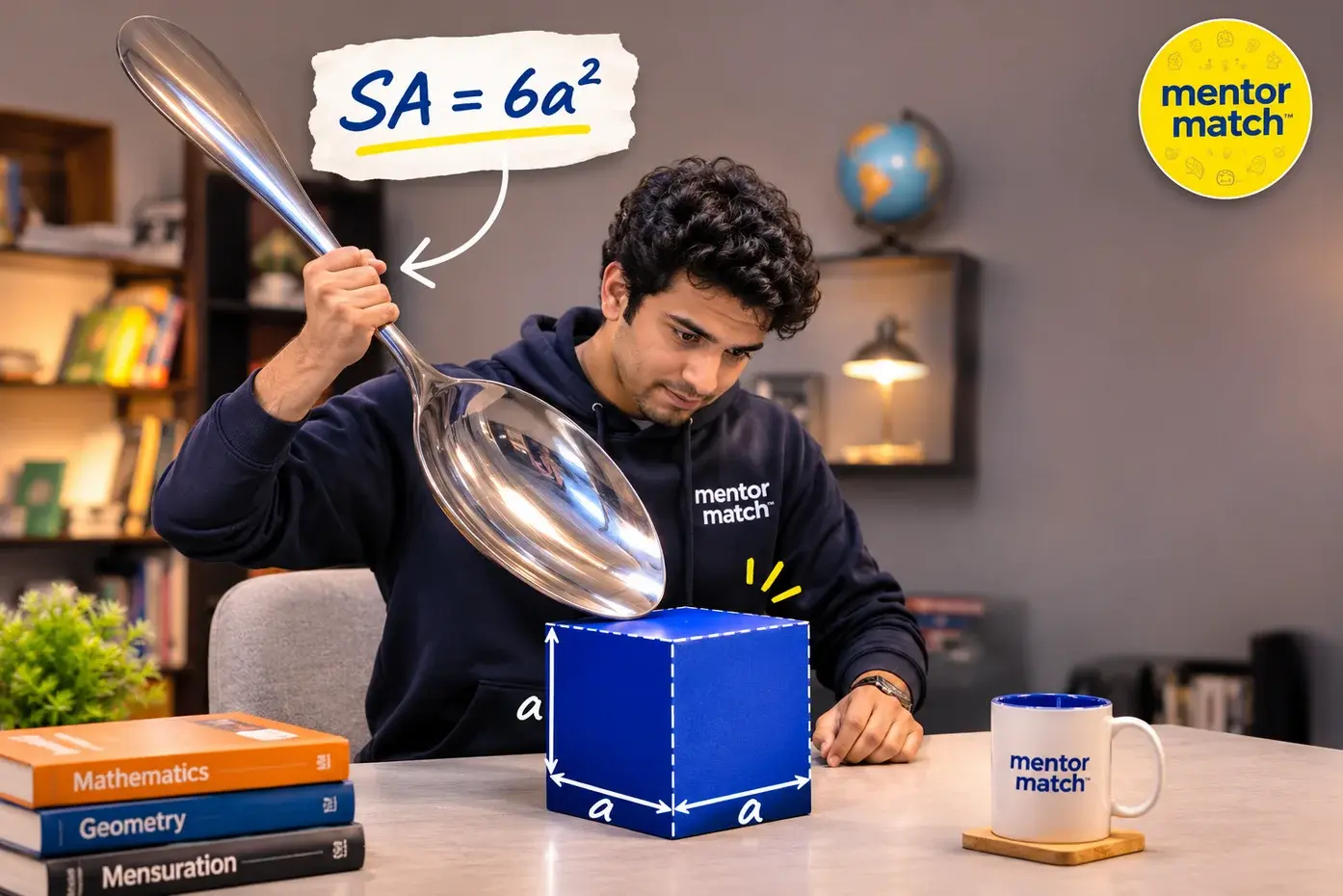
Picture unfolding a cardboard cube until it lies flat. You get six identical squares, and the space they cover on the table is the cube's surface area. For a cube whose edges are all a long, that comes to 6a²: one square of a², six times over.
Teachers and textbooks split this into two measurements:
- Total Surface Area (TSA): every face counted, so all six squares
- Lateral Surface Area (LSA): just the four upright sides, with the lid and base left out
Quick taste: give each edge 7 cm and the six faces add up to 6 × 7² = 294 cm².
By the end of this guide you'll know:
- what "surface area" means for a cube
- how TSA and LSA differ, and when to use each
- where 6a² and 4a² come from
- how to get the answer when you're handed the volume or a diagonal instead of the edge
- how to tackle worked examples, practice questions and common FAQs
What is the surface area of a cube?
Think of a cube as a perfectly regular box: 6 matching square faces, 12 edges of identical length and 8 corners. Because every face is a copy of the others, one measurement, the edge, tells you everything.
The surface area of a cube is its outside skin. Add up the six faces and you know how much material it takes to wrap it.
Gift wrapping makes this concrete. To cover a cube-shaped present with no gaps, the paper you need equals the cube's total surface area, before allowing for overlaps.
Answers always come in square units, because you're measuring flat area: cm², m², in² and so on.
Types of surface area of a cube
You'll meet two versions in exam questions:
1. Total Surface Area (TSA)
TSA leaves nothing out. The lid, the base and the four walls all count.
2. Lateral Surface Area (LSA)
LSA keeps only the four walls that stand around the sides. Ignore the top and the bottom.
Important: Every face of a cube is flat, so there is nothing "curved" about it. If a book asks for the CSA of a cube, read it as LSA.
Surface area of a cube formula
Call the edge length a.
- One face is an a-by-a square, so its area is a²
- Six such faces make TSA = 6a²
- The four walls alone make LSA = 4a²
In short: a is the edge, TSA counts all six faces, and LSA counts four.
Total surface area of a cube (TSA) formula
For the total, add up six identical squares, which is the same as multiplying one square by 6:
TSA = 6a^2
Try it with an 11 cm edge:
- TSA = 6 × 11² = 6 × 121
- TSA = 726 cm²
Lateral surface area of a cube (LSA) formula
For the walls only, multiply one square by 4:
LSA = 4a^2
Same 11 cm cube:
- LSA = 4 × 11² = 4 × 121
- LSA = 484 cm²
Difference between TSA and LSA of a cube
- Faces counted: TSA uses all 6, LSA uses 4
- Formula: 6a² compared with 4a²
- Lid and base: in TSA, out of LSA
- Unit: square units for both
Subtract one from the other and you're left with exactly the lid and the base:
TSA - LSA = 6a^2 - 4a^2 = 2a^2
How to find the surface area of a cube?
With the edge in hand, it's a four-step job:
- Note the edge length and label it a.
- Square it to get the area of one face, a².
- Times by 6 for TSA, or by 4 for LSA.
- Finish with square units.
A 3 cm cube, for instance:
- TSA = 6 × 3² = 54 cm²
- LSA = 4 × 3² = 36 cm²
Harder questions hide the edge. They give you the volume, a diagonal or the base area, and you work back to the edge first, or use a shortcut formula.
Surface area of a cube when volume is given
Volume is the edge cubed, V = a³, so cube-rooting the volume brings back the edge: a = ∛V. Drop that into 6a² and the two steps collapse into one:
TSA = 6V^{2/3}
Example: A cube holds 2,744 cm³. What is its total surface area?
- Step 1: V = 2,744 cm³
- Step 2: a = ∛2,744 = 14 cm
- Step 3: TSA = 6 × 14² = 6 × 196
- Answer: 1,176 cm²
Surface area of a cube when diagonal is given
The space diagonal runs from one corner, straight through the middle, to the opposite corner. Applying Pythagoras twice shows it is a√3 long. Turn that round and a = d/√3. Put it into 6a² and the root disappears:
TSA = 2d^2
Example: A cube's space diagonal measures 4√3 cm. Find the total surface area.
- Given: d = 4√3 cm
- Shortcut: TSA = 2d² = 2(4√3)² = 2 × 48
- Answer: 96 cm²
Watch out: the diagonal drawn across a single face is shorter, a√2. Only the corner-to-corner diagonal through the cube is a√3.
Surface area of a cube when base area is given
The base is just one of the six identical faces, so its area is a². That means you can skip finding a altogether:
- TSA = 6 × base area
- LSA = 4 × base area
Example: A cube sits on a base of 169 cm². What is its total surface area?
- TSA = 6 × 169
- Answer: 1,014 cm²
Important points about the surface area of a cube
- When a question just says "surface area", it nearly always means TSA.
- TSA = 6a².
- LSA = 4a².
- One face = a².
- TSA and LSA are always 2a² apart.
- With only flat faces, a cube has no curved surface area.
- Area goes in square units, and volume goes in cubic units.
- Double the edge and the surface area quadruples.
Surface area of a cube examples
Work through these one at a time. Each starts by spotting what you've been given.
Example 1: Find the total surface area of a cube with an edge length of 17 inches
- We know: a = 17 in
- Rule: TSA = 6a²
- Working: 6 × 17² = 6 × 289
- Result: 1,734 in²
Example 2: Find the edge length and total surface area of a cube whose base area is 324 square units
- We know: one face covers 324 square units
- Edge: that face is a square, so a = √324 = 18 units
- Working: six faces × 324
- Result: 1,944 square units
Example 3: Find the lateral surface area of a cube with an edge length of 9 feet
- We know: a = 9 ft
- Rule: walls only, so LSA = 4a²
- Working: 4 × 9² = 4 × 81
- Result: 324 ft²
Example 4: Find the total surface area of a cube whose volume is 3,375 cm³
- We know: V = 3,375 cm³
- Edge first: cube-root it, ∛3,375 = 15 cm
- Working: 6 × 15² = 6 × 225
- Result: 1,350 cm²
Example 5: Find the total surface area of a cube whose space diagonal is 9√3 cm
- We know: d = 9√3 cm
- Shortcut: TSA = 2d²
- Working: (9√3)² = 81 × 3 = 243, and 2 × 243
- Result: 486 cm²
Example 6: The total surface area of a cube is 2,400 cm². Find its edge length
- We know: all six faces add to 2,400 cm²
- One face: 2,400 ÷ 6 = 400 cm²
- Edge: the square root of 400
- Result: 20 cm
Example 7: Find the area required to paint the four side faces of a cube with an edge length of 2.5 m
- We know: a = 2.5 m, and only the walls get paint
- Rule: LSA = 4a²
- Working: 4 × 6.25
- Result: 25 m²
Example 8: A cube-shaped gift box has an edge length of 22 cm. Find the wrapping paper required to cover it completely
- We know: a = 22 cm, and every face gets covered
- Rule: TSA = 6a²
- Working: 6 × 484
- Result: 2,904 cm²
Buy a little more than this in practice, because folded edges overlap.
Real-life applications of the surface area of a cube
You'll use cube surface area whenever something box-shaped needs covering, coating or making.
- Packaging: sizing the card sheet that folds into a cube-shaped carton
- Painting: judging how many tins it takes to coat a cube-shaped bench or planter
- Construction: working out the exposed face area of concrete or stone blocks
- Manufacturing: costing a protective coating or polish for cube-shaped parts
- Gift wrapping: cutting just enough paper for a square-sided present
Common mistakes when calculating the surface area of a cube
- Grabbing the wrong formula. All six faces is 6a². The walls only is 4a².
- Skipping the square. A face is a × a, so a², not plain a.
- Sneaking the lid and base into LSA. Lateral means sides only.
- Mixing up area and volume. Area is in cm², space inside is in cm³.
- Picking the wrong diagonal. Across one face it's a√2. Corner to far corner it's a√3.
- Square-rooting a volume. Volume needs the cube root, ∛V.
- Dropping or muddling units. Finish every answer in a squared unit.
Practice questions on surface area of a cube
Have a go before peeking at the answers.
- Find the total surface area of a cube with an edge length of 19 cm.
- Find the lateral surface area of a cube with an edge length of 8 m.
- A cube has a volume of 4,096 cm³. Find its total surface area.
- The base area of a cube is 0.36 m². Find its total surface area.
- Find the total surface area of a cube whose space diagonal is 2√3 cm.
- The total surface area of a cube is 3,174 cm². Find its edge length.
- A cube-shaped box has an edge length of 25 cm. How much cardboard is required to cover the entire box?
- The edge length of a cube is tripled. By what factor does its total surface area change?
Answers
- 6 × 361 = 2,166 cm²
- 4 × 64 = 256 m²
- Edge = 16 cm, so 6 × 256 = 1,536 cm²
- 6 × 0.36 = 2.16 m²
- 2 × (2√3)² = 2 × 12 = 24 cm²
- One face is 529 cm², so the edge is 23 cm
- 6 × 625 = 3,750 cm²
- 9 times bigger, because 3² = 9
Frequently asked questions about the surface area of a cube
What is the formula for the surface area of a cube?
Take one edge, square it, then multiply by six: TSA = 6a². That covers every face.
What is the lateral surface area of a cube?
It's the area of the four upright walls, leaving out the lid and base. Work it out with 4a².
What is the difference between TSA and LSA of a cube?
TSA counts six faces and LSA counts four, so the gap between them is always the top plus the bottom, 2a².
Does a cube have a curved surface area?
No. Every face is a flat square. Questions that say "CSA" for a cube mean the four walls, LSA.
How do you find the surface area of a cube when its volume is given?
Cube-root the volume to recover the edge, then feed that edge into 6a². In one line, TSA = 6V^(2/3).
How do you find the surface area of a cube using its diagonal?
For the corner-to-corner diagonal d, the surface area is simply 2d². You never need to find the edge.
What is the area of one face of a cube?
Edge times edge, a². Every one of the six faces has this same area.
What units are used to measure the surface area of a cube?
Any squared unit that matches the edge: mm², cm², m², in² or ft².
What happens to the surface area if the edge length is doubled?
It grows fourfold. The edge gets squared, and 2² = 4, so 6(2a)² = 24a².
Is the surface area of a cube the same as its volume?
No. One is the wrapping on the outside, in square units. The other is the room inside, in cubic units.
Learn Maths with Mentor Match
Cube questions get easier once you can see which faces a question includes and why each formula works.
Our one-to-one Maths tutors help students picture 3D shapes, get comfortable with mensuration, and practise the multi-step questions that show up in exams.
Book your free demo class with Mentor Match.


