


77.32% of parents see better grades in 3 months!
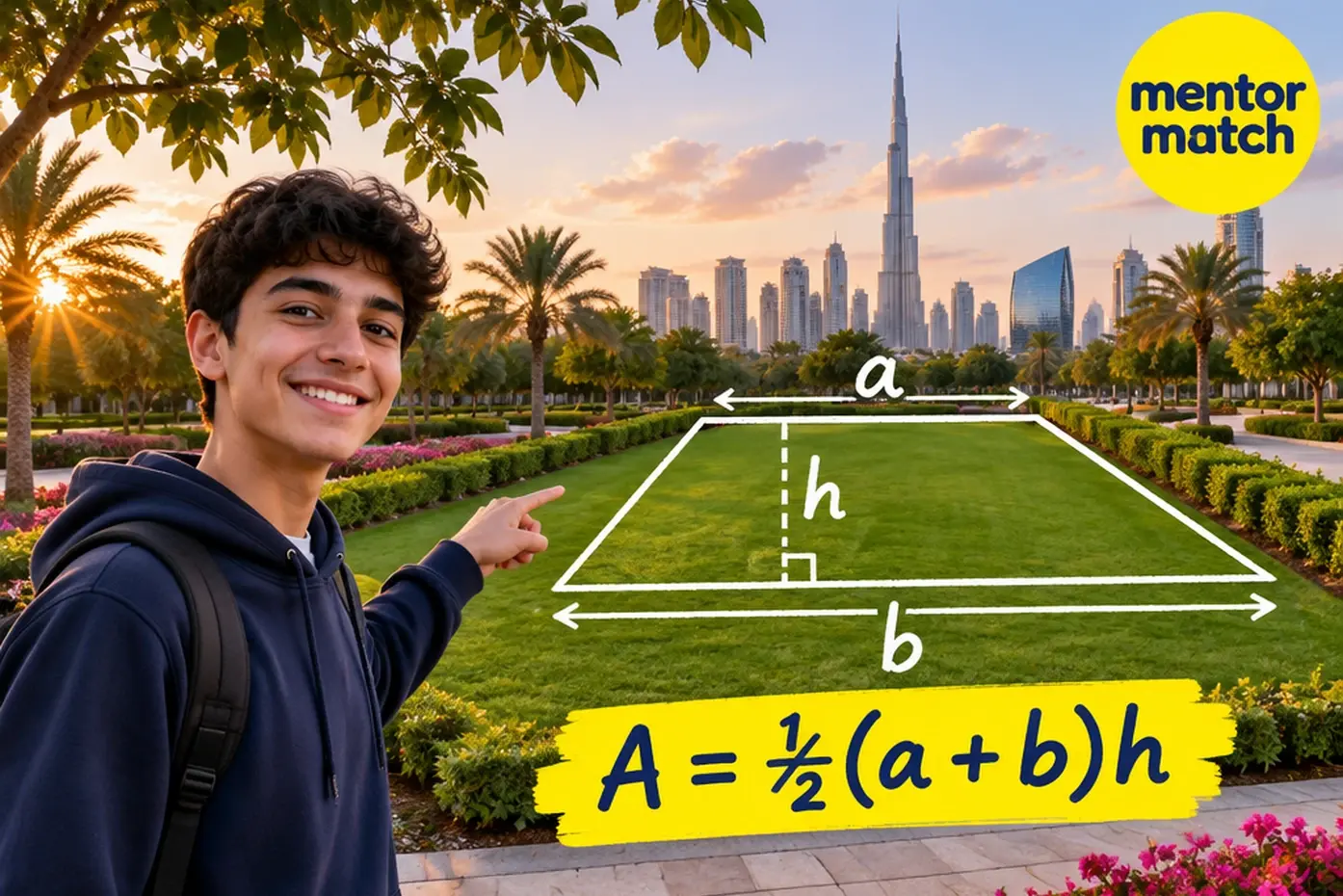
Short answer: draw two lines that run side by side like train tracks, join their ends with two slanting lines, and you've made a trapezium. To get its area, use ½(a + b)h: find the average of the two parallel edges, then multiply by how far apart they are.
You've seen trapeziums everywhere without naming them: the side of a handbag, a lampshade's outline, a slice of a staircase railing, the cross-section of a canal. They also turn up constantly in IGCSE exams, both as a shape in their own right and hidden inside compound-area questions.
This guide covers what makes a shape a trapezium, its types and properties, the area and perimeter formulas (and why the area formula works), eight worked examples and practice questions with answers.
What Is a Trapezium?
In geometry terms, it's a quadrilateral (any closed shape built from four straight edges) in which exactly two of the edges facing each other never meet, however far you extend them. Those are its parallel sides.
The parts have names:
- Bases (a and b): the two parallel sides
- Legs: the two sides that aren't parallel
- Height (h): the perpendicular distance between the parallel sides, not the length of a slanted leg
Trapezium or trapezoid?
It's the same shape with a different name depending on where you are:
- UK, India, UAE, IGCSE, IB: trapezium
- USA and Canada: trapezoid
Search for "area of a trapezoid" and you'll get exactly the same formula.
Types of Trapezium
- Isosceles trapezium: both slanting edges match in length, so the shape folds neatly onto itself down the middle. The corners pair up in equal twos, and the two diagonals come out the same length.
- Right-angled trapezium: one slanting edge stands straight up instead, meeting both tracks at 90°. Think of a ramp viewed side-on.
- Scalene trapezium: nothing matches except the parallel pair. Every leg and every corner is different.
Properties of a Trapezium
- Four edges, four corners, and nothing curved.
- Exactly one pair of facing edges runs parallel; that's the shape's defining feature.
- Go all the way round inside and the corners total 360°, the same as any four-sided shape.
- Walk along either slanting leg: the two corners at its ends always make 180° together, because they're co-interior angles trapped between the parallel tracks.
- The two diagonals cross somewhere inside, but in general they don't cut each other in half or meet square-on.
- Make it isosceles and two extra things happen: the diagonals match in length, and each pair of base corners is equal.
Is a parallelogram a trapezium?
It depends on the definition. If a trapezium has at least one pair of parallel sides, then parallelograms, rectangles and squares all count. If it has exactly one pair, they don't. Textbooks differ, so in an exam just stick to the definition your syllabus uses. IGCSE questions almost always mean a shape with one pair.
Area of a Trapezium Formula
Area = ½ (a + b) × h
Where a and b are the parallel sides and h is the perpendicular height.
In words: average the parallel sides, then multiply by the height.
Why it works
Take two identical trapeziums. Flip one upside down and fit it against the other. Together they make a parallelogram with base (a + b) and height h.
- Area of the parallelogram = (a + b) × h
- One trapezium is half of it: ½(a + b)h
The area formula is on the Cambridge IGCSE formula list, but knowing why it works helps when a question gives you the area and asks for a missing side.
Perimeter of a Trapezium
Perimeter = a + b + c + d
Just add all four sides. If a leg is missing, you may need Pythagoras to find it first (see Example 6).
Solved Examples on Trapezium
Example 1: Area
A trapezium has parallel sides of 9 cm and 15 cm, and a height of 6 cm. Find its area.
- Formula: ½(a + b)h
- Substitute: ½ × (9 + 15) × 6 = ½ × 24 × 6
- Answer: 72 cm²
Example 2: Finding the height
A trapezium has area 105 cm² and parallel sides 8 cm and 13 cm. Find its height.
- 105 = ½ × (8 + 13) × h
- 105 = 10.5h
- Answer: h = 10 cm
Example 3: Finding a parallel side
A trapezium has area 90 cm², height 9 cm and one parallel side of 7 cm. Find the other parallel side.
- 90 = ½ × (7 + b) × 9
- 180 = 9(7 + b), so 7 + b = 20
- Answer: b = 13 cm
Example 4: Perimeter
A trapezium has a perimeter of 52 cm. Three of its sides are 14 cm, 10 cm and 18 cm. Find the fourth side.
- 14 + 10 + 18 = 42
- Answer: 52 − 42 = 10 cm
Example 5: Angles
In an isosceles trapezium, one base angle is 65°. Find the other three angles.
- Isosceles, so the other angle on the same base is also 65°
- Angles along each leg add up to 180°: 180 − 65 = 115°
- Answer: 65°, 65°, 115°, 115° (check: total 360° ✓)
Example 6: Using Pythagoras to find the height
An isosceles trapezium has parallel sides 10 cm and 22 cm, and legs of 10 cm. Find its area.
- The longer base sticks out by (22 − 10) ÷ 2 = 6 cm on each side
- Each leg forms a right-angled triangle with base 6 cm and hypotenuse 10 cm
- Height: h = √(10² − 6²) = √64 = 8 cm
- Area: ½ × (10 + 22) × 8
- Answer: 128 cm²
Example 7: A real-life cost question
A garden lawn is a trapezium with parallel sides 30 m and 50 m, 20 m apart. Turf costs AED 25 per m². Find the total cost.
- Area: ½ × (30 + 50) × 20 = 800 m²
- Cost: 800 × 25
- Answer: AED 20,000
Example 8: Splitting into simpler shapes
Show that a right-angled trapezium with parallel sides 6 cm and 10 cm and height 4 cm has the same area by splitting it.
- Rectangle: 6 × 4 = 24 cm²
- Triangle: ½ × (10 − 6) × 4 = 8 cm²
- Total: 32 cm²
- Formula check: ½ × (6 + 10) × 4 = 32 ✓
Common Mistakes to Avoid
- Using the slanted side as the height. The height must be perpendicular to the parallel sides.
- Forgetting the ½. Without it you get double the area.
- Adding the wrong pair of sides. Only the two parallel sides go in the bracket.
- Mixing units. Convert everything to the same unit before calculating.
- Writing cm instead of cm². Area is always in square units.
- Assuming the diagonals are equal. That's only true for an isosceles trapezium.
Practice Questions on Trapezium
Question 1: Find the area of a trapezium with parallel sides 6 cm and 10 cm and height 5 cm.
Question 2: Find the area of a trapezium with parallel sides 12 m and 20 m and height 9 m.
Question 3: A trapezium has area 60 cm² and parallel sides 5 cm and 7 cm. Find its height.
Question 4: A trapezium has area 150 cm², height 10 cm and one parallel side of 18 cm. Find the other parallel side.
Question 5: Find the perimeter of a trapezium with sides 9 cm, 6 cm, 13 cm and 6 cm.
Question 6: One angle along a leg of a trapezium is 48°. What is the other angle on that leg?
Question 7: An isosceles trapezium has a base angle of 70°. Find all four angles.
Question 8: An isosceles trapezium has parallel sides 8 cm and 20 cm and legs of 10 cm. Find its area.
Answers
- ½ × 16 × 5 = 40 cm²
- ½ × 32 × 9 = 144 m²
- 60 = 6h, so h = 10 cm
- 150 = 5(a + 18), so a + 18 = 30 and a = 12 cm
- 9 + 6 + 13 + 6 = 34 cm
- 180 − 48 = 132°
- 70°, 70°, 110°, 110°
- Overhang 6 cm, height √(100 − 36) = 8 cm, area ½ × 28 × 8 = 112 cm²
Frequently Asked Questions
1. What is a trapezium?
Any four-edged flat shape with a single pair of parallel edges. The parallel pair are its bases; the other two are its legs.
2. What is the formula for the area of a trapezium?
½(a + b)h. Add the two parallel edges, halve the total to get their average, then multiply by the square-on distance between them.
3. What are the properties of a trapezium?
One parallel pair, corners totalling 360°, and each leg's two corners summing to 180°. The isosceles version adds equal legs, equal diagonals and matching base angles.
4. What is the difference between a trapezium and a trapezoid?
Nothing, in school maths. "Trapezium" is used in the UK, India, the UAE and in IGCSE and IB; "trapezoid" is the US term.
5. What are the properties of an isosceles trapezium?
It's the symmetrical one. The legs are the same length, so the left half mirrors the right half. That gives it equal base angles, diagonals of matching length and a single line of symmetry down the middle.
6. Can a trapezium have a right angle?
Yes, and when it does it actually has two, because the upright leg meets both parallel edges square-on. That's called a right-angled trapezium.
7. Is a trapezium a parallelogram?
Not usually. A parallelogram needs both pairs of facing edges to be parallel; a trapezium only promises one. Some books treat parallelograms as a special kind of trapezium, but no book treats every trapezium as a parallelogram.
8. What do the angles in a trapezium add up to?
A full 360°. Slice it corner to corner into two triangles and you get 180° + 180°.
9. How do you find the perimeter of a trapezium?
Total up all four edges. If one is unknown, work it back from the given perimeter, or use Pythagoras with the height if it's a slanted leg.
10. Is the trapezium area formula given in the IGCSE exam?
Yes. In Cambridge IGCSE Maths 0580 the area of a trapezium is on the formula list. You still need to know which lengths to use, especially that h is the perpendicular height.
Book Your Free Demo Class with MentorMatch
Trapezium questions are rarely just "plug into the formula". IGCSE papers hide the height inside a Pythagoras step, ask for a missing side from the area, or bury a trapezium inside a compound shape. A tutor helps your child spot the structure every time.
MentorMatch tutors teach 1:1 online, matched to your curriculum and your child's pace.
Also read: Geometry Formulas for IB and IGCSE and Area of a Circle.


