


77.32% of parents see better grades in 3 months!
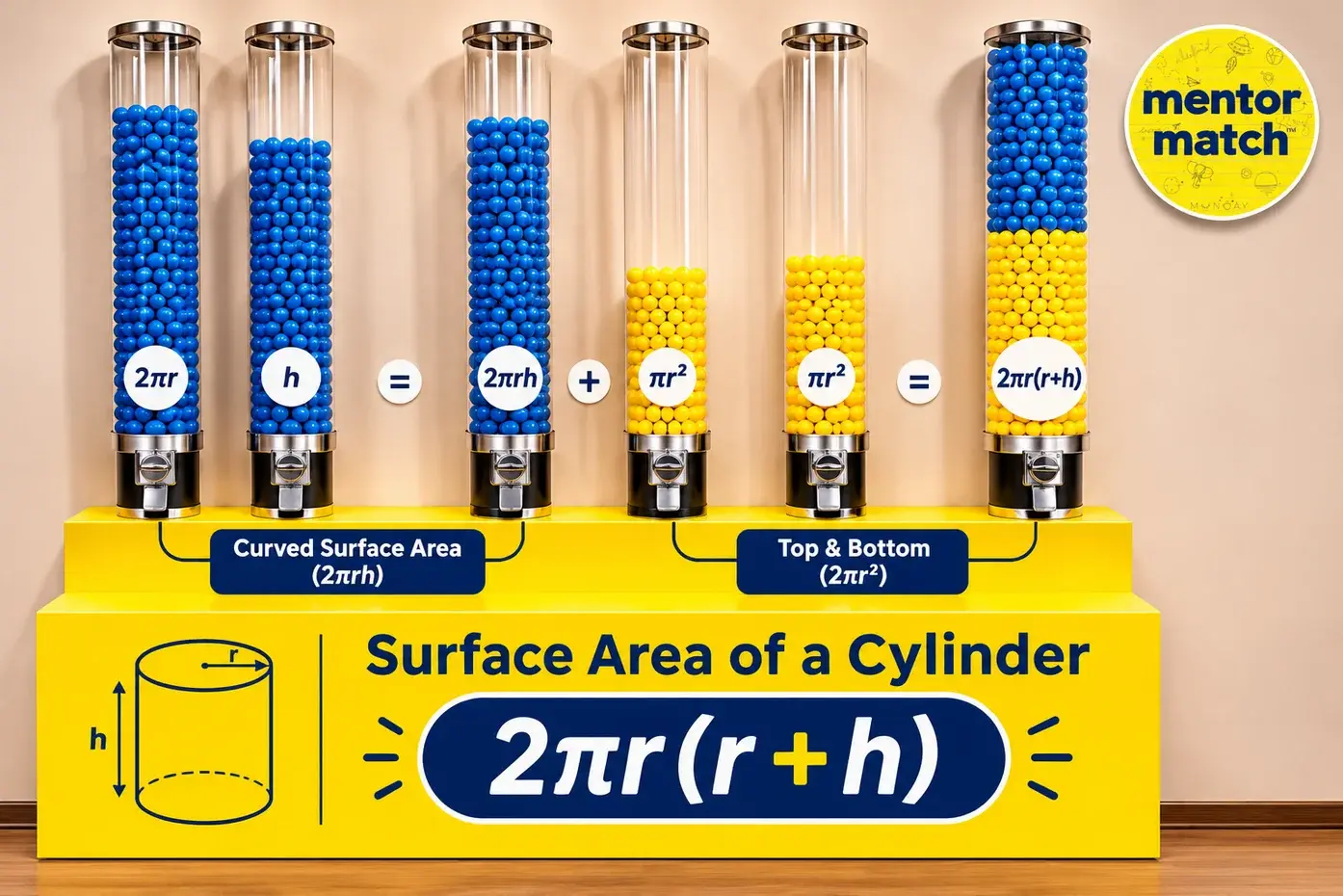
Short answer: add up the side and the two lids. For a cylinder with radius r and height h, TSA = 2πr(r + h) covers everything, while CSA = 2πrh covers the side alone.
Most students learn these two lines by heart and then lose marks by picking the wrong one. So this guide spends as much time on which formula to choose as on the formulas themselves. You'll also see the version for a cup or bucket with no lid, eight worked problems, and a few places engineers rely on this every week.
What Is the Surface Area of a Cylinder?
Grab a tin of beans and run a knife down its side from rim to rim. Peel the metal open, press it flat, and pop off both lids. On the table you now have a long strip plus two discs. Those three pieces, laid side by side, are the surface area.
So the surface area of a cylinder is simply how much flat material it would take to build the shape with nothing missing.
The three pieces each have a job:
- The lid: a disc of radius r sitting on top
- The base: an identical disc underneath
- The wall: the strip that bends round to join lid and base, as tall as the cylinder (h)
Exam questions usually ask for one of two totals.
1. Total Surface Area (TSA)
Here you count all three pieces. If the tin is sealed and you want to paint every bit of it, the total surface area of a cylinder is the figure you need.
2. Curved Surface Area (CSA)
Here you count the wall strip and ignore both discs. The curved surface area of a cylinder is what matters for anything wrapped around the outside, such as the paper sleeve on a candle or the vinyl skin on a drum.
Quick Check
A jam jar is 4 cm in radius and 9 cm tall. The printer is making a sticker that goes round the glass but doesn't touch the lid or the bottom.
TSA or CSA?
Answer: CSA. The sticker only meets the wall, never the two discs.
Surface Area of a Cylinder Formula
There isn't one single surface area of cylinder formula. There are three, and the shape of the object tells you which to grab:
- the wall only → Curved Surface Area (CSA)
- wall + both discs → Total Surface Area (TSA)
- wall + one disc, or wall with no discs → open cylinder
Curved Surface Area of Cylinder (CSA)
CSA = 2πrh
Here r is the radius of each circular end, h is the height (the gap between the ends), and π can be taken as 3.14159 or 22/7.
Where the 2πrh comes from
Go back to that flattened tin. The wall strip is a rectangle. Its short edge is as tall as the tin, so it measures h. Its long edge used to wrap once round the rim, so it measures exactly one circumference: 2πr.
Rectangle area is long edge times short edge, which gives 2πr × h, or 2πrh.
Worked Example: a candle sleeve
A pillar candle has radius 6 inches and stands 13 inches tall. How much paper wraps round it exactly once?
- What we know: r = 6 in, h = 13 in, and only the wall is covered
- Rule to use: CSA = 2πrh
- Working: 2 × π × 6 × 13 = 156π
- Result: about 490.09 square inches of paper
Total Surface Area of Cylinder (TSA)
For the total surface area of a cylinder, take the wall strip and add on the two discs.
TSA = 2πr(r + h)
One disc covers πr², so a pair covers 2πr². Put that next to the wall's 2πrh and you get 2πr² + 2πrh. Both chunks share a factor of 2πr, so pull it out the front: 2πr(r + h). The factorised form is quicker on a calculator because you only multiply once.
Worked Example: wrapping the whole candle
The same 6-inch by 13-inch candle is now being gift-wrapped, top and bottom included. How much paper is needed?
- What we know: r = 6 in, h = 13 in, all surfaces covered
- Rule to use: TSA = 2πr(r + h)
- Working: 2 × π × 6 × 19 = 228π
- Result: about 716.28 square inches
Compare the two candle answers: 228π − 156π leaves 72π. That leftover is exactly the two discs, 2 × π × 36, which is a handy way to check your work.
Surface Area of an Open Cylinder
Plenty of real cylinders are missing a lid, or both. An open cylinder just means you drop whichever disc isn't there.
1. One end open (cups, buckets, plant pots)
SA = πr² + 2πrh
That's the wall plus one base.
2. Both ends open (pipes, tubes, cardboard rolls)
SA = 2πrh
No discs at all, so this is just the CSA again.
Worked Example: a lidless bucket
A metal bucket has radius 14 cm, height 20 cm and no lid. How much metal goes into it? (Take π as 22/7.)
- What we know: r = 14 cm, h = 20 cm, base present, top missing
- Rule to use: SA = πr² + 2πrh
- The base: 22/7 × 14 × 14 = 616
- The wall: 2 × 22/7 × 14 × 20 = 1,760
- Result: 616 + 1,760 = 2,376 cm² of metal
Practice Questions: Surface Area of a Cylinder
Five problems, easiest first. Cover the answer, have a go, then check.
Question 1: Find the Curved Surface Area
A kettle drum shell is 7 cm in radius and 15 cm deep. What area of skin wraps round its side? (π = 22/7)
- A) 330 cm²
- B) 660 cm²
- C) 968 cm²
- D) 1,320 cm²
Hint: Only the side, so 2πrh.
Answer: B) 660 cm²
Question 2: Calculate the Total Surface Area
A sealed tin of lip balm has a 2 cm radius and stands 9 cm tall. Give its full outer area in terms of π.
- A) 22π cm²
- B) 36π cm²
- C) 40π cm²
- D) 44π cm²
Hint: Sealed means both discs count.
Answer: D) 44π cm²
Question 3: Find the Radius
The printed band on a 5 cm tall gift box covers 440 cm² of its curved side. How wide is the radius? (π = 22/7)
- A) 7 cm
- B) 10 cm
- C) 14 cm
- D) 21 cm
Hint: Put 440 = 2πr × 5 and solve for r.
Answer: C) 14 cm
Question 4: Open Cylinder Problem
A plant pot (no lid, but with a base) is 7 cm in radius and 9 cm tall. How much plastic is it made from? (π = 22/7)
- A) 462 cm²
- B) 550 cm²
- C) 616 cm²
- D) 704 cm²
Hint: One disc plus the wall.
Answer: B) 550 cm²
Question 5: Apply the Formula
A rooftop water tank is 28 m wide and 10 m tall. Its outside needs a coat of paint, lid and base included. What area will be painted? (π = 22/7)
- A) 1,232 m²
- B) 2,112 m²
- C) 2,112π m²
- D) 3,344 m²
Hint: 28 m is the width (diameter), so r = 14 m.
Answer: B) 2,112 m²
Real-World Applications of Cylinder Surface Area
This isn't only exam maths. Every can, tank, pipe and pill bottle in the world was costed using one of these formulas.
1. Paint Can Manufacturing
A paint factory buys sheet metal by the square metre. To price each can, lid and base included, it works out the TSA and multiplies by the number of cans in a production run.
2. Oil Storage Tanks
Those giant drums at a refinery need steel plates and a protective coating on the outside. The TSA tells the engineers how much of both to order.
3. Pipe Insulation
A pipe has no ends to cover, so lagging it is a pure CSA job. Get the wall area right and the insulation fits without gaps or waste.
4. Pharmaceutical Packaging
The label on a medicine bottle wraps the curved side and stops at the cap and the base, so designers size it from the CSA.
Key Takeaways: Surface Area of a Cylinder
- The shape: two matching discs joined by a bent wall.
- r: measured from the middle of a disc out to its rim. Given a diameter? Halve it.
- h: the straight gap between the two discs.
- CSA = 2πrh: the wall on its own, with neither disc.
- TSA = 2πr(r + h): the wall plus both discs; use it for anything sealed.
- Missing a lid: πr² + 2πrh.
- Missing both ends: 2πrh, the same as the CSA.
- The net: unfold a sealed cylinder and you see one rectangle and two equal circles.
- π: circumference divided by diameter, roughly 3.14159 or 22/7.
FAQs on Surface Area of a Cylinder
1. What is the surface area of a cylinder?
It is the amount of flat material needed to make the cylinder: the bent wall plus the lid and the base. With radius r and height h, the full figure is 2πr(r + h).
2. What is the difference between TSA and CSA of a cylinder?
The TSA counts the wall and both discs, giving 2πr(r + h). The CSA counts the wall alone, giving 2πrh. The gap between them is always the two discs, 2πr².
3. How do you find the surface area of a cylinder when the diameter is given?
Halve the diameter first, because every formula here uses the radius. Say a tube is 10 cm across and 8 cm tall:
- r = 10 ÷ 2 = 5 cm
- TSA = 2π × 5 × 13 = 130π
- That's about 408.41 cm²
4. What is the surface area of an open cylinder?
With the top missing, as in a mug, it is πr² + 2πrh. With both ends missing, as in a pipe, only the wall is left, so it is 2πrh.
5. Why does the curved surface area formula use 2πr × h?
Unroll the wall and it lies flat as a rectangle. One edge is the height, h. The other once ran all the way round the rim, so it equals the circumference, 2πr. Multiply the two edges and you get 2πrh.
6. Can the curved surface area of a cylinder be zero?
Only on paper. 2πrh hits zero if r or h is zero, but then you no longer have a real cylinder, just a flat disc or a line.
7. What are the common mistakes when calculating the surface area of a cylinder?
- Counting just one disc for a sealed cylinder
- Plugging in the diameter where r should go
- Using TSA when the question only wants the side
- Using the sealed formula for a cup or pipe
- Leaving off the squared unit (cm², m²)
Learn Mathematics with MentorMatch
Memorising 2πrh takes a minute. Spotting, under exam pressure, that a "rooftop tank" needs TSA and a "lagged pipe" needs CSA is the skill that actually earns marks.
At MentorMatch, a 1:1 online tutor works through exactly those judgement calls with your child, at their pace and in their curriculum.
Geometry, mensuration, algebra or anything else in maths, the right guidance turns "I'm not sure which formula" into "I know which one and why".
Want more on 3D shapes? Read our guides on the volume of a cylinder and the surface area of a cube.
Book Your Free Demo Class with MentorMatch


