


77.32% of parents see better grades in 3 months!
In one line: the sloping wall of a cone measures πrl, and once you include the round floor the whole skin comes to πr(r + l). The letter r is how wide the base is from centre to edge, and l is the slant height: lay a ruler along the side from the point to the bottom edge, and that reading is l.
Picture a birthday hat, the orange cones lining a road in Al Quoz, or a funnel in the school lab. All three start as a ring and squeeze down to a single point. Wondering how much glittery card makes the hat, or how much rubber wraps the road cone, is really a surface area question.
You'll meet cones in IGCSE, IB MYP and CBSE Class 9–10 mensuration, right after cubes, cuboids and cylinders. Below: both formulas, the paper-cutting trick that explains πrl, what to do when you're handed the upright height, eight worked problems, a sector-to-cone puzzle for Extended students, and practice with answers.
The Three Lengths of a Cone
Before any formula, get these three measurements straight. Cone questions juggle them constantly.
- r (radius): half-way across the round base
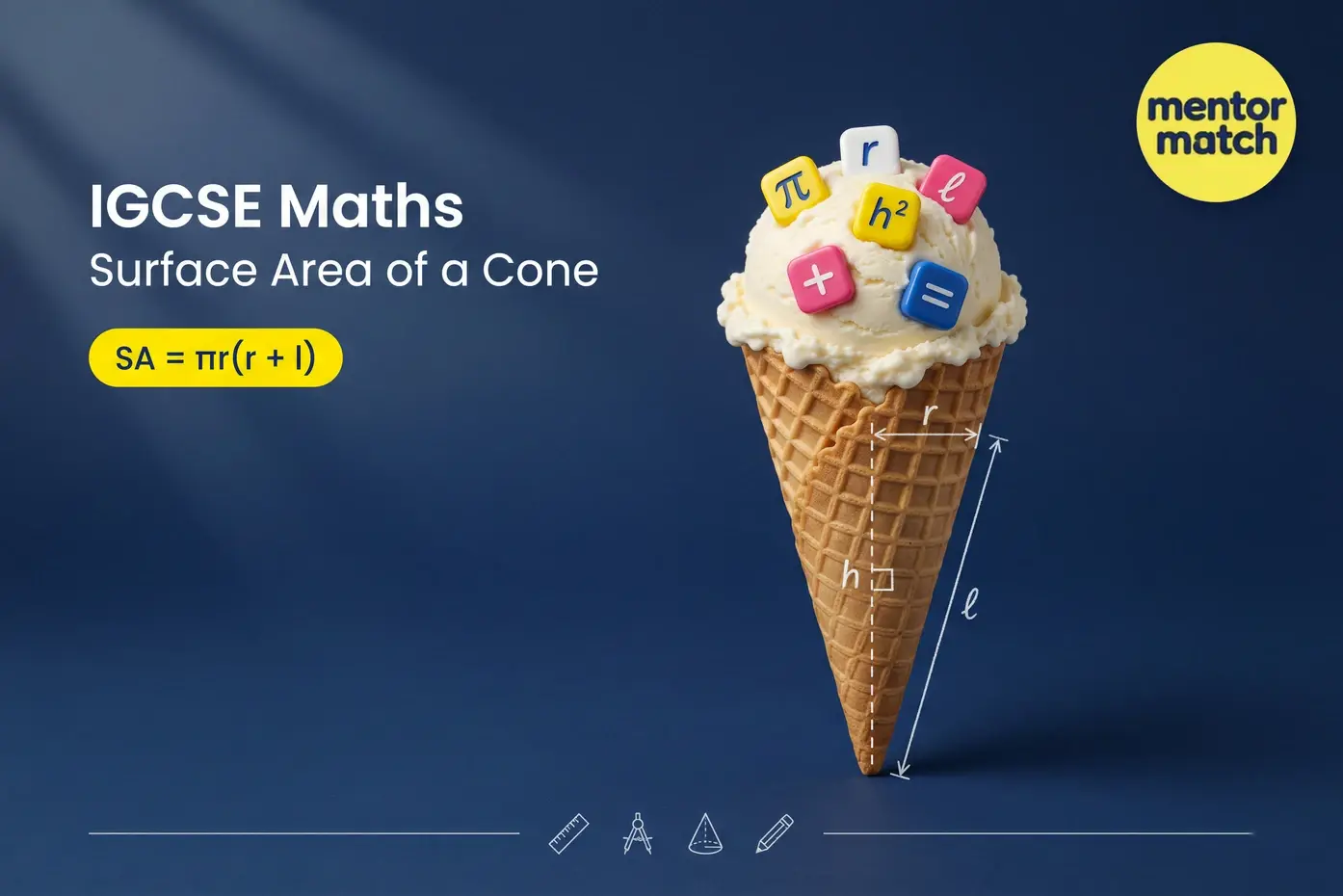
- h (vertical height): the drop from the point straight down to the middle of the base, like a plumb line
- l (slant height): the length along the outside surface, point to edge
Slice a cone down the middle and you'll spot a right-angled triangle hiding inside: r along the bottom, h up the centre, and l as the long sloping side. Pythagoras ties them together:
l² = r² + h², so l = √(r² + h²)
Because l is the hypotenuse, it must beat both r and h. A question that hands you a slant height smaller than the radius describes a cone that can't be built.
Surface Area of a Cone Formula
Curved surface area (CSA) = πrl
Total surface area (TSA) = πrl + πr² = πr(r + l)
Take π as 3.14159, or 22/7 when the measurements divide nicely by 7.
- CSA, the side only (some books say lateral surface area). Pick this when nothing covers the round end: a wafer cone, a paper hat, a tent pitched on sand.
- TSA, side plus floor. Pick this when the circle at the bottom is real material too: a wooden cone on a shelf, a sealed conical tub.
If you're given the height instead of the slant height
Run Pythagoras to get l, then drop it into either formula. Written out in one go:
- CSA = πr√(r² + h²)
- TSA = πr[r + √(r² + h²)]
Where πrl Comes From
Grab scissors and a paper cone. Cut one straight line from the edge up to the point, then press it flat on the desk. You won't get a triangle. You'll get a sector, like a wedge of pizza from a much bigger pizza.
- The wedge's straight edges are as long as the cone's slanted side, so its radius is l
- Its curved crust once ran all the way round the base, so that crust is 2πr long
For any sector, area = half the crust length multiplied by the radius. Plug in:
- CSA = ½ × 2πr × l = πrl
Add the circular base, πr², and you get the total: πrl + πr² = πr(r + l).
Bonus: the wedge's angle is θ = 360° × r ÷ l. Hang on to that; the Extended question later needs it.
How to Find the Surface Area of a Cone
- Collect r and l. Diameter given? Halve it. Upright height given? Turn it into l with Pythagoras.
- Check the bottom. Covered base means TSA; open base means CSA.
- Plug in to πrl or πr(r + l).
- Finish with squared units, or leave π in the answer if that's what's asked.
Solved Examples on Surface Area of a Cone
Example 1: CSA and TSA
A cone has radius 6 cm and slant height 10 cm. Find its curved and total surface area.
- CSA = π × 6 × 10 = 60π ≈ 188.50 cm²
- TSA = π × 6 × (6 + 10) = 96π ≈ 301.59 cm²
Example 2: Given the height
A cone has radius 5 cm and height 12 cm. Find its CSA and TSA.
- Slant height: l = √(5² + 12²) = √169 = 13 cm
- CSA = π × 5 × 13 = 65π ≈ 204.20 cm²
- TSA = π × 5 × (5 + 13) = 90π ≈ 282.74 cm²
Example 3: Using π = 22/7
Find the CSA and TSA of a cone with radius 14 cm and slant height 20 cm.
- CSA = 22/7 × 14 × 20 = 44 × 20 = 880 cm²
- TSA = 22/7 × 14 × (14 + 20) = 44 × 34 = 1,496 cm²
Example 4: Finding the slant height from the TSA
A cone has TSA 144π cm² and radius 8 cm. Find its slant height.
- π × 8 × (8 + l) = 144π
- 8 + l = 18
- l = 10 cm
Example 5: Finding the height from the CSA
A cone has radius 21 cm and CSA 1,914 cm². Find its vertical height. (Use π = 22/7.)
- 22/7 × 21 × l = 1,914, so 66l = 1,914 and l = 29 cm
- h = √(29² − 21²) = √(841 − 441) = √400
- h = 20 cm
Example 6: Given the diameter
A cone has base diameter 16 cm and slant height 17 cm. Find its TSA.
- Radius: r = 16 ÷ 2 = 8 cm
- TSA = π × 8 × (8 + 17) = 200π ≈ 628.32 cm²
- Bonus: its height is √(17² − 8²) = 15 cm
Example 7: A conical tent
A desert camping tent is a cone with radius 3.5 m and slant height 6 m, and it has no floor. Canvas costs AED 40 per m². Find the cost of the canvas. (Use π = 22/7.)
- No floor, so only the CSA: 22/7 × 3.5 × 6 = 66 m²
- Cost: 66 × 40
- AED 2,640
Example 8: An ice-cream cone
A wafer cone has radius 2.5 cm and height 6 cm. What area of wafer is needed? (It's open at the top.)
- l = √(2.5² + 6²) = √42.25 = 6.5 cm
- Open top, so only the CSA: π × 2.5 × 6.5 = 16.25π
- ≈ 51.05 cm²
For IGCSE Extended Students: Making a Cone from a Sector
A favourite Extended question gives you a flat sector and asks for the cone it folds into.
Example: A sector of radius 12 cm and angle 150° is rolled into a cone. Find the cone's radius and height.
- The sector's radius becomes the slant height: l = 12 cm
- The sector's arc becomes the base circumference: arc = 150/360 × 2π × 12 = 10π
- So 2πr = 10π, giving r = 5 cm
- Height: h = √(12² − 5²) = √119 ≈ 10.9 cm
The idea to remember: the sector's radius becomes the slant height, and its arc becomes the base circumference.
Common Mistakes to Avoid
- Putting h where l belongs. πrl wants the sloping length. Convert first.
- Believing a slant height smaller than r. It can't happen. Re-read the question.
- Treating the diameter as r. Cut it in half before anything else.
- Paying for a floor that isn't there. Wafers, hats and tents on sand need the side only.
- Writing cm³. Area is squared units; cubed belongs to volume.
- Muddling the sector puzzle. The wedge's radius turns into l, not r.
Practice Questions on Surface Area of a Cone
Question 1: Find the CSA and TSA of a cone with radius 4 cm and slant height 9 cm.
Question 2: Find the CSA and TSA of a cone with radius 7 cm and slant height 15 cm. (Use π = 22/7.)
Question 3: A cone has radius 9 cm and height 12 cm. Find its TSA.
Question 4: A cone has CSA 440 cm² and radius 7 cm. Find its slant height. (Use π = 22/7.)
Question 5: A cone has diameter 10 cm and slant height 13 cm. Find its TSA in terms of π.
Question 6: A floorless conical tent has radius 12 m and height 5 m. How much canvas does it need?
Question 7 (Extended): A sector of radius 10 cm and angle 216° is made into a cone. Find the cone's radius and height.
Answers
- CSA = 36π ≈ 113.10 cm²; TSA = 52π ≈ 163.36 cm²
- CSA = 330 cm²; TSA = 484 cm²
- l = 15 cm, so TSA = π × 9 × 24 = 216π ≈ 678.58 cm²
- 22l = 440, so l = 20 cm
- r = 5, so TSA = π × 5 × 18 = 90π cm²
- l = 13 m, so CSA = 156π ≈ 490.09 m²
- Arc = 216/360 × 20π = 12π, so r = 6 cm; h = √(10² − 6²) = 8 cm
Frequently Asked Questions
1. What is the surface area of a cone?
All the material on the outside of the cone, the slope and the round bottom together: πr(r + l).
2. What is the CSA of a cone?
Curved surface area, πrl. Just the slope, ignoring the circle at the bottom.
3. What is the TSA of a cone?
Total surface area, πr(r + l): the slope πrl with the floor πr² added on.
4. Is lateral surface area the same as curved surface area for a cone?
Yes. Both mean the sloping side only, πrl.
5. What is the slant height of a cone?
The length you'd measure running a finger from the point down the outside to the bottom edge. Get it from √(r² + h²) if you only know the upright height.
6. How do you find the surface area of a cone with the height?
Convert height to slant height with Pythagoras, l = √(r² + h²), then use whichever formula fits.
7. How do you find the surface area of a cone with the diameter?
Split the diameter in two to get r, then carry on as normal. Written with d: TSA = π(d/2)(d/2 + l).
8. Why is the curved surface area πrl?
Unroll the side and it's a pizza-slice shape: radius l, crust 2πr. Half of crust times radius gives πrl.
9. Can the slant height be less than the radius?
Never. It's the longest side of the hidden right triangle, so it always beats the radius and the height.
10. Is the cone surface area formula given in IGCSE exams?
The Cambridge 0580 formula list gives you πrl for the sloping side. Adding the base for a total, and turning h into l, is still on you.
Book Your Free Demo Class with MentorMatch
Cone questions trip students up in small ways: using h instead of l, adding a base that isn't there, or getting lost in a sector-to-cone question. A tutor helps your child build the habit of drawing the right triangle first and picking the right formula every time.
MentorMatch tutors teach 1:1 online, matched to your curriculum and your child's pace.
Also read: Surface Area of a Cube and Area of a Circle.
Book Your Free Demo Class with MentorMatch


