


77.32% of parents see better grades in 3 months!
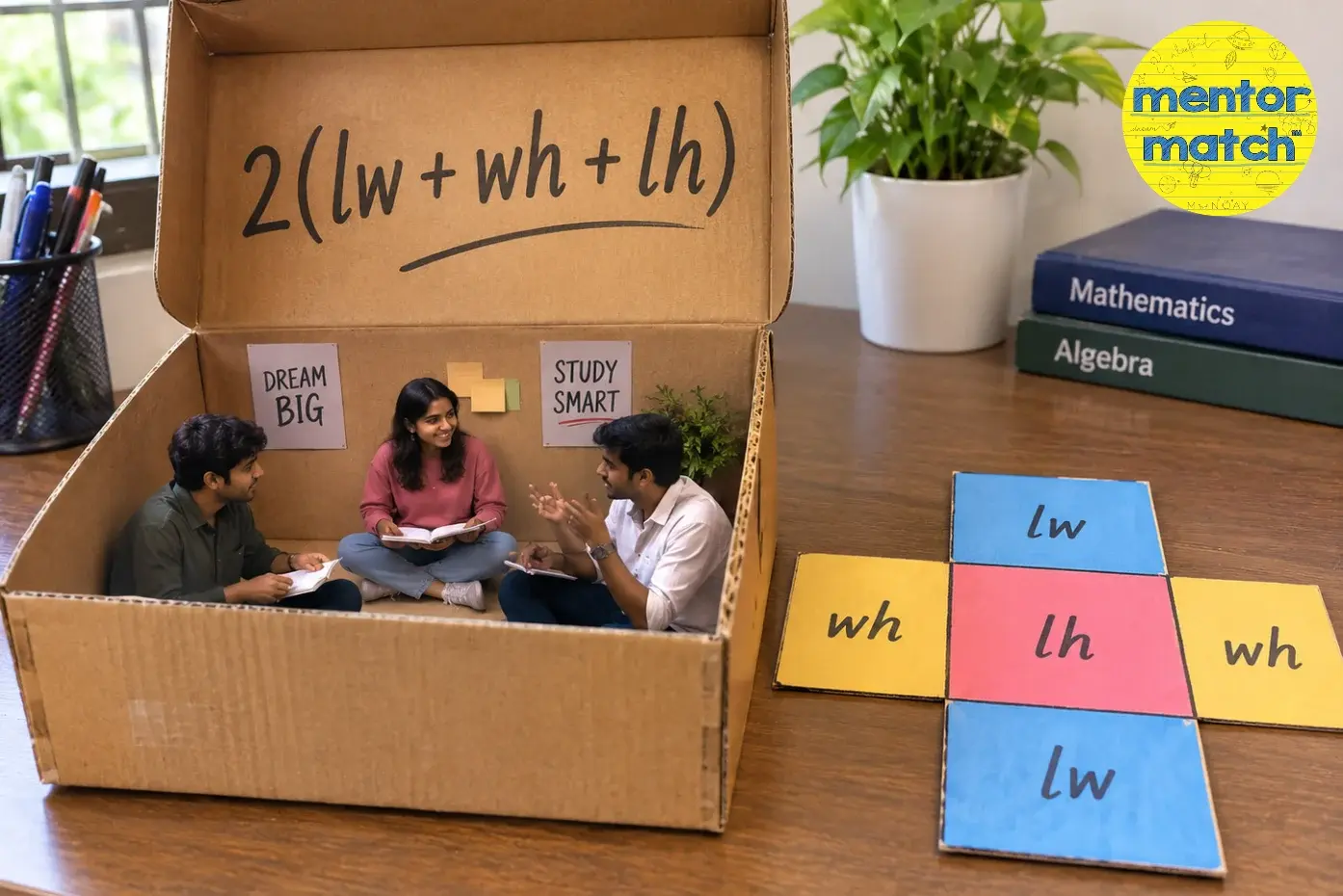
The surface area of a cuboid is the total area of its six rectangular faces. For length l, width w and height h, the total surface area (TSA) = 2(lw + wh + lh) and the lateral surface area (LSA) = 2h(l + w).
A shoebox, a brick, a fish tank and a room are all cuboids. Work out how much cardboard wraps a box, how much glass a tank needs or how much paint covers a room's walls, and you're finding surface area.
This is core mensuration in IGCSE Maths, IB MYP and CBSE Class 9 and 10. Below you'll find both formulas, why they work, the open-box version, eight solved examples, an extension question for IGCSE Extended and IB students, and practice questions with answers.
What Is a Cuboid?
A cuboid is a 3D shape with 6 rectangular faces, 12 edges and 8 corners (vertices). Opposite faces are identical, so the six faces come in three matching pairs:
- Top and bottom: each l × w
- Front and back: each l × h
- Left and right sides: each w × h
That "three pairs" idea is the whole secret behind the formula.
A cube is a special cuboid where l = w = h.
Surface Area of a Cuboid Formula
TSA = 2(lw + wh + lh)
LSA = 2h(l + w)
Where:
- l = length
- w = width (sometimes called breadth, b)
- h = height
All three must be in the same unit, and the answer is always in square units (cm², m², in²).
Some textbooks write the TSA as 2(lb + bh + hl). It's the same formula with b for breadth.
Why the Formula Works
Unfold a cardboard box and lay it flat. This flat shape is its net, made of six rectangles.
Add up the three pairs:
- Top + bottom = lw + lw = 2lw
- Front + back = lh + lh = 2lh
- Two sides = wh + wh = 2wh
Total = 2lw + 2lh + 2wh. Take out the common 2 and you get TSA = 2(lw + wh + lh).
Total Surface Area of a Cuboid (TSA)
The total surface area counts all six faces. Use it when the whole outside is covered, for example:
- wrapping a gift box completely
- the cardboard needed to make a closed carton
- painting a wooden block on every side
Lateral Surface Area of a Cuboid (LSA)
The lateral surface area counts only the four side faces, leaving out the top and bottom.
LSA = 2h(l + w)
It comes from adding front, back and both sides: 2lh + 2wh = 2h(l + w).
LSA is also called CSA (curved surface area) in many Indian textbooks, even though a cuboid has no curves. Both names mean the four walls.
Use LSA when the top and bottom aren't included, for example:
- painting the four walls of a room (not the floor or ceiling)
- a label wrapped round the sides of a box
- the glass sides of an aquarium with no lid
Difference Between TSA and LSA of a Cuboid
- Faces counted: TSA counts all 6. LSA counts the 4 sides only.
- Formula: TSA = 2(lw + wh + lh). LSA = 2h(l + w).
- Link between them: TSA = LSA + 2lw. The extra 2lw is the top and bottom.
- Typical use: TSA for closed boxes. LSA for room walls and open-ended containers.
Surface Area of an Open Box (No Lid)
A box without a lid has five faces: the four sides plus the bottom.
Open box surface area = lw + 2h(l + w)
That's LSA plus one base. Look for words like "open", "without a lid" or "open at the top".
How to Find the Surface Area of a Cuboid
- Write down l, w and h. Check which measurement is which.
- Convert to one unit. Don't mix cm and m.
- Choose the formula. TSA for a closed box, LSA for the sides only, lw + 2h(l + w) for an open box.
- Work out each product first. lw, wh and lh separately, then add.
- Give square units.
Solved Examples on Surface Area of a Cuboid
Example 1: Total surface area
A closed box is 9 cm long, 5 cm wide and 3 cm high. Find its TSA.
- Given: l = 9, w = 5, h = 3
- Formula: TSA = 2(lw + wh + lh)
- Substitute: 2(9×5 + 5×3 + 9×3) = 2(45 + 15 + 27) = 2 × 87
- Answer: 174 cm²
Example 2: Lateral surface area
Find the LSA of the same box.
- Formula: LSA = 2h(l + w)
- Substitute: 2 × 3 × (9 + 5) = 6 × 14
- Answer: 84 cm²
- Check: TSA − LSA = 174 − 84 = 90 = 2 × 9 × 5, the top and bottom ✓
Example 3: Open box
A box with no lid measures 12 cm by 8 cm by 5 cm high. How much cardboard does it need?
- Formula: lw + 2h(l + w)
- Base: 12 × 8 = 96
- Sides: 2 × 5 × (12 + 8) = 200
- Answer: 96 + 200 = 296 cm²
Example 4: Painting a room
A room is 7 m long, 5 m wide and 3 m high. Its four walls are painted, but the floor and ceiling are not. A door takes up 2 m². Paint costs AED 15 per m². Find the cost.
- Walls (LSA): 2 × 3 × (7 + 5) = 72 m²
- Subtract the door: 72 − 2 = 70 m²
- Cost: 70 × 15
- Answer: AED 1,050
Example 5: Finding a missing height
A cuboid has TSA 220 cm², length 10 cm and width 4 cm. Find its height.
- Formula: 2(lw + wh + lh) = 220
- Substitute: 2(40 + 4h + 10h) = 220
- Simplify: 40 + 14h = 110, so 14h = 70
- Answer: h = 5 cm
Example 6: Mixed units
A crate is 1.2 m long, 50 cm wide and 40 cm high. Find its TSA in m².
- Convert to cm: l = 120, w = 50, h = 40
- TSA = 2(120×50 + 50×40 + 120×40) = 2(6,000 + 2,000 + 4,800) = 25,600 cm²
- Convert: 1 m² = 10,000 cm², so 25,600 ÷ 10,000
- Answer: 2.56 m²
Example 7: When the cuboid is a cube
Show that the cuboid formula gives 6a² for a cube of side a.
- Put l = w = h = a: TSA = 2(a² + a² + a²) = 2 × 3a²
- Answer: 6a², the surface area of a cube formula
Example 8: Scaling up
Every dimension of a cuboid is doubled. What happens to its surface area?
- New TSA = 2(2l×2w + 2w×2h + 2l×2h) = 2 × 4(lw + wh + lh)
- Answer: the surface area becomes 4 times larger. (Lengths × k means area × k².)
For IGCSE Extended and IB Students: The Cheapest Box
A common extension question asks for the box that uses the least material.
Example: An open-topped box has a square base of side x cm and height h cm. It must hold 32 cm³. Find the dimensions that use the least card.
- Volume: x²h = 32, so h = 32/x²
- Surface area (open top): S = x² + 4xh = x² + 4x(32/x²) = x² + 128/x
- Differentiate: dS/dx = 2x − 128/x²
- Set to zero: 2x = 128/x², so x³ = 64 and x = 4
- Then h = 32/16 = 2
- Minimum card: S = 16 + 32 = 48 cm²
The second derivative, 2 + 256/x³, is positive, confirming a minimum. IB students meet this in Maths AA and AI optimisation. IGCSE Extended students can find the same answer by plotting S against x.
Common Mistakes to Avoid
- Adding each face once. There are six faces in three pairs, so don't forget the 2 in front.
- Mixing up LSA and TSA. Room walls are LSA; a closed box is TSA.
- Using TSA for an open box. Subtract the missing lid, or use lw + 2h(l + w).
- Mixing units. Convert everything to one unit first.
- Wrong area conversion. 1 m² = 10,000 cm², not 100.
- Writing cubic units. Surface area is in square units; volume is in cubic units.
Practice Questions on Surface Area of a Cuboid
Question 1: Find the TSA of a cuboid 11 cm × 6 cm × 4 cm.
Question 2: Find the LSA of a cuboid 15 m long, 10 m wide and 8 m high.
Question 3: An open box (no lid) has length 10 cm, width 10 cm and height 6 cm. Find its surface area.
Question 4: The LSA of a cuboid is 210 cm² and l + w = 15 cm. Find the height.
Question 5: Find the TSA of a cuboid 3 cm × 4 cm × 5 cm.
Question 6: A cube has side 7 cm. Use the cuboid formula to find its TSA.
Question 7: A box measures 2 m × 1 m × 50 cm. Find its TSA in m².
Question 8: Every dimension of a cuboid is tripled. By what factor does its surface area increase?
Answers
- 2(66 + 24 + 44) = 268 cm²
- 2 × 8 × 25 = 400 m²
- 100 + 2 × 6 × 20 = 340 cm²
- 2h × 15 = 210, so h = 7 cm
- 2(12 + 20 + 15) = 94 cm²
- 2(49 + 49 + 49) = 294 cm²
- 2(2 + 0.5 + 1) = 7 m²
- 9 times (3²)
Frequently Asked Questions
1. What is the surface area of a cuboid?
It is the total area of its six rectangular faces. The formula is 2(lw + wh + lh), where l, w and h are the length, width and height.
2. What is the TSA of a cuboid?
TSA means total surface area: all six faces added together, 2(lw + wh + lh).
3. What is the LSA of a cuboid?
LSA means lateral surface area: the four side faces only, without the top and bottom. Its formula is 2h(l + w).
4. Is CSA the same as LSA for a cuboid?
Yes. Many textbooks call the four side faces the curved surface area (CSA), even though they're flat. Both use 2h(l + w).
5. What is the surface area of a cuboid without a lid?
lw + 2h(l + w): one base plus the four sides.
6. What is the unit of surface area of a cuboid?
Square units, such as cm², m² or in², matching the unit used for l, w and h.
7. How is the surface area of a cuboid different from its volume?
Surface area, 2(lw + wh + lh), measures the outside covering in square units. Volume, l × w × h, measures the space inside in cubic units.
8. How many faces does a cuboid have?
Six rectangular faces, arranged in three pairs of identical opposite faces. It also has 12 edges and 8 vertices.
9. How do you find the surface area of a cuboid from its net?
Find the area of each of the six rectangles in the net and add them. You'll always get three matching pairs.
10. Is a cube a cuboid?
Yes. A cube is a cuboid with all sides equal. Putting l = w = h = a into the cuboid formula gives 6a².
Book Your Free Demo Class with MentorMatch
Mensuration questions rarely ask for a plain TSA. They hide an open box, mixed units, a missing height or a cost calculation inside the question. A tutor helps your child spot the twist and pick the right formula every time.
MentorMatch tutors teach 1:1 online, matched to your curriculum and your child's pace.
Want more on 3D shapes? Read our guides on the surface area of a cube and the volume of a cylinder.


